

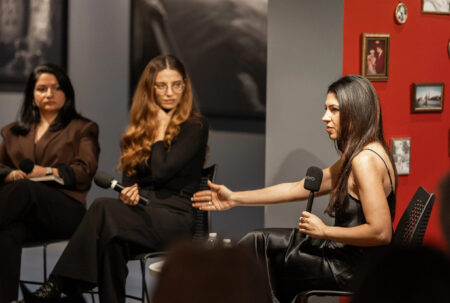
From left, Anahit Gasparyan, Angela Sarafyan and Diana Markosian (photo Natalie Nigito)

Diana Markosian Exhibition Opening at Armenian Museum Features Discussion with Actress Angela Sarafyan

470
0

WATERTOWN — The Armenia Museum of America continues on the path of prolifically offering audiences one stimulating art exhibit after another with the inauguration of “Father,” an exhibit by artist Diana Markosian, on May 28. The artist participated in a discussion with actress Angela Sarafyan moderated by curator Anahit Gasparyan that evening.
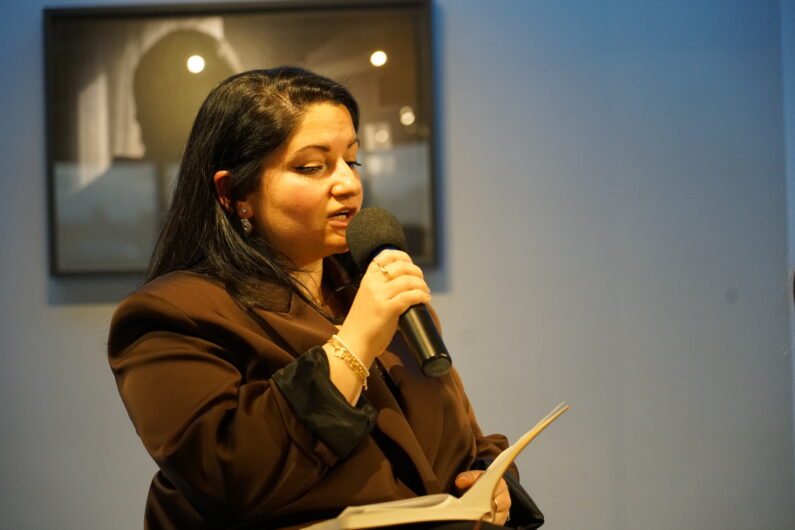
Curator Anahit Gasparyan of the Armenian Museum of America (photo Aram Arkun)

The exhibit continues through September 13, and incorporates photography, film and narrative in Markosian’s attempt to reconnect with her long absent father. It is co-produced by Les Rencontres d’Arles and FOAM Amsterdam and sponsored by the JHM Charitable Foundation.
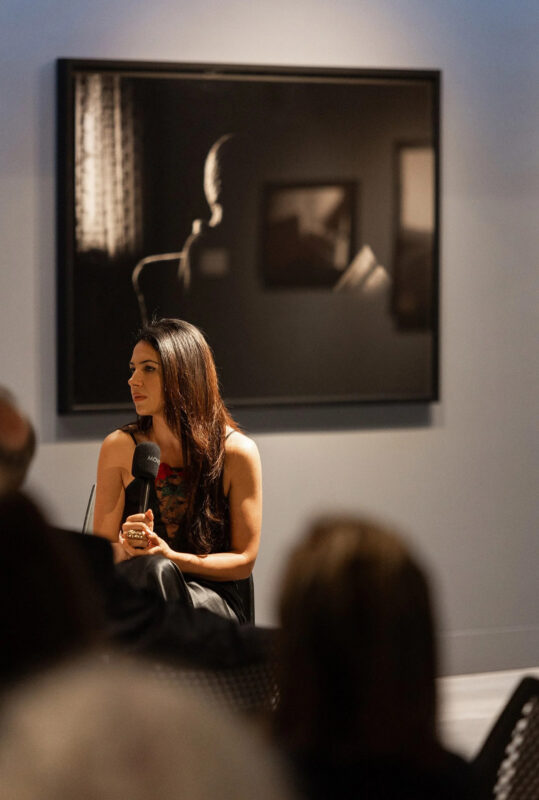
Diana Markosian (photo Natalie Nigito)

The pairing of Markosian and Sarafyan, on the surface unexpected, brought out interesting contrasts of individual connections to identity, family, memory and art. Sarafyan had the opportunity to sit down and compare experiences with Markosian for the first time only two days prior to the event.
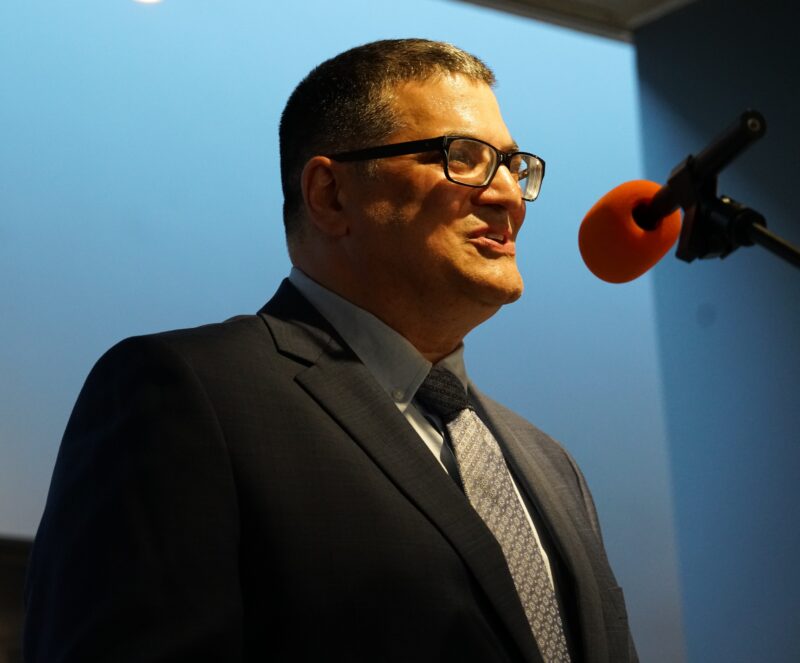
Armenian Museum Executive Director Jason Sohigian welcomes guests to the museum exhibition (photo Aram Arkun)

Markosian, born in Moscow but raised in the US, is a well-established American artist in her late 30s working across photography, film and installation. Her work has been exhibited internationally at such institutions as the San Francisco Museum of Modern Art, the International Center of Photography, National Portrait Gallery and FOAM Amsterdam. She earned a master’s degree from Columbia University’s Graduate School of Journalism in 2010.

The current exhibition is accompanied by her eponymous photobook Father, published in 2024. Markosian received the Madame Figaro Prize for both in 2025. She is the author of two other books and is working on her first feature film.
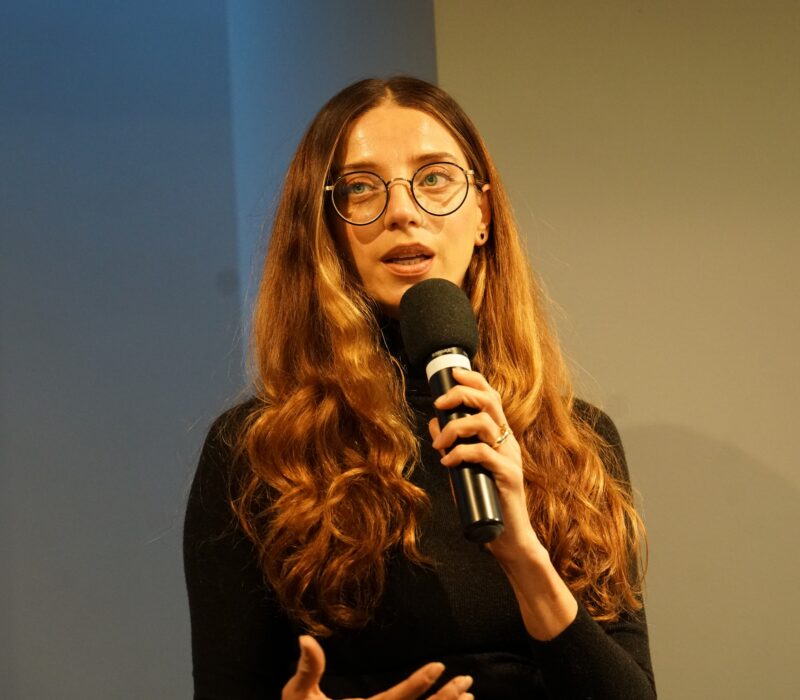
Actress Angela Sarafyan (photo Aram Arkun)

Sarafyan is an Armenian-American actress who has been seen in many recent films, including “Superman” (2025), “Billy Knight” (2025), “The Promise” (2016), which portrayed the Armenian Genocide, “1915” (2015), “Lost and Found in Armenia” (2012), “The Twilight Saga: Breaking Dawn (Part 2)” (2012) and “A Beautiful Life” (2008). She has appeared in HBO’s Emmy Award-winning drama “Westworld” and has a new Amazon Prime series coming out in the fall named “El Gato.” This year, she received the Best Actress Award at the Malaga Film Festival in Spain for her role in the film “Quase Deserto” [Almost Deserted].
Get the Mirror in your inbox:

Gasparyan, who kept the discussion moving with comments and questions, is an art historian specializing in Armenian art and visual culture. She holds a master’s degree in art history from Tufts University and has worked in curatorial, archival, and cultural heritage institutions, including the Getty Institute and the MassArt Art Museum. She began working for the Armenian Museum as its curator last September.

Separation vs. Integration

Markosian began the discussion on the nature of her project by declaring: “I think for me this is an attempt to build a relationship. I think ultimately my dad and I found each other after so many years, and I was a stranger to him, and vice versa. I didn’t know my dad.” In other words, it was an attempt to reconstruct something which did not exist for her.

She was seven when her mother found an opportunity to leave Moscow in 1996 and come to the United States by connecting with an American man in Santa Barbara, Calif., through a matchmaking agency. Her father and mother had separated before she was born and her father alternated living between Armenia and Moscow, where he would visit Markosian. He only found out through a letter in an empty Moscow apartment that his daughter, son and wife left for the US.

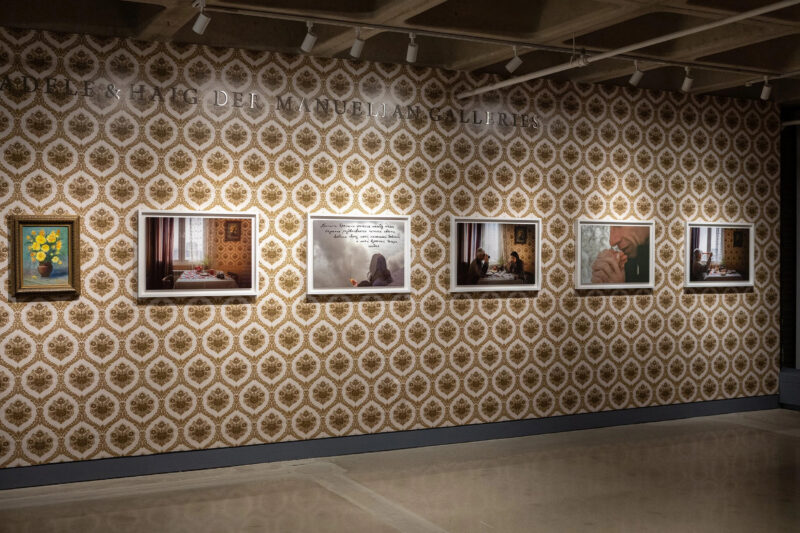
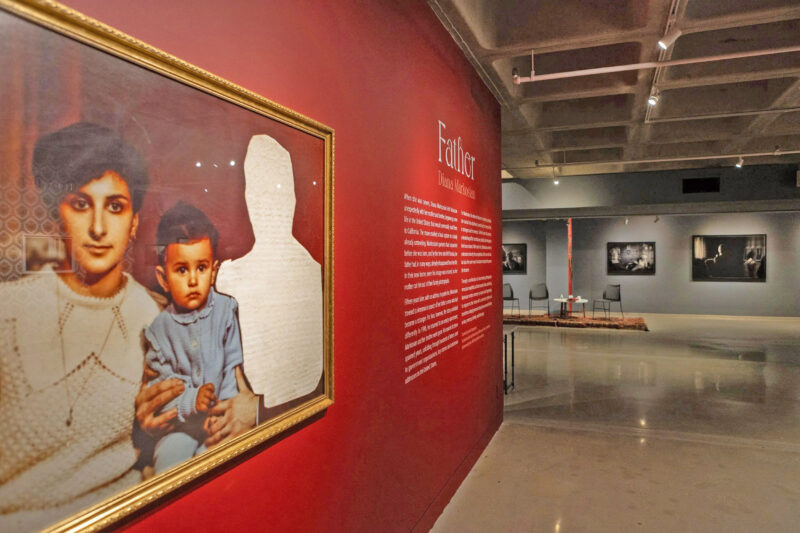
The exhibition starts with Diana Markosian’s “The Cut Out,” Father Series, 2014-2024 (photo Natalie Nigito)

He spent the next 15 years trying to find out where they were, while Markosian said she grew up with the story that his father just left. Moreover, she and her mother were busy becoming Americans and she had a new American stepfather. In order to forget the past, her mother cut out her husband’s image from all their photographs.

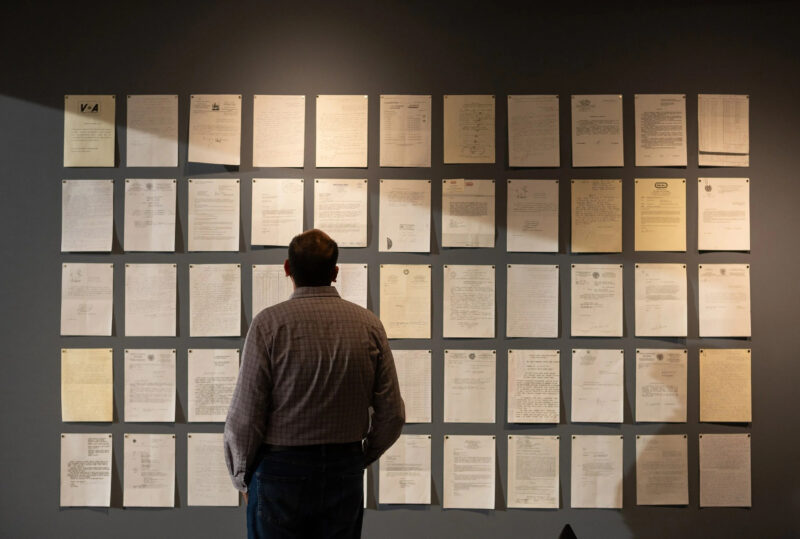
Some of the letters written by Diana Markosian’s father in search of his family and the responses received (photo Natalie Nigito)

Her father later told her that he did not want to come to America because he was a single child and needed to take care of his own parents, while Markosian’s mother had four siblings in a big family who stayed in Armenia.

The wallpaper in the Markosian home in Armenia is reproduced on the Armenian Museum wall where some of her works have been placed (photo Natalie Nigito)

Sarafyan said her experience was the opposite of that of Markosian, as both her parents came to the US together with Sarafyan, adding, “And Armenia was my home in Los Angeles. So there was no fragmentation. There was just a continuation.” She added, “There’s this question of Armenian identity and I think I was so lucky because it was never something separate or something that I was seeking. It was always just in the kitchen, in the living room. My grandma would cook…”

Sarafyan grew up in Hollywood from the age of four and recalled, “Every neighbor I had was Armenian. The grocery store, everything. I was not away from Armenia. I came to Armenia and Hollywood and I loved it.”

Reconnection

On the other hand, Markosian said that when she went back to Armenia in her 20s, “I felt like a foreigner coming in. I had remembered my grandparents’ home, of course, on my mother’s side, and always just the warmth towards that.” However, she said she did feel like she belonged there, especially from 2015 or 2016. She was making the current work, and she also spent time with her grandfather, a painter, as both her grandparents were alive.

Markosian explained that after she graduated school she became a photographer, and that became her compass and passport to travel all around the world. When she finally found her father, she and her brother went to Armenia and had two different experiences. When they first went to their father’s home and he did not recognize them, her brother decided he was never going to come back.

Markosian, however, decided to move there and live with her father while she made her images. She said, “But also it was just so important for me to find that home within myself and within him and the country, the culture. I just wanted to make up for the thing that was broken in some small way.”

Over the last ten years, Markosian would go back to visit and, she said, “It’s like my attempt to make up for that lost time, my attempt to really bridge the experiences I didn’t have.” She is still trying to do this, she said, but with the absence of her grandparents there, despite still loving to go to Armenia, she again feels like a stranger there.

Ultimately, she discovered that she could not make up for the tears and sorrow in the past despite all her efforts. She said, “I think what I’ve done now is make a different story with him … And it’s one that doesn’t feel negative. It doesn’t mean grief or joy. It just means that it’s different.”

Sarafyan noted that on the other hand, the first time she went back to Armenia was for work in 2010, to make the movie “Lost and Found in Armenia.” Her father passed away when she was 19 and during her trip, she said she was almost able to relive her memories, which was magical. She went again during the commemoration of the centennial of the Armenian Genocide in 2015, which was a different experience, and the last time was last summer. She said, “I found Armenia to be this beautiful, beautiful, moving new country…It felt like it was reinventing itself, and there was opportunity that I never saw before, so it filled me with hope.”

In fact, she declared, “Every time I’m there, I feel like I see all of my relatives and all the people that I don’t know. I can see my grandmother who passed away. I can see my dad. I can see my sisters and brothers, and I’m so moved.”

Creating One’s Own Narrative

Gasparyan asked whether the two speakers used storytelling respectively in art or acting in order to reconstruct memory or something else, or instead to create an entire thing.

Markosian said, “I try to make sense of the world. I try to make sense of my own life. I think art has been there for me when I needed it. It’s become almost a friend in my life where, when things go bad, I turn to it and it’s there for me.” She was able since she was 20 to use this language and way of understanding the world to confront it instead of running away, through film, photography and writing, and, she said, to express something deeper.

In closing, Markosian said, “I think for me, the most important thing as an artist or as a person has been to not be defined by a story, to not be a victim of a story, to not be defined by my mom’s decisions.” She wanted to have her own story and the courage and compassion to truly get to know her family and friends. That is what she wished the younger generations who look at her project and listen to this discussion would take away from it.

In the question and answer session with the audience that ensued, among other things, Markosian revealed that her first book, Santa Barbara (2020) was about her mother, whose story was more dramatic than her father’s.

Get the Mirror-Spectator Weekly in your inbox: