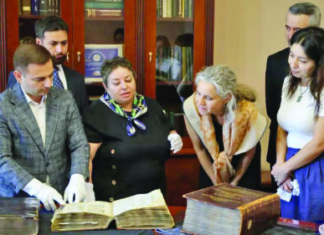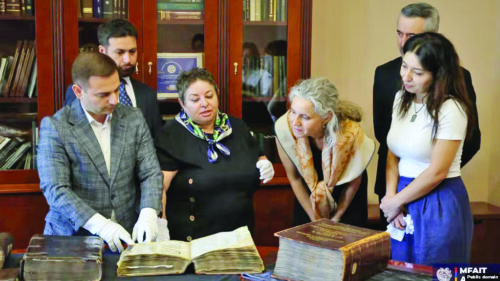


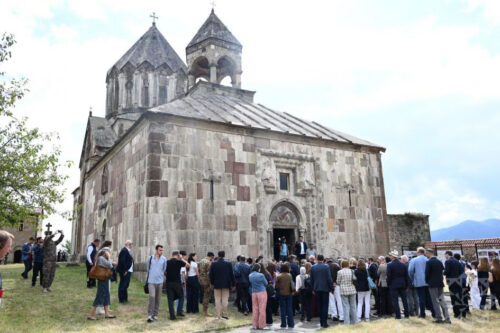
Foreign diplomats visit the Gandzasar monastery in Nagorno-Karabakh in September 2026 (photo Azertac)

Outcry in Armenia as Azerbaijan Portrays Armenian Heritage in Nagorno-Karabakh as Caucasian Albanian

65
0

By Arshaluys Barseghyan and Rafig Shahbazov

A two-day visit by representatives foreign diplomats in Azerbaijan to Nagorno-Karabakh has prompted controversy and outcry in Armenia, as Azerbaijan portrayed Armenian religious heritage as Caucasian Albanian.

The battle over monuments in Nagorno-Karabakh has long been central to the conflict over the region, with Azerbaijan often labeling medieval monasteries or heritage as Caucasian Albanian, and denying their Armenian origin despite widespread recognition among international scholars.

Caucasian Albania, not related to modern-day Albania in the Balkans, was an ancient Christian kingdom that existed in the South Caucasus.

Since taking control of Nagorno-Karabakh, experts have accused Azerbaijan of trying to erase Armenian religious and cultural heritage, through the destruction of ancient cemeteries, residential areas, and settlements, along with former government buildings, with some cases documented by authorities or satellite imagery.

In turn, Azerbaijan has repeatedly cited the widespread destruction of Azerbaijani heritage sites, towns, and religious buildings that occurred when the region was under Armenian control.
Get the Mirror in your inbox:

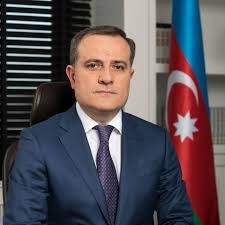
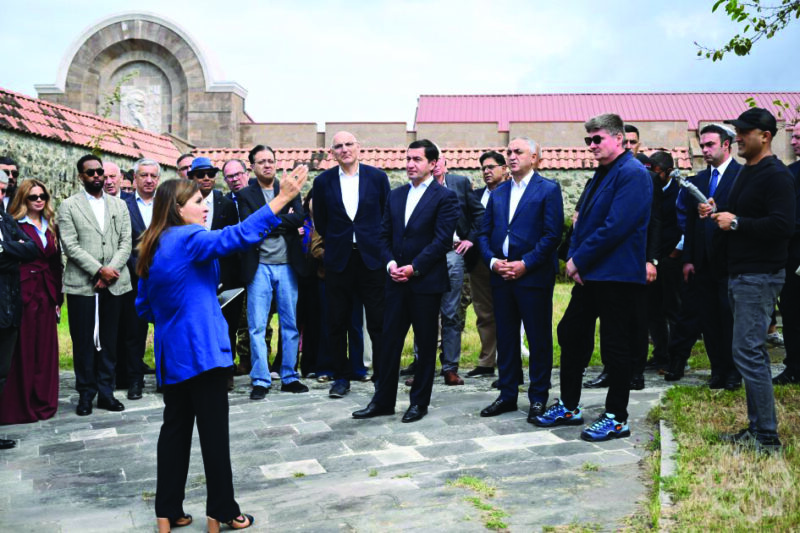
The visit, organized by presidential aide Hikmet Hajiyev, took place on September 11. The delegation included 150 representatives from 58 countries and nine international organizations.

Azerbaijani presidential aide Hikmet Hajiyev (centre) with foreign diplomats visiting the Gandzasar monastery in September 2026 (photo Azertac)

While there, Hajiyev told the diplomats that Nagorno-Karabakh “has been, is, and will remain the cultural heart of Azerbaijan and the Azerbaijani people.” While there, Hajiyev shared a video from the delegation’s visit to the Gandzasar and Dadivank (referred to by Azerbaijan as “Khudavang”) monasteries. Hajiyev claimed that the two monasteries were Caucasian Albanian, and that Gandzasar was built in the 13th century by Hasan Jalal, who he said was a ruler of Caucasian Albania.

However, most sources agree that the Hasan-Jalal and his dynasty, the Hasan-Jalalyans, were of Armenian descent.

Hajiyev additionally said that historical monuments in Nagorno-Karabakh were subjected to “external intervention” under the guise of “restoration,” which damaged their architectural authenticity and character.

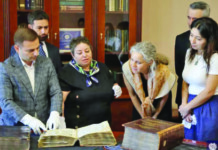
While there, Hajiyev showed the diplomats books containing Armenian historical materials and manuscripts on display inside the churches, pointing out that their pages were empty. The remarks were not well received in Armenia, where officials denied the claims and said such rhetoric could undermine the peace process.

The EU’s Special Representative for the South Caucasus, Magdalena Grono, also joined the delegation, marking her first visit to Azerbaijan’s former conflict-affected territories.

“The peace process is, of course, led by the parties, and we fully respect that. However, we are ready to be partners in supporting both governments and both countries in implementing very practical measures. In this region in particular, I believe we have been an important partner in mine clearance. This work, of course, helps create the conditions for people to safely return to their homes,” Grono said in a statement on Sunday, September 13.

While in Yerevan, Grono visited Matenadaran, Armenia’s Research Institute of Ancient Manuscripts, where she viewed “the rich collection of Armenian manuscripts and their history,” the Armenian Foreign Ministry said.

After the tour, Grono spoke to Armenian state-run media outlet Armenpress about her controversial post on X in which she said that “deeply diverging views and narratives persist, for instance on origins of some sites” in the region.

“I certainly do not contest the past Armenian presence and rich footprint in former conflict-affected areas in Karabakh. I could see it firsthand for the first time during the visit to Kalbajar and Aghdara districts last week,” Grono said.

Matenadaran’s head, Ara Khazmalyan also told FIP.am that all original manuscripts from Gandzasar were being kept in Yerevan in the institution.

The portrayal of Armenian heritage as Caucasian Albanian caused an outcry in Armenia, with questions raised over how genuine efforts in the peace process were.

Armenian authorities have generally refrained from commenting on the destruction of Armenian heritage in the region amidst the fragile peace process, but they responded to Hajiyev’s statements on Monday, calling them “unfounded.”

“The statements […] naturally, do not contribute or are not useful in the context of peace, apart from the fact that they are also unfounded,” Armenian Parliamentary Speaker Ruben Rubinyan said.

However, underscoring the importance of the peace process, Rubinyan added: “It is good that we are now in a state of peace, and our disagreements or disputes are about such issues, rather than being expressed through border shootings or clashes.”

Similarly, several Armenian members of the Peace Bridge Initiative between Armenia and Azerbaijan, who have conducted several mutual visits as part of the peace process, expressed concern over the “presentation” of Armenian cultural heritage.

“Building peace requires difficult and honest conversations, attention to each other’s concerns, and a conscious effort to avoid actions that may reopen wounds or reinforce hostility. We therefore call on all actors involved in the peace process to act with the responsibility required at this moment and to refrain from statements and actions that may be perceived as unconstructive,” the statement read.

In turn, political analyst and Regional Center for Democracy and Security head Tigran Grigoryan, who is originally from Nagorno-Karabakh, argued in a CivilNet op-ed that the diplomats were taken to the region to “add another layer of legitimization to the ethnic cleansing,” referring to the mass exodus of the Armenian population following Azerbaijan’s final offensive in 2023.

Grigoryan said it was particularly troubling that countries and institutions that had been “heavily involved” in mediating the Nagorno-Karabakh conflict and had “repeatedly insisted that there could be no military solution to the conflict” visited Victory Park in Stepanakert, which he described as “a marble expression of [Azerbaijani President Ilham] Aliyev’s megalomania and a primary monument to the ethnic cleansing.”

The park itself was built on the site of a historic neighborhood in the city, later completely destroyed by Azerbaijan.

He also criticized the diplomats for allowing themselves to be used in what he described as Azerbaijan’s “historical revisionism.”

(This story originally appeared on www.oc-media.org on September 14.)

Get the Mirror-Spectator Weekly in your inbox: