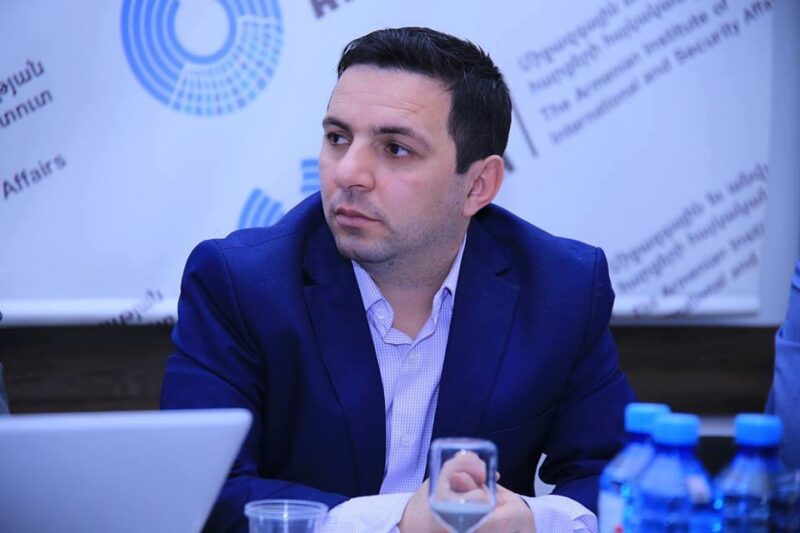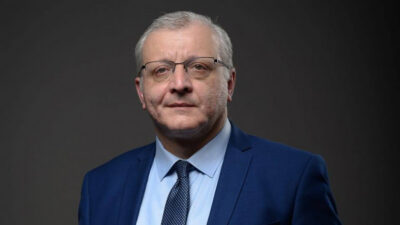


Political scientist Suren Surenyants

Armenia Risks Being Hurt by US Policy to Economically Choke Iran

58
0

By Irina Atanyan

Special to the Mirror-Spectator

YEREVAN — Tensions between the United States and Iran have entered a new phase. With the war entering a six-month quagmire, Washington seems to now target Iran’s economy. On August 24, US Treasury Secretary Scott Bessent announced the launch of efforts aimed at economically isolating Iran. On the same day, the United States imposed sanctions on more than 60 individuals, organizations, and other entities linked to Iran.

Bessent said that any country or company cooperating with Iran should be prepared for US sanctions and warned that continued financial ties with Iran could result in exclusion from the dollar-based financial system.

This makes Armenia’s position particularly difficult: Yerevan is simultaneously deepening its relations with both the United States and Iran, as it announced in its five-year program.

In one section, it notes, “Maintaining active political dialogue with Iran and expanding trade and economic ties are among the priorities of bilateral relations. Cooperation with Iran in the energy sector will continue to deepen, border infrastructure will be developed, and connectivity routes through Iran will be expanded, including the North-South and Persian Gulf–Black Sea routes.”
Get the Mirror in your inbox:

At the same time, the program calls for deepening the strategic partnership with the United States and implementing the TRIPP project.

“Based on the Charter on Strategic Partnership between the Republic of Armenia and the United States of America, bilateral partnership will be further deepened,” according to the plan.

TRIPP (Trump Regional Infrastructure and Peace Program) is a US-backed transport connectivity initiative aimed at unblocking regional communication routes and connecting Azerbaijan with its Nakhichevan exclave through Armenia, under Armenian sovereignty and border control. The framework for the initiative gained momentum last year, when Armenia and Azerbaijan initialed a peace agreement at the White House in the presence of US President Donald Trump.

Just how Armenia can navigate relationships with these two powerful yet antagonistic allies remains to be seen.

Political analyst Suren Surenyants noted that Armenia’s main challenge in the current situation is to preserve its flexibility in foreign policy.

“Each geopolitical center is trying to impose very tough preconditions, and in this sense, wiggle room for countries with a degree of agency, including Armenia, is genuinely shrinking. Under these circumstances, the Armenian authorities are obliged to pursue a very cautious, balanced foreign policy,” he said.

Surenyants also linked the issue to the implementation of TRIPP. In his view, as long as US-Iranian relations remain unresolved, moving the project into the practical stage could create risks.

“On the one hand, there is a desire to bring TRIPP to life very quickly; on the other hand, there is a very high likelihood that if this work enters the practical stage, the Islamic Republic of Iran could target that infrastructure, considering it a threat to itself,” he added.

Surenyants says that for this reason, the Armenian government should avoid taking abrupt steps. “The problems are very serious. That is why I am often surprised that at this stage the Armenian government is so enthusiastic about talking about the implementation phase of TRIPP without taking these risks into account,” he continued.

As for the provision in the government program on deepening relations with Iran, Surenyants said he believed that the document itself cannot have a decisive impact on global geopolitical processes.

According to him, the most desirable scenario for Armenia would be a reduction in regional tensions.

He said, “The most desirable situation for Armenia would be for both the war in Ukraine and the tensions around Iran to end, so that our room for maneuver increases. Otherwise, many of our foreign policy programs may either be revised or never implemented.”

Following Surenyants’ assessment, the issue can also be viewed from the perspective of how important a partner Iran is for Armenia.

Iranologist Garik Misakyan

Iran expert Garik Misakyan stressed that Armenia’s ties with Iran have not only political but also vital importance. He particularly highlighted energy cooperation involving gas and electricity, as well as existing infrastructure and transport links between Armenia and Iran.

According to Misakyan, Armenia should pursue a particularly cautious diplomatic policy in the current situation, taking into account its geographical position and its shared border with Iran.

In his assessment, the impact of US-Iran tensions on Armenia could become more apparent once TRIPP enters the practical stages of construction and eventual operation.

Armenia-Iran relations involve not only trade, but also energy, infrastructure, and transit cooperation.

The two countries have a “gas-for-electricity” arrangement under which Armenia receives gas from Iran and supplies electricity to Iran in return.

A tunnel project in Kajaran is also being implemented with the participation of an Iranian company. The project is an important part of the North-South transport corridor.

In 2025, trade between Armenia and Iran amounted to approximately $770 million, while around 20 percent of Armenia’s foreign trade passes through Iranian territory.

Against the backdrop of these existing ties, the new US sanctions raise the question of whether they could affect ongoing Armenian-Iranian projects.

The Armenian government is clearly aware of the tightrope it has to walk on and has addressed the situation surrounding US-Iran relations. Earlier, Prime Minister Nikol Pashinyan had said Armenia had managed to maintain reliable relations with both countries.

“We cooperate with the Islamic Republic of Iran, and despite all the difficulties and problems, our mutual trust with Iran has deepened during this period because we have acted in accordance with our agreements and understandings, while at the same time managing to maintain reliable relations with both the United States and the Islamic Republic of Iran,” he said.

Pashinyan also stressed: “We do not play games with our partners. We present our positions directly and honestly, and we are grateful to them for understanding our particular circumstances.”

On August 20, addressing the intensification of US economic pressure on Iran and its potential impact on Armenia, Pashinyan said Yerevan was concerned about the situation and was working with both sides.

“We are, naturally, very concerned about the situation related to the United States and Iran, and we are also working very closely on this issue with both the United States and the Islamic Republic of Iran. Our wish is for this situation to be resolved as soon as possible.”

There is currently no basis to claim that the United States is preparing to impose sanctions on Armenia. However, it is important to understand which areas of Armenian-Iranian cooperation could potentially be affected by the new US restrictions. This is where Iran expert Armen Vardanyan offers his assessment.

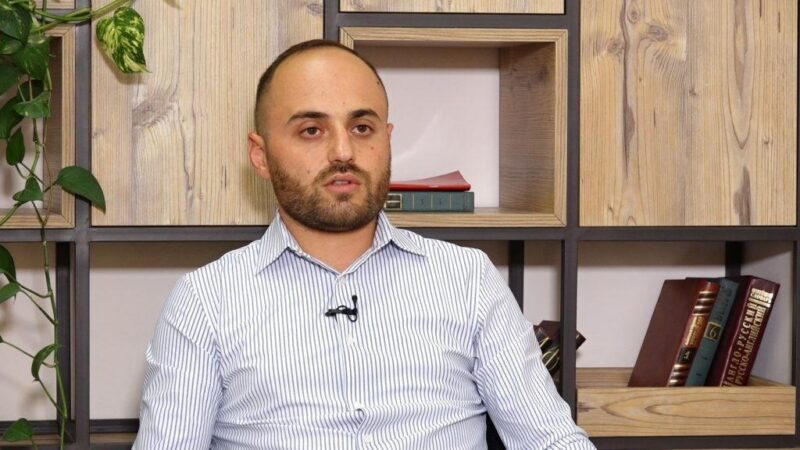
Armen Vardanyan

Vardanyan said he considers the likelihood of direct US sanctions against Armenia to be low.

According to him, Armenia has good relations with Iran, but the sectors that are usually targeted by US sanctions are not currently relevant to Armenia.

“It is true that Armenia’s relations with Iran are at a good level, but the sensitive sectors that are consistently targeted by US sanctions do not apply to Armenia. We are mainly talking about oil purchases, because the US usually imposes sanctions on countries that buy oil from Iran. Armenia does not buy oil from Iran,” he said.

Vardanyan recalls that the United States has previously pressured other countries over oil trade with Iran.

“Years ago, when the Iranian crisis deepened again, Trump demanded that several of his allies stop buying oil from Iran, otherwise he promised to impose sanctions on them, and some countries complied with that demand. For example, South Korea, which was a major buyer of Iranian oil, stopped buying Iranian oil. Japan did the same,” he explained.

In his assessment, the current US policy does not pose a direct threat to Armenia, although there could be indirect risks.

Vardanyan also stresses that Armenia cannot completely cut its economic ties with Iran: “Armenia simply cannot stop trading with Iran. It has to, because it has closed borders.”

The dilemma is not new. Vardanyan recalled concerns expressed by the United States during the construction of the Armenia-Iran gas pipeline.

“Years ago, there were some concerns regarding the energy sector. For example, when the Armenia-Iran gas pipeline was being built, there were several statements from the United States, but Armenia managed to reach an understanding, and no sanctions were imposed on Armenia,” he said.

According to Vardanyan, the situation is also different today given the deepening of Armenian-American relations.

“Armenia’s relations with the United States are improving significantly, and I do not think the US will impose any sanctions on Armenia,” he concluded.

But if US-Iran tensions continue and Washington’s economic pressure expands to third countries cooperating with Iran, it will be crucial for Armenia to preserve its flexibility, avoid abrupt steps, and prevent itself from being forced to choose between the two sides.

Get the Mirror-Spectator Weekly in your inbox: