

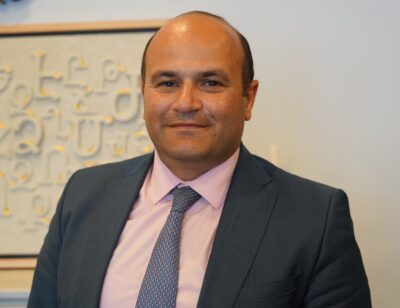
Ambassador Narek Mkrtchyan (photo Aram Arkun)

Ambassador Mkrtchyan Tells The Hill ‘Everything Is Discussable’ Regarding US Request to Isolate Iran

15
0

WASHINGTON — In a new interview with The Hill, NewsNation International Correspondent Robert Sherman spoke with Armenian Ambassador Narek Mkrtchyan to the United States to discuss trade relations, the future of Armenia, and the major peace deal brokered between Armenia and Azerbaijan on the one-year anniversary of the Washington Peace Declaration. (Editor’s note: The interview below is a raw transcript of the video interview and may contain grammatical errors.)

On the first anniversary of one of the major peace deals brokered between Armenia and Azerbaijan:

“It’s my pleasure to speak about the first anniversary of the peace. You know, last year at the White House, President Trump broke a peace between Armenia and Azerbaijan. And we call this historic because, you know, after three decades, now Armenia and Azerbaijan and region is in peace. And we live in a peaceful situation, which is very appreciated by both people of Armenia and Azerbaijan. And when we talk to our people saying that, you know, this piece is a very important precondition for a prosperity, now taking into consideration the projects, the bilateral project that we have with US, it like comes to prove that really this was precondition and still continuing to be precondition for a prosperity. Just after like Washington piece declaration, we signed a couple of documents and literally put three months after signing these documents we got approval for biggest tech projects in Armenia by NVIDIA for example the AI factory project which is a $4-billion project in Armenia and now a lot of new prospects are opening after this peace deal. But also the piece that became important for bilateral relations between Armenia and Azerbaijan. Of course, peace cannot come overnight after signing one document; [it] is a process. And I can say that the process is really progressing. So we don’t have diplomatic relation with Azerbaijan. We don’t have like the established embassies etc., we don’t have final peace sign[ed] but we have peace. We have actual peace, we are doing trade. We are buying some stuff from Azerbaijan [and Azerbaijan] is considering to buy some stuff from Armenia, so this is actually something which will be leading to the ultimate peace and this is only thanks to Washington Declaration that we signed last year. I hope that in very near future we can make real progress and have final peace deal and to build future together in our region.”

On where he envisions Armenia sitting between the two major world powers, Moscow and Washington, in the years ahead:

“Of course, there is a movement, but that movement is about Armenian sovereignty, Armenia’s independence, more strong sovereignty and more strong independence. And this is also the movement about the diversification. After all, we announced that Armenia will be diversifying …. And so this process also should be considered [under] the lens of diversification. So we started the diversification of Armenia, so diversification of procurement, diversification of supply chain, diversification of economic partnerships, diversification of security partnership. And you know when Vice President JD Vance visited Armenia, key three deliverables, like the signing of the Declaration on Energy Partnership, partnership on AI, critical technologies, and also about the first procurement defense technologies, like sophisticated drone technologies that the Vice President brought with him to Armenia. These are about the diversification. And you know, diversification is important for more strong sovereignty, because when you are dependent on one country, you are less independent, but when you are dependent on several actors, it means that your sovereignty and your independence are more strong. And you know, one of the uniqueness of President Trump’s brokered peace is that it respects the three principles of sovereignty, territorial integrity and jurisdiction. These are guaranteed in the Washington Peace Declaration. That’s why we consider this is an important step towards the diversification of Armenia, and also towards more sovereign and more independent Armenia. And behind these discussions, there is a project called TRIPP, the Trump Route for International Peace and Prosperity, which is the main project behind peace, I would say, and the main project which will change all the geo-economy of the region and which will be playing a key role in bridging different regions like Central Asia, South Texas and Europe together with this 42 kilometer road passing to Armenia.”

On trade routes opening up from east to west that circumvent Russia and Iran, creating new avenues for trade and how that could change the South Caucasus’ role in regional trade:

Get the Mirror in your inbox:

“First of all, the TRIPP project is an organic part of Crossroads of Peace project. You may know that our Prime Minister [Nikol Pashinyan] put into circulation the concept, the project of Crossroads of Peace, like trying to turn our country into crossroads of peace, bringing different countries together, to work together, to trade together, to have more people-to-people contact, to use each other’s territories, infrastructures, but respect each other’s sovereignty, territorial integrity and jurisdiction. … We are ready to partner with every country. But there are certain rule of the games. So we have this project not against third country. This is not against Iran. This is not against Russia. This is for cooperation. And if Russia and Iran want to cooperate, there are certain rules of the games. Of course, they also can cooperate with us on this project within the context of Crossroads of Peace. So we think that there is a huge potential. And that potential is to turn this project into global supply chain, a new supply chain. Indeed, US has more, let’s say, a role because the TRIPP development company has been created by Armenian government and the US government, 74 percent of the shares belongs to US government. But again, this is not against third countries.

On whether Armenia is comfortable with the United States having 74-percent ownership share in their country: 

“Totally fine with these new kind of partners being in the region long term. Indeed, we are very happy because, first of all, such kinds of partnership also will support the comprehensive strategic partnership that we signed when Secretary [Marco] Rubio on May visited Armenia on May 26. And we signed a couple of documents, including a comprehensive strategic partnership charter, MOU [memorandum of understanding] on energy partnership, and of course, the initial intergovernmental agreement on TRIPP. And so, considering the fact that jurisdiction, the principle of jurisdiction of like Armenia, which means that everything will be decided by Armenian institutions. This is most important, like one of the most important principles that is respected by US and by Azerbaijan in the Washington Peace Declaration, which means that Armenia keeps all its sovereignty, all territorial integrity in its independence, and also sovereignty of the decisions. We are happy to have the US as a key partner in this project, because this project will also bring a lot of new projects from the US. These are all promising and untapped potential that we can use in upcoming years and really to turn not only Armenia, but also the region into a new prosperous place. And we say that all of these projects that we are working on with the US, we are happy also to share with our neighbors. I will bring one example when we got approval of export control licenses for AI data center for NVIDIA in Armenia. Literally after months, the same company, which got agreement with NVIDIA and approval from Department of Commerce, signed another agreement because another $10 billion project. And the philosophy of TRIPP and the philosophy of Crossroads of Peace project is now manifested, like having Armenian-American project also present in Central Asia and bringing Central Asia, for example, data to Armenia through TRIPP and 10 sent to US because the final beneficiary of this data will be American companies. I think this is a beautiful project which can bring different societies together to work and create more long lasting cooperation between them.

On whether the United States has requested Armenia to isolate Iran or whether Armenia would consider doing it if the U.S. made such a request:

You know, I think there is no topic in the world that cannot be discussed. But I want to say that the main, the priority topic between Armenia and Azerbaijan in the region right now is implementation of TRIPP. And I would say that, you know, during this last year, we really advanced a lot from idea, from MOU, from documents into actual implementation. Right now we are in the stage of feasibility study by IECOM [International Industrial Engineering Competition] and I hope that in the end of October there will be the final assessment of feasibility study which means that we can start the first groundbreaking ceremony of TRIPP. And right now, between US and Armenia, the number one topic is implementation of TRIPP. Actually, a day ago, the delegation of State Department visited Armenia, visited the south of Armenia, and even had a meeting with public hearings with local people to show the details of the TRIPP project and what kind of benefits the local people would have from the functionalizing the project in very near future. We also communicated about this project with our neighbor, Iran, because Iran is the ultimate neighbor, the immediate neighbor. And, you know, we have our Armenian community there. We need to have normal relations and we always had a normal relation with Iran and you know having a peaceful border with Iran is also very important for successful implementation of the TRIPP project and we communicated with our neighbors that.

On what the future of Armenia looks like on the long road to peace and prosperity in the South Caucasus:

Confidence building and trust building are important like precondition for long lasting peace. And of course, I agree that we need to bring our societies closer. But so far, I can say that we have really like interesting progress. So we don’t have again diplomatic relations. We don’t have like final peace treaty sign. But there are, on the ground, a lot of positive developments. I’m sure you know that there are reciprocal visits by civil society representatives, some high-level visits from Azerbaijan to Armenia and Warsaw. Of course, the trade is also very important. And when we again thinking about peace, you look at the European history. So no like peace treaty brought like real peace in one day, in one year. It’s a process. I can say that there’s a political view from both sides to continue this process. And to take care of this process in order, it brings our societies closer. It’s not easy because the pain is still fresh. But we need to break a lot of stereotypes. And the trade that we have right now, this is one of the cases that we keep people together to see each other’s interests while interacting, while doing trade. I think I can say that from both sides, there is interest. And I can say also that among the societies, there are like a lot of layers that are interested in peace.  And we are working with Azerbaijan, there is like active working channels.

On whether he believes the current administration can broker peace around the globe, having seen what he has done with Armenia and Azerbaijan:

You know, first of all, I want to say that the Armenian nation will always remember President Trump. So he will enter into Armenian history as someone who really brokered a peace deal. … . This is something that we always appreciate. You know, it would be impossible if there was no will, for example, from Armenian side, Azerbaijani side. We did our homework and we agreed that we need to live in a peace. It’s not an easy process. It’s a new normal, I would say, because in the last three decades, we never lived in peace. And there are some sensitive issues.

To see the interview in its entirety, visit: https://www.youtube.com/watch?v=Ur8P_r3usGM


Get the Mirror-Spectator Weekly in your inbox: