


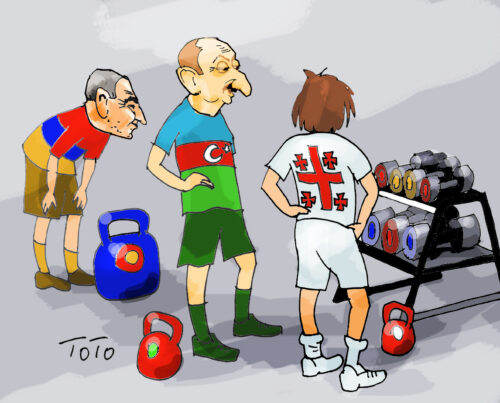
The political landscape surrounding Armenia presents a complex picture. Armenian-Russian relations are evolving in a way that is neither hostile nor friendly. Relations with the European Union are progressing slowly, with visa liberalization — a long-awaited issue for the Armenian public — still a distant prospect, according to recent statements from the EU. Iran is clearly signaling that it does not trust Armenia or the Armenian authorities when it comes to the Trump Route for International Peace and Prosperity (TRIPP) and its future. Meanwhile, the United States is still waiting to see what happens in the war with Iran or in the negotiations before moving forward with the TRIPP project.
It is generally accepted that foreign policy is a continuation of domestic policy, and vice versa. In other words, these two processes are closely interconnected. In most countries, foreign policy processes tend to have a more significant impact on domestic political developments than the reverse. The United States can be considered an exception, as its domestic political dynamics can, to a considerable extent, shape and even dictate foreign policy. For example, the president may make certain foreign policy decisions with the aim of strengthening his standing domestically or addressing the domestic political agenda. Similarly, taking domestic political developments into account, the US Congress may restrict or suspend certain presidential powers related to the foreign policy agenda or to a specific area of foreign policy.
Armenia, unlike the US, is a small country, and virtually all major developments in international and foreign policy have a direct impact on it. Its domestic political processes are therefore closely connected to its ability to address external policy challenges. This is a characteristic feature of small and less powerful states, which are generally more vulnerable to developments in the international environment. To face these kinds of challenges, Armenia needs to be able to accurately assess and analyze foreign policy processes, anticipate potential developments, and formulate and implement a coherent sequence of actions that would minimize the impact of external challenges on the country. Unfortunately, this is not happening. We are witnessing significant tensions in the international system, and these tensions have also created a highly volatile environment around Armenia.
This suggests that the Armenian leadership has been unable to prevent these external tensions from spilling over into the country. Tensions that originate in the broader foreign policy environment are being directly transferred into Armenia, while the Armenian government is failing to take sufficient steps to ensure that Armenia does not become entangled in areas of confrontation among major international actors. Armenia should avoid becoming directly involved in these points of tension or playing a role in escalating or exacerbating existing geopolitical rivalries. The responsibility of any government should be precisely this: to minimize the spillover of external tensions into the country, as such tensions can undermine economic development, weaken the national security environment, erode national unity, and adversely affect other vital national interests.
Armenia’s situation, of course, is not quite the same. For example, Armenia currently has strained relations with Russia. Although Russia has not taken any steps that directly target Armenia’s vital interests, tensions between Armenia and Russia have repercussions within Armenia and are reflected in both domestic and foreign policy agendas. This tension is not rooted in fundamental disagreements between Armenia and Russia, but rather in Armenia’s relations with the EU. The same can be said of the EU’s approach. The EU wants Armenia to end its membership in the Eurasian Economic Union (EAEU) and the Collective Security Treaty Organization (CSTO) and, more broadly, views Armenia within the context of its broader strategic competition with Russia.
The same applies to the strained relations between Iran and the United States, which also have direct repercussions in Armenia. The broader geopolitical tensions surrounding Armenia find a mirror reflection in the country’s own political environment. It should be emphasized once again that external influence on countries like Armenia is extremely significant, but this does not mean that tensions among external players should be brought into Armenia’s domestic political agenda, turning Armenia itself into a party to those tensions. Doing this is extremely difficult, and not every country has been successful in managing it. Georgia, for example, faces considerable difficulties in this regard. Azerbaijan, by contrast, has been more cautious in this respect and has sought to avoid bringing conflicts among global players into its domestic political agenda.