


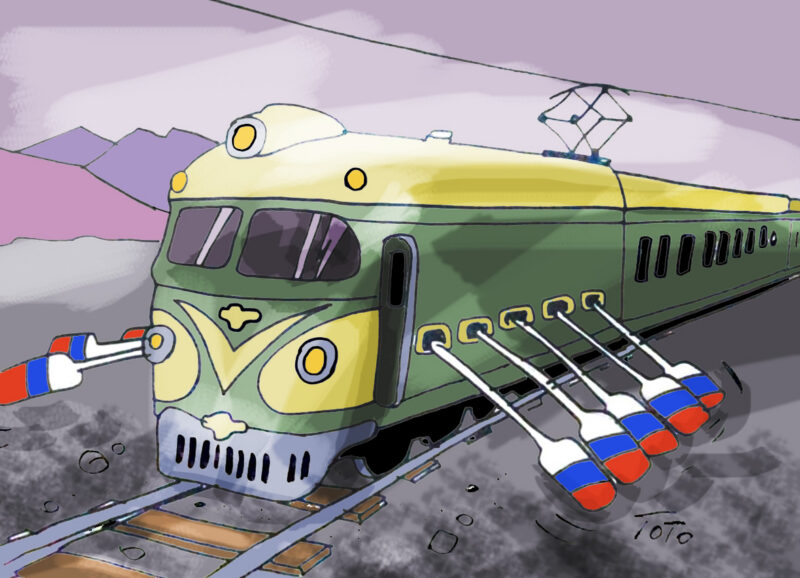
Russia’s policy in the South Caucasus, particularly toward Armenia, has become noticeably more active in recent weeks. In particular, this concerns regional communications and infrastructure, concerning which Russia has begun making more proactive proposals to Armenia. Recent statements by Russian Deputy Prime Minister Alexey Overchuk regarding the restoration of certain sections of Armenia’s railway infrastructure are particularly noteworthy.
Essentially, Russia has offered to help Armenia restore two railway sections: one running from Yeraskh, south of Yerevan, toward the northern part of Azerbaijan’s Nakhichevan Autonomous Republic, and another connecting Gyumri to the Turkish border. It presents these projects as part of a broader process of unblocking regional transport links.
Also noteworthy is the unplanned trilateral meeting between Russian President Vladimir Putin, Armenian Prime Minister Nikol Pashinyan, and Azerbaijani President Ilham Aliyev on the sidelines of the gathering of the Commonwealth of Independent States (CIS) leaders. Although the meeting was brief, it is evident that Russia is seeking to position itself within the process of normalizing bilateral relations, including by exploring the possibility of becoming involved in the Trump Route for International Peace and Prosperity (TRIPP).
Of course, the question of Russia’s involvement in the project will be discussed and potentially resolved through negotiations between Moscow and Washington. If the two great powers reach an understanding, Armenia and Azerbaijan will have relatively little say in determining Russia’s role.
A phone conversation between Putin and Trump took place on the same day as the trilateral meeting. It is difficult to imagine that Russia’s potential participation in the project could have been discussed during their telephone conversation. Nevertheless, it cannot be ruled out that the issue was raised and may continue to be discussed at lower levels. Regarding Overchuk’s October 2 statement, he clarified that an important meeting is expected to take place in the near future – one that will help move these issues forward. Most likely, he was referring to an upcoming visit to Armenia by the head of Russian Railways, during which all these matters are expected to be discussed. This visit will most likely take place before Pashinyan travels to Moscow, as the railway issue will naturally also be discussed with Putin.