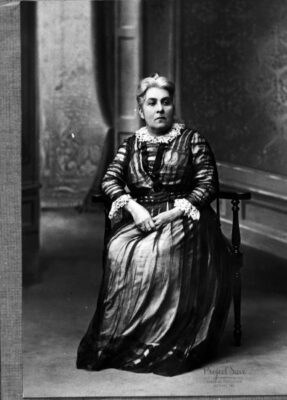


Diana Agabeg Apcar in a long gown, about 1915 (Photo by Farsari. Project SAVE Armenian Photograph Archives. Courtesy of Katherine Apcar Berberian)

By Julia Hallisy and Meline Mesropyan

In 2020, just as quarantines were being lifted during the global pandemic, Dr. Julia Hallisy discovered that she was one generation removed from genocide.

Hallisy had always assumed that her family’s immigration story followed the common narrative of coming to America for greater opportunities and a better life. Her family members had never shared any details about the circumstances of their immigration to the United States.

Once Dr. Hallisy was able to reopen her dental office in the summer of 2020, a discussion with a new patient of Assyrian descent led to her discovery that her father’s family were genocide refugees. This conversation led her to begin researching both her family history and the geopolitical events of the time. The results of her inquiries left no doubt that her family’s journey in 1921didn’t originate from hopeful anticipation of a better future. Her grandparents were fleeing the atrocities of Seyfo, or the Assyrian Genocide, which, unbeknownst to her, had taken place alongside the Armenian Genocide during the First World War.

The early 20th century was a perilous time in the Ottoman Empire, which included large parts of the present-day Middle East. Hallisy immediately realized the importance of understanding the relationship between internal political unrest and regional and global conflict, as they are often precursors to violence and displacement.

The political climate of the Ottoman Empire had changed dramatically in the years before World War I. The Young Turk Revolution of 1908 initially promised constitutional government and greater equality among the empire’s diverse peoples. But the years that followed brought political upheaval, military defeats, and the loss of much of the empire’s European territory in the Balkan Wars. In January 1913, the Committee of Union and Progress (CUP) seized power in a coup and increasingly concentrated political power in its own hands. At the same time, the CUP’s emphasis on centralization and demographic transformation placed growing pressure on the empire’s Christian populations. Beginning in 1915, the CUP government implemented a centrally organized campaign of mass deportation, dispossession, and killing that destroyed much of the Armenian population of the Ottoman Empire. This campaign formed part of a broader effort to reshape the population of Anatolia, while wartime accusations of Armenian disloyalty and collaboration with Russia were used to portray Armenians as a threat to state security.

Get the Mirror in your inbox:

Assyrian Christians were also caught in this wider transformation and wartime violence, although their experience did not follow a single pattern or simply replicate what happened to the Armenians. In some regions Ottoman authorities ordered their deportation and dispersal; elsewhere local massacres expanded with the involvement or approval of provincial and central authorities and the Ottoman military. In the borderlands of eastern Anatolia and northwestern Persia, Armenian and Assyrian experiences became particularly intertwined.

The Urmia region, where Hallisy’s family lived, was among the first areas devastated. When Ottoman forces occupied northwestern Persia in early 1915, Assyrian and Armenian communities were subjected to massacres, plunder, and displacement. Similar violence engulfed Assyrian communities across the Ottoman-Iranian borderlands during World War I, reaching its greatest intensity in 1915, remembered by Assyrians as Seyfo—the ‘Year of the Sword.

The name “Assyrian” was increasingly used in the early twentieth century for several historically distinct Christian communities of the Middle East, although these communities were still commonly identified by their churches, including the Church of the East, the Chaldean Catholic Church, and the Syriac Orthodox Church. After World War I, efforts to forge a broader shared Assyrian identity gained momentum. Before the war, these communities were spread across a broad region extending from Urmia in northwestern Persia through the Hakkari Mountains of the Ottoman Empire and westward into southeastern Anatolia, with other communities in what are now northern Iraq and Syria. The name invokes the ancient Assyrian past, although the precise relationship between these communities and the ancient Assyrians is a complex and debated question.

Because these communities were counted under different names and no comprehensive census existed, their total population before World War I is difficult to determine but has been estimated at between 500,000 and 600,000. In 1919, representatives of these communities reported that 250,000 Assyrians had been killed in Anatolia and Ottoman-occupied Iran, a figure that was increased to 275,000 in 1923. Although the exact number of victims remains uncertain, in some areas more than half of the Assyrian population may have been lost.

Julia Hallisy’s grandparents lived in a village along Lake Urmia in present-day Iran called Abdullakand or Atlakande. Their life in the region around Lake Urmia meant living close to the land and embracing simplicity and humility. Her grandparents had grown their own food, raised livestock, and lived in a close-knit community with their church and their faith at the center of their lives.

After their village was sacked, the family eventually joined the flight south from the Urmia region toward British-held Mesopotamia, where Hallisy’s father was later born in a British refugee camp. Her family’s village, their entire way of life, and eventually their ancestral homeland was forcibly uprooted as they escaped the atrocities.

Hallisy’s family spent several years in a refugee camp. However, the British-run refugee camps were intended to be temporary. British authorities initially hoped to repatriate the Assyrian refugees to their former homes, but when return proved difficult, they began pursuing other forms of relocation and resettlement. Wartime assurances by Britain and its Allies had raised Assyrian expectations that they would be able to return to a secure homeland under Allied protection. But the hopes that Britain’s “smallest ally” and valuable military asset would again know a secure homeland went unfulfilled.

Land has always been the foundation of any nation. It’s especially challenging for a nation with hundreds of villages, different dialects, and several religions to hold together and survive without the physical land that binds them. Assyrians were victimized physically by their oppressors and then left politically and geographically vulnerable when the Allied powers they had trusted failed to secure the homeland they had hoped for. This betrayal is still a gaping wound carried by the grandchildren and great-grandchildren of Assyrian genocide survivors.

During this period of refugee-camp closures and resettlement, Hallisy’s family, along with many other genocide refugees, began a rare and little-known journey toward Asia—an extraordinarily long and physically and emotionally grueling passage.

The records do not reveal the exact route Hallisy’s family took from Mesopotamia to Japan. Hallisy believes that, rather than traveling north from Baghdad through Russia and Vladivostok, they may have traveled south to Basra and continued by sea toward Asia. From the Persian Gulf, a possible route would have taken them to India and then through ports such as Singapore, Hong Kong, or Shanghai before reaching Yokohama. Their precise itinerary remains unknown. What the surviving records do establish is that the family eventually reached Yokohama, from where they sailed across the Pacific to San Francisco.

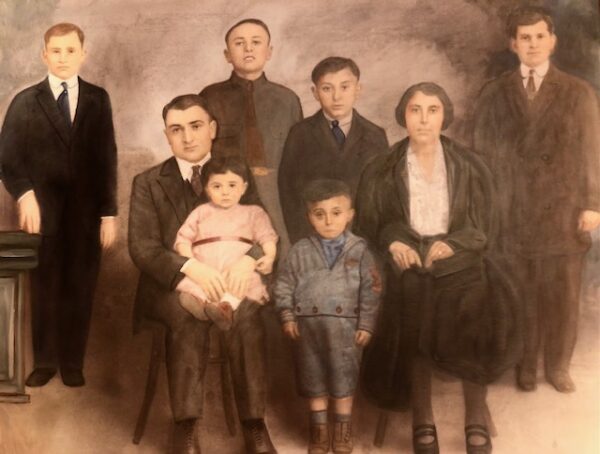
According to immigration records (…), between 1918 and 1926, The Angel Island Immigration Station processed several hundred Assyrians and Armenians arriving on Japanese ships from Yokohama and Kobe, Japan. Among them was Hallisy’s grandfather Elisha Bajan, her grandmother Shalam Bajan, her uncles Theodorus Bajan and Ardruis Bajan and her father, Yulius Bajan, who was only 4 months of age.

In examining the ship manifest from their journey from Yokohama to San Francisco, Hallisy happened upon the name ‘Mrs. Apcar,’ explicitly identified as a ‘Friend’ in the column for “the nearest relative or friend in the country from which the passenger came”.

Dr. Hallisy initially assumed that Mrs. Apcar was an administrative clerk or government employee who had helped the refugees with their paperwork. She decided to search for the name and address that was listed on the document, which led her to the discovery that “Mrs. Apcar” was Diana Agabeg Apcar (1857-1937), an Armenian humanitarian living in Yokohama, Japan. The search also led to a website called “The Stateless Diplomat” created by Mimi Malayan, Diana Apcar’s great-granddaughter and the author of a docudrama bearing the same title. Dr. Hallisy emailed Ms. Malayan via the website and she answered almost immediately. She confirmed that her great- grandmother had aided Assyrians fleeing the genocide. Remarkably, both Ms. Malayan and Dr. Hallisy reside in San Francisco, and they made plans to meet in person to discuss Diana Apcar’s humanitarian efforts.

Diana Agabeg Apcar was an Armenian writer and humanitarian who had lived in Japan since 1891 and became a prominent advocate for the Armenian cause. Born in Rangoon in 1859 to an Armenian family from Calcutta, she later settled in Yokohama with her husband and children and made Japan her permanent home. From there, thousands of miles from the Ottoman Empire, she became an outspoken voice for Armenians facing persecution, publishing books, articles and pamphlets in English and corresponding with political, religious, and humanitarian figures around the world. As refugees displaced by war, revolution, and persecution began passing through Japan, her advocacy increasingly expanded into direct humanitarian work.

In 1920, the Republic of Armenia appointed Apcar its honorary consul in Japan. Although the Japanese government did not formally recognize the appointment, it became an important part of her historical legacy.

Today, Apcar is commemorated as a prominent Armenian historical figure. A park in central Yerevan on Mashtots avenue bears her name, Armenia has issued a postage stamp in her honor, and plans are underway for a monument dedicated to her. Her life and humanitarian work are also the subject of Mesropyan and Arisa Ohta’s recent Japanese-language book, A “Diaspora” in Japan: The Armenian Genocide and Diana Apcar, based on extensive archival research in Japan and abroad. As the anniversary of Apcar’s birth on October 17th approaches, this story brings to light a lesser-known part of that legacy: her assistance to Assyrian refugees passing through Japan.

The histories of Armenians and Assyrians during these years are deeply connected by persecution, displacement, and loss. But bringing these two lines of research together reveals another side of that shared history as well—one of solidarity and humanitarian assistance.

The Bajan family

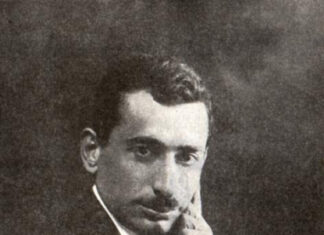
Hallisy’s family records offer another intriguing glimpse of how that assistance may have worked. On their passenger manifest, another Armenian, Mihran K. Serailian, was listed as their “Friend” and U.S. contact in San Francisco. Hallisy subsequently located contemporary newspaper reports that revealed much more about Serailian. He was an Armenian artist and businessman whose own family had suffered devastating losses in the Ottoman Empire. His father had been killed during the Hamidian massacres of the 1890s, and he later learned that his mother, his two sisters, three children of his older sister, an aunt, and more than twenty other relatives had perished during the deportations and massacres of 1915. By 1920, contemporary newspapers described Serailian as a staunch supporter of Near East Relief in San Francisco, while other reports show him actively participating in Armenian relief efforts in California.

His appearance on Hallisy’s family manifest was not an isolated occurrence. Hallisy and Mesropyan found Serailian’s name on several other passenger manifests, including several records in which refugees listed Apcar as their “Friend” in Japan and Serailian as their “Friend” or contact in the United States. Given that these passengers came from different communities and had no evident prior personal relationship with Serailian, the designation “Friend” may not necessarily have meant a personal acquaintance, but rather a trusted contact to whom the refugees had been introduced or directed. Although no surviving correspondence has yet been found directly linking Apcar and Serailian, the recurring combination of their names, together with Serailian’s documented involvement in relief work, raises the possibility that they were connected through a broader trans-Pacific relief network assisting refugees traveling from Japan to North America.

Hallisy finds it remarkable that Diana Apcar didn’t limit her efforts to Armenian refugees, which would have been understandable in her role as a tireless advocate for the Armenian people. It might have been easy for some people to focus their work on the needs of their own countrymen, but Apcar’s humanitarian concern gradually extended beyond the Armenian cause.

Apcar’s own writings show how her concern gradually expanded beyond the Armenian cause. Her early political writings focused overwhelmingly on the persecution of Armenians in the Ottoman Empire, but by 1911 her concern was already beginning to extend to other oppressed Christians and, more broadly, to weaker peoples and nations. During World War I, that widening concern came to include the Assyrians of northwestern Persia. In 1916, writing about the violence in northwestern Persia, she described the fate of Armenians alongside thousands of “Syrians,” the term she then used for the Assyrian Christians of the region; by 1918, she referred to them as “Assyrians.” Looking back in 1923, Apcar described this change herself: “I had only the cause of the Armenians at heart, but naturally sympathies widened to include all those who have suffered and are suffering from Turkish atrocities.” By the time Assyrian refugees began reaching Japan, Apcar’s broader concern had become practical humanitarian assistance.

Hallisy’s discovery connected with a search that Mesropyan had been pursuing from the other direction. During years of researching Diana Apcar, Mesropyan had come across scattered references to Assyrians in Apcar’s writings and surviving correspondence. Some showed that Apcar had helped Assyrian refugees in Japan but often revealed little about who they were or what happened to them. Mesropyan had spent years trying to find descendants of refugees Apcar had helped, finding several Armenian families but never a descendant of one of the Assyrians. That changed when Mimi Malayan, Apcar’s great-granddaughter and Mesropyan’s longtime collaborator and friend, forwarded Hallisy’s email to her. Hallisy had initially learned of passenger records identifying perhaps fifty Assyrians who had passed through Japan, but Mesropyan had already encountered evidence suggesting that the number was higher. She pointed Hallisy toward passenger records where more might be found. Hallisy’s subsequent search identified 403 Assyrian passengers who departed Japan for North America, primarily for San Francisco and Seattle, with a smaller number traveling to Canada. The finding revealed a much larger, previously little-known movement of Assyrians through Japan in the years surrounding World War I.

The records do not reveal how many of these 403 passengers received Apcar’s assistance. Surviving correspondence documents her help to some Assyrians, but the absence of a surviving body of Apcar’s personal papers makes it difficult to determine the full extent of her refugee-relief activities. During her research on Apcar, Mesropyan recently located previously unknown records of an organized refugee-relief effort in Yokohama with which Apcar herself appears to have been connected. Herbert Stanley Sneyd of the local Young Men’s Christian Association (YMCA) chaired the Japan Committee for the Relief of Christian Refugees of the Near East, which assisted Armenian and Assyrian refugees passing through Japan. In his own reports, Sneyd referred to a “Local Relief Committee” of which he was the chairman and which represented what he called the “Armenian and Assyrian Relief Committee of New York,” a New York-based organization providing relief to refugees from the Near East, later to become known as Near East Relief. The Yokohama committee provided housing, clothing, and other assistance to refugees, helping those with relatives in America continue their journeys and arranging for others to return westward. Sneyd reported that it had assisted more than two hundred Armenian and Assyrian refugees during the year ending September 30, 1919.

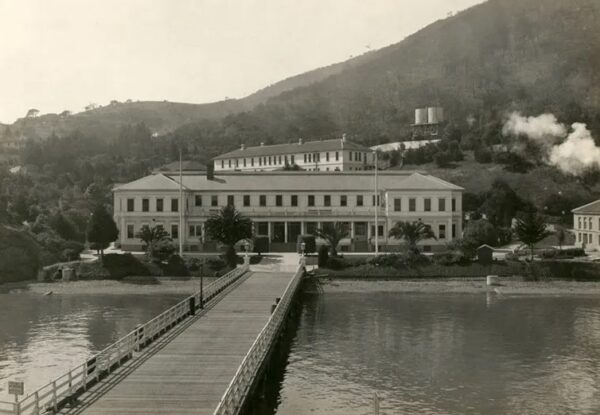
Angel Island Immigration Station, National Archives

Mesropyan also identified an important reference in Apcar’s own correspondence connecting her to the committee. Writing to the American Red Cross in Vladivostok (May 29, 1919), about a group of fifteen Assyrian refugees who had arrived in Japan without sufficient funds to continue to America, Apcar stated that if they remained, “our Committee will have to bear all their expenses,” and referred to Sneyd as “Chairman of our Committee.” Her precise position within the committee cannot yet be established, but these references indicate that she was connected with it. The records reveal a previously unknown organized dimension to Apcar’s humanitarian work in Japan.

Discovering in her mid-fifties that she’s the descendant of genocide refugees has changed Julia Hallisy’s life. She now lives with the realization that her very existence is miraculous — and even more so due to the little-known and grueling route of refuge they took through Asia, with the assistance of a total stranger whose humanitarian concern had extended beyond her own Armenian people to other persecuted Christian communities.

Since this revelation, Hallisy has felt a responsibility to honor the story of her ancestors and to fight for the type of world that once opened their hearts and doors to those who struggle and suffer. She lives in awe of wondrous lives that can be forged out of terror and trauma.

Happy Birthday, Mrs. Apcar!

Get the Mirror-Spectator Weekly in your inbox: