

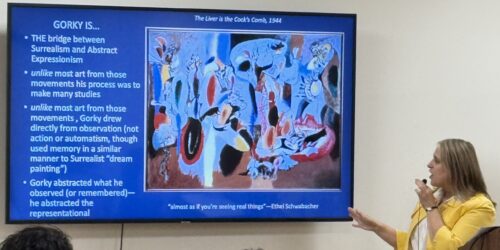
WATERTOWN — Dr. Kim Servart Theriault gave an illustrated talk on “Arshile Gorky: Between the Figural and Abstract” on Friday, September 18, at the Baikar Building organized by the Tekeyan Cultural Association (TCA) Boston Chapter.
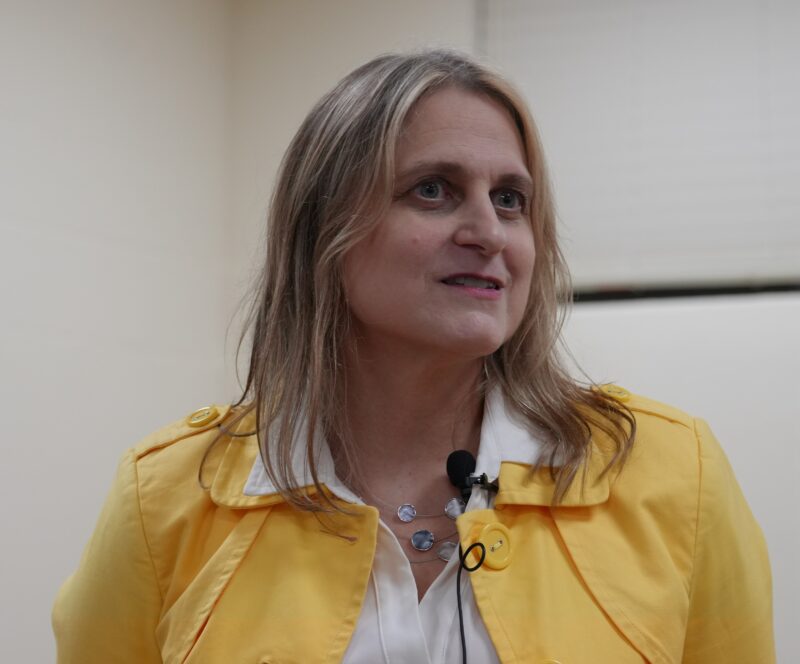
Theriault, the curator of the recently closed exhibition titled Arshile Gorky: Redrawing Community and Connections at the Armenian Museum of America in Watertown, has spoken and written about Gorky’s Armenian identity and his forging of an artistic identity in the past.
She declared, “When you’ve been working on an artist for over 30 years — half a lifetime, [or] a lifetime for many of you — you really want to look for and thinking about what is new to discover. What can I learn?”
She decided to focus in her talk on the formal qualities of his art, the importance of his personal friendships with other artists and his continued use of representational art. Some people qualify Gorky as an abstract expressionist. However, she noted that Gorky’s work was always founded in direct observation.
She said, “Whether drawing an image of a fellow artist, a family member, or a friend or abstracting the structures, forms or outlines of a landscape, Gorky maintained an attachment to the figural and representational because he sought out, retained, or forged an emotional connection to the individuals, spaces, and places that he presented in his compositions, even if his creations were abstracted renditions.”
In her talk, Theriault pointed out in seemingly abstract works the representational basis of various images, while explaining the process Gorky used to grow as an artist, mimicking and adapting various techniques of earlier great artists. He and a group of his artist friends, including Willem de Kooning (1904-1997) or Stuart Davis (1892-1964), developed new styles but kept representational elements amongst the abstract in their paintings or drawings.