

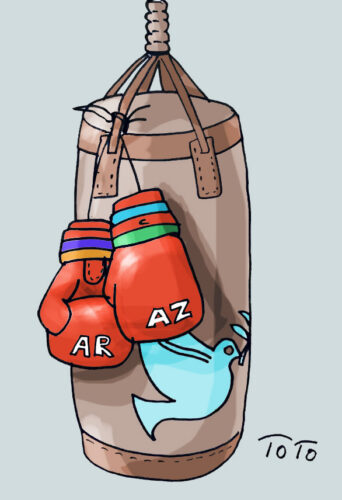
Armenian-Azerbaijani relations have taken on a rather interesting turn. Relations can be characterized as a “neither war nor peace” situation, which seem to be not leaning more toward peace, at least judging by Azerbaijani statements and actions.
It is understandable that the sides do not have a signed peace agreement, and it seems that the signing of such an agreement is not a particularly realistic possibility in the near future. On the other hand, the sides are not engaged in military hostilities and are not shooting at each other. The hostilities, as such, seem to have moved into the public sphere, in the form of statements and political rhetoric, and are usually one-sided. Statements made at the highest levels are often unfriendly in nature and primarily come from the Azerbaijani leadership. Although there is no military confrontation, the confrontation in the political and information spheres against Armenia continues.
Relations that have not reached their logical conclusion are temporary in nature, and sooner or later, the sides will have to reach peace. However, the fact remains that, at this point, such a possibility does not yet seem realistic in the short term, and this issue is being pushed into the medium-term perspective.
Most likely, this will happen after a referendum is held in Armenia, which will satisfy the preconditions put forward by Azerbaijan. Such a situation primarily serves Azerbaijan’s interests because, as the victorious side and the more powerful state, Azerbaijan is able to resolve several important issues. First, it has strengthened its position in the region and is able to act as a more powerful regional player than the other states in the region. At the same time, Azerbaijan is able to obtain significant concessions from Armenia. In other words, Armenia is making preliminary concessions in accordance with Azerbaijan’s demands, which, of course, creates a favorable environment for Azerbaijan not to sign the peace agreement, or to put forward maximum demands and sign it as late as possible. Therefore, even if the Trump Route for International Peace and Prosperity (TRIPP) is implemented, it still does not constitute a guarantee that Azerbaijan will sign the peace agreement.
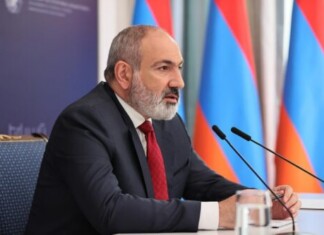
The United States also does not want to directly link the implementation of TRIPP with the signing of the peace agreement. This raises the question of why Azerbaijani President Ilham Aliyev has recently been speaking about Armenia in such an aggressive manner, displaying overt hostility. There could be several reasons for this. For example, it cannot be ruled out that Armenian President Nikol Pashinyan promised him something but, for some reason, has not yet been able to implement it.
It is possible this aggressiveness is due to Azerbaijan needing to create a link between itself and its exclave, Nakhichevan, as quickly as possible, and the Azerbaijani government understands that the biggest problem lies with the railway. Therefore, perhaps it is exerting pressure so that Armenia resolves this issue in Moscow as quickly as possible during Pashinyan’s upcoming visit. Otherwise, a number of problems could once again arise in relations between the two sides and in the peace process.