


Russian Military Base in Armenia Is a Test of the Future of Armenian–Russian Relations

141
0

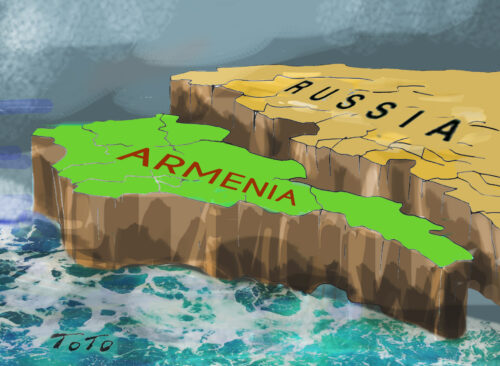
The Russian 102nd Military Base in Armenia was one of the few topics that was not discussed in Armenia’s domestic political discourse. Discussions about it were minimal, unlike other controversial issues on the Armenia–Russia agenda, including the Eurasian Economic Union (EAEU), Collective Security Treaty Organization (CSTO), gas prices, certain restrictions imposed on Armenia, and so on. It also was not a contentious issue on the bilateral Russian-Armenian agenda around which intense political debates could develop. Yet this topic was brought onto the agenda following the meeting between the Russian president and the Armenian prime minister, when Russian President Vladimir Putin said that the military base could be withdrawn from Armenian territory at an accelerated pace if Armenia did not need it.

This then became a serious and heated topic of discussion in Armenian political and political-science circles. It was the Russian side that brought the issue onto the agenda and directed the responsibility for the decision toward Yerevan with the formulation, “if Yerevan does not need it.” In other words, Russia appeared to be waiting for Armenia to declare that it wanted the military base withdrawn.

Armenia’s response surprised many, particularly pro-Western forces, because Armenia countered that if Russia wanted to withdraw the military base, Armenia would not object. This was stated at the level of the prime minister, and, in essence, the responsibility for making the decision was shifted back to the Russian side, so that Russia would make the decision. Thus, it appears that the two sides shifted responsibility for the decision onto each other, while at the same time bringing the issue of the military base’s withdrawal into the public debate and onto the political agenda.

The Russian military base in Armenia was established with several objectives, the first of which was to maintain a Russian military presence in the South Caucasus. This became particularly important after the withdrawal of Russian troops from Georgia and Russia’s departure from the Gabala radar station in Azerbaijan. The base remained Russia’s only foothold in the South Caucasus. In addition, it was a military base located directly opposite the border with NATO member Turkey, which had strategic significance from the perspective of NATO–Russia confrontation. It was also one of the components of Russia’s status as a great power, because having a military base in another country’s territory underscored Russia’s role as a global player.

The presence of the military base played an important role in maintaining the balance of power in the South Caucasus. Its presence was not in Turkey’s interests, since the base of a rival state was located directly on its border. On the other hand, it was not making Iran nervous, at least from the perspective that there could not be another type of military presence in Armenia apart from the Russian one. This made Armenia and the region more predictable and controllable for Tehran, even if the military presence belonged not to Iran itself but to a country with more or less friendly relations. It was also an indicator of the strategic and military-diplomatic partnership between Russia and Armenia, something that was proudly emphasized in both countries.

The base played a certain role in ensuring regional stability, considering the security architecture that existed before the 2020 war while Russia and Armenia were strategic allies. Formally, its existence also pursued the goal of protecting Armenia and was presented as a deterrence mechanism, if not for Nagorno-Karabakh, then for Armenia’s security.

Get the Mirror in your inbox:

However, the picture changed significantly after the 2020 war, the transformation of the nature of Russian–Turkish relations, the Russia–Ukraine war, and various other processes which took place in the South Caucasus over the past five to six years. The military base lost some of its importance and significance for both Armenia and Russia, although this was determined primarily by regional realities rather than by bilateral relations.

Putin’s statement regarding the military base was unexpected, and it appears that its purpose was to encourage Armenia to view its relationship with Russia not through individual agenda items, but as a comprehensive package. Ultimately, the CSTO is an international organization, as is the EAEU, while bilateral relations include the price of gas, the railway issue, the nuclear power plant issue — which, incidentally, Armenia has stated it is ready to cooperate with Russia on — as well as the economic restrictions that Moscow applies toward Yerevan. In other words, Russia is placing its bilateral and multilateral relations with Armenia into one comprehensive and large package that includes all security and economic issues.

This means that if Armenia wants to distance itself from Russia, the corresponding step would amount to total disengagement. Putting the question of a referendum before Yerevan means that Russia appears to want Yerevan to approach the entire spectrum of its relations with Russia through the referendum, rather than focusing only on membership in the EAEU. This leaves Yerevan in a more difficult position, because the stakes become considerably higher.

The essence of the referendum could become not only Armenia’s withdrawal from the EAEU, but a broader reconsideration of the nature and level of relations with Russia, since Russia is turning all the issues on the agenda into one unified package. As a result of such a referendum, Armenia and Russia will not become enemies, but the economic, political, and military relations that have been built between them over many years will either be reduced to zero or become insignificant. Here, it is important to emphasize that Russia is Armenia’s number one trading partner, and the economic ties between the two countries number in the thousands.

In other words, Russia is saying that relations should take on a new format, the basis for which could be not the policy of the Armenian government, which many consider pro-European in Moscow, but the Armenian people. That is, if the desire to distance Armenia from Russia comes not from the Armenian government, but from the Armenian people, then the decision belongs to the people, and it should be a public decision, with the people assuming responsibility for its consequences.

The escalation of these issues could also mean that Armenia is simply receiving a strong rationale for not distancing itself from Russia and not leaving the EAEU, because the alternatives cannot be provided by the EU. Therefore, there may be no need to make such a choice. Conversely, if Armenia wants to obtain greater independence from Russia, this becomes more difficult — not because of the circulation of the military-base issue itself, but because Russia’s relationship with Armenia is being viewed not only through economic ties, but also through military, geopolitical, energy, communications, and other dimensions.

The reality is that Armenian-Russian political, military, and strategic relations are currently at their lowest level in recent decades. However, in the economic sphere, they remain significantly strong and deeply interconnected. Therefore, Russia’s approach appears to be that either integration and the deepening of relations in all areas move along the same path and in the same direction, or they do not move forward at all and instead move toward a reduction in the level of bilateral relations, similar to what happened between Georgia and Russia after 2008.

Get the Mirror-Spectator Weekly in your inbox: