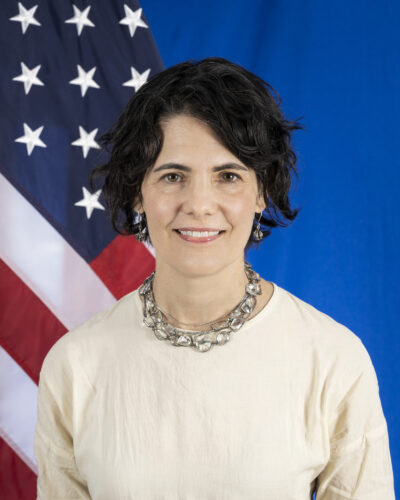


Amb. Nina Hachigian

Biodiversity Is Local: That’s Why Mayors Are Going to Armenia

9
0

By Amb. Nina Hachigian

Special to the Mirror-Spectator

This October, I will return to Armenia for the third time. The first time, I went as a mother. The second, as a diplomat. This time, I will return as a supporter of local elected leaders.

Although I was born and raised in the United States, Armenia has always been part of my story. My grandparents came from a community that is now in Türkiye, and my family’s history is intertwined with a country that has endured extraordinary challenges, foremost the Genocide, while holding fiercely to its identity, culture, and connection to its land. I am a proud Armenian American.

So it is deeply meaningful to me that I will be heading a delegation of roughly 50 American mayors, county leaders, and regional officials to Yerevan for COP17, the United Nations conference on biodiversity. It is a tremendous and well-deserved honor for Armenia to host this gathering. I hope the experience will not only strengthen Armenia’s security and economy, but also introduce my colleagues to the wonders of this amazing country I love — from fresh lahmajun to the ancient vanks tucked into mountains.

We are going to Armenia to confront a challenge that can seem far removed from city halls: the loss of biodiversity, as species disappear and wilderness continues to shrink. But the more time I spend working with local leaders around the world, the more convinced I am that some of our biggest global challenges are ultimately local. Biodiversity is one of them.


Get the Mirror in your inbox:

Biodiversity is the forest outside a community. It is the river running through a city. It is the pollinators that sustain agriculture and the wetlands that protect neighborhoods from flooding. It is the parks and green spaces that make cities healthier, cooler, and more livable. These are not abstract environmental assets. They are the places where people live, work, and raise their families. And they are where solutions can begin.

Armenia knows something about the importance of place.

For a country of its size, Armenia contains remarkable ecological diversity, from forests and wetlands to mountain ecosystems and rare species found nowhere else. The Yerevan Blue butterfly, featured on the COP17 emblem, is endemic to Armenia. Its survival depends on a particular landscape in a particular place.

That makes it an apt symbol for the biodiversity challenge. We often talk about extinction and ecosystem loss in global terms, but biodiversity is experienced one place at a time. A forest is protected — or lost — in a particular community. A river is restored—or polluted—in a particular watershed. A habitat is preserved — or destroyed — in a particular place.

That is why local leaders have such an important role to play, and why the US delegation heading to Armenia matters.

To date, the United States has not ratified the Convention on Biological Diversity. But American local officials do not need to wait for national governments to act before they begin protecting the places and communities they serve. They can learn from one another, share what works and adapt solutions to the needs of their own residents.

With support from ICLEI USA, the California Global Biodiversity Alliance, and ALLIES, our delegation will join local leaders from around the world in Yerevan. We will share what American communities are doing, learn what is working elsewhere and bring those lessons home.

The timing also matters. At COP17, countries will conduct the first global review of progress toward the Kunming-Montreal Global Biodiversity Framework, which established 23 targets for halting and reversing biodiversity loss by 2030. Those global commitments are important. But they will only mean something if they translate into action on the ground.

That is where mayors, county leaders, and other local officials come in. They make decisions about parks, public spaces, land use, infrastructure and resilience. They see firsthand how environmental changes affect residents, and they are often among the first to hear from communities about what is working and what is not.

They can also learn from one another in ways national governments cannot. A city in California can learn from a municipality in Europe about restoring habitat. An American county can learn from a community in Asia about protecting watersheds. A mayor can return home with an idea that has already been tested in another part of the world and adapt it to the needs of their own residents.

That is the promise of city diplomacy: turning relationships across borders into practical improvements at home.

My Armenian heritage and professional experience have always reminded me that countries are more than their governments. They are people, communities, histories, landscapes and the places they call home. Those connections can survive across generations and across oceans.

The same is true of the relationships being built between cities today — mayor to mayor, city to city, community to community. That is what I hope this delegation will do in Yerevan.

Together, we will go to Armenia with a shared concern about the future of our planet. But we will also go with something more practical: a willingness to listen, share ideas, learn and bring ideas home.

While the challenge of biodiversity is global, its solutions will be built in specific places, by people who know those places best. I’m honored to return to Armenia to learn from others, share what our communities are doing, and bring those lessons home.

Get the Mirror-Spectator Weekly in your inbox: