

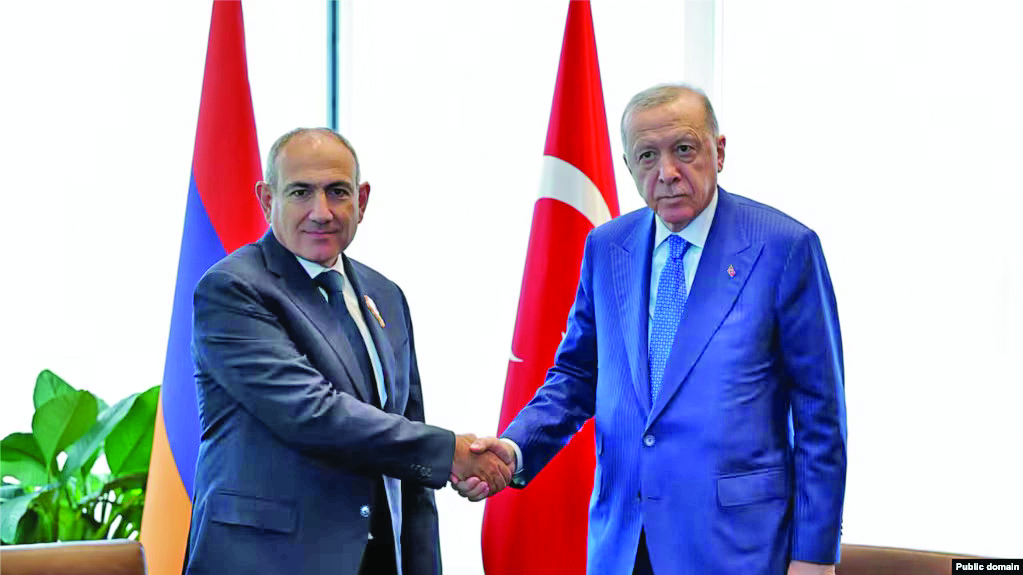
Turkish President Recep Tayyip Erdogan and Armenian Prime Minister Nikol Pashinyan meet at the Turkish House in New York, September 23, 2026.

Armenian Security Chief Sees No Threat From Turkey, as Pashinyan Meets with Erdogan in New York

30
0

YEREVAN (Azatutyun) — Prime Minister Nikol Pashinyan met with Turkish President Recep Tayyip Erdogan in New York on September 23 to discuss Turkish-Armenian relations and the Armenian-Azerbaijani peace process.

The talks were held at the Turkish House on the sidelines of the ongoing session of the UN General Assembly.

In a statement, the Turkish presidency said that Erdogan voiced support for “the normalization process with Armenia in the areas of bilateral trade and transportation” and praised “growing cooperation with Armenia in international organizations.” He was also reported to hail “reciprocal steps” taken by Armenia and Azerbaijan.

Pashinyan’s office reported, for its part, that the two leaders expressed readiness to “advance” that process and, in particular, commercial ties between their countries. It said they also “stressed the need” for the implementation of an agreement to open a US-administered transit corridor for Azerbaijan through Armenia.

Turkey continues to make the opening of its border with Armenia conditional on an Armenian-Azerbaijani peace deal acceptable to Azerbaijan. That means accepting Baku’s demands for a change of Armenia’s constitution and the opening of the corridor that would connect Azerbaijan to its Nakhichevan exclave and Turkey. There were no indications after Erdogan’s latest talks with Pashinyan that Ankara will drop these preconditions.

Contrary to reports in the Turkish press, Ankara refrained from implementing ahead of Armenia’s recent parliamentary elections a 2022 agreement to open the border for Armenian and Turkish diplomatic passport holders as well as citizens of third countries. It took instead other, largely symbolic steps, including a permission of Turkish-Armenian cargo shipments through Georgia’s rail link with Turkey.
Get the Mirror in your inbox:

Pashinyan telephoned Erdogan four days before the June 7 elections which were praised by the Turkish Foreign Ministry.

The next day, in Yerevan, Alen Simonyan, now the secretary of the Armenian government’s Security Council and a long-time political ally of Pashinyan, said Turkey poses no threat to Armenia’s national security.

“I do not see a threat to the sovereignty of the Republic of Armenia from Turkey. Starting from [the initialization of an Armenian-Azerbaijani peace accord on] August 8, 2025, I do not see any such threat whatsoever,” Simonyan told reporters, commenting on the future of Russian military presence in the country.

The Russian military base headquartered in Gyumri is facing an uncertain future amid a continuing deterioration of Russian-Armenian relations. Russian President Vladimir Putin publicly raised the possibility of its closure right after his September 1 talks with Pashinyan. He said Moscow is ready to do that “even tomorrow” if asked by the Armenian government.

Pashinyan responded by saying that he “will not object” if Russia decides to withdraw its troops. He repeated on September 17 that their presence is not of “vital importance” to his country.

Simonyan echoed Pashinyan’s remarks. But he declined to say why Yerevan is not demanding the withdrawal of the Russian troops. Russian Foreign Ministry spokeswoman Maria Zakharova said last week that Moscow will stick to a 2010 Russian-Armenian agreement that extended Russia’s basing rights by 25 years, until 2044.

Pashinyan and his political allies argue that the Russian troops failed to intervene when Azerbaijan invaded Armenian border areas in 2021 and 2022. Armenian opposition leaders counter that the Russian base is first and foremost a deterrent against a perceived threat emanating from Turkey, Azerbaijan’s closest ally. They have expressed serious concern over its possible closure.

Samvel Karapetyan, a Russian-Armenian billionaire leading the main opposition Strong Armenia alliance, told 24news.am on Thursday that such a scenario would leave the South Caucasus nation defenseless against its biggest and most powerful traditional enemy. Karapetyan described the Russian military presence as a major “component of our national security system.”


Get the Mirror-Spectator Weekly in your inbox: