

Alongside the pressure coming from Azerbaijan, Russia has become considerably more active in its policy towards Armenia. Most likely, recognizing that its strategic presence in the South Caucasus is under threat, Moscow changed its foreign political strategy toward Yerevan after the Armenian elections.
Russia appears to be withholding from Prime Minister Nikol Pashinyan the support he had enjoyed since the 2020 war, whether through various statements by the Russian president himself or through Moscow’s political backing in helping him remain in power (as voiced by the Armenian opposition back in those days). The main objective was probably realizing the November 9, 2020, agreement, which Moscow hoped to implement as long as Pashinyan remained in power.
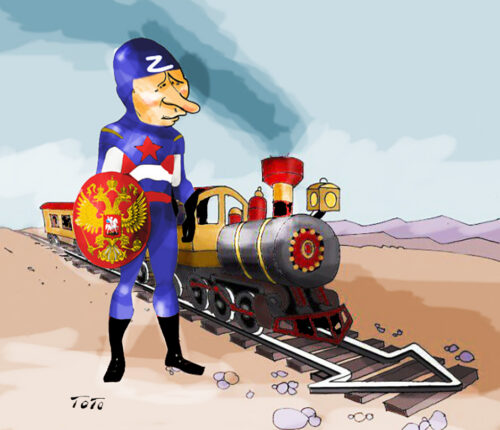
Today Russia has changed its strategy, and the impression is that the trust Moscow once placed in Pashinyan has taken on a different character. Moscow seeks new strategies to maintain its influence in the South Caucasus. One of its new initiatives and political moves is a project for railway and road links along the Black Sea coast connecting Russia, Georgia, and Armenia, which reportedly has been presented by Moscow. Provisionally dubbed “Putin’s Route,” the proposal has become a subject of extensive public discussion in expert circles in recent days.
Although it has not been officially announced, the public discussion is most likely a way to test the reactions of Armenia and Georgia. What is particularly interesting is that Russia is not taking this step by accident. Moscow is well aware of Pashinyan’s Crossroads of Peace initiative, and through this new proposal, it appears to be seeking a clear response from the Armenian authorities.
If Yerevan rejects Moscow’s proposal on this route, this could suggest that, from Yerevan’s perspective, the Crossroads of Peace applies only to the normalization of relations with Armenia’s direct neighbors and it would help the West to gain influence in Armenia to balance Russia. If Yerevan does not reject it, Moscow would gain an opportunity to intensify its political engagement in the South Caucasus, using this economic initiative as a basis, just like in the case of the Trump Route for International Peace and Prosperity (TRIPP).
This is a carefully calculated move that could provide answers to several important questions. It cannot be ruled out that Pashinyan and Russian President Vladimir Putin will discuss the matter at their next meeting. For Russia, whose position in the South Caucasus has weakened, every available opportunity must be used to restore its influence in what Moscow considers its traditional sphere of influence, while simultaneously counterbalancing Turkish and American influence.