

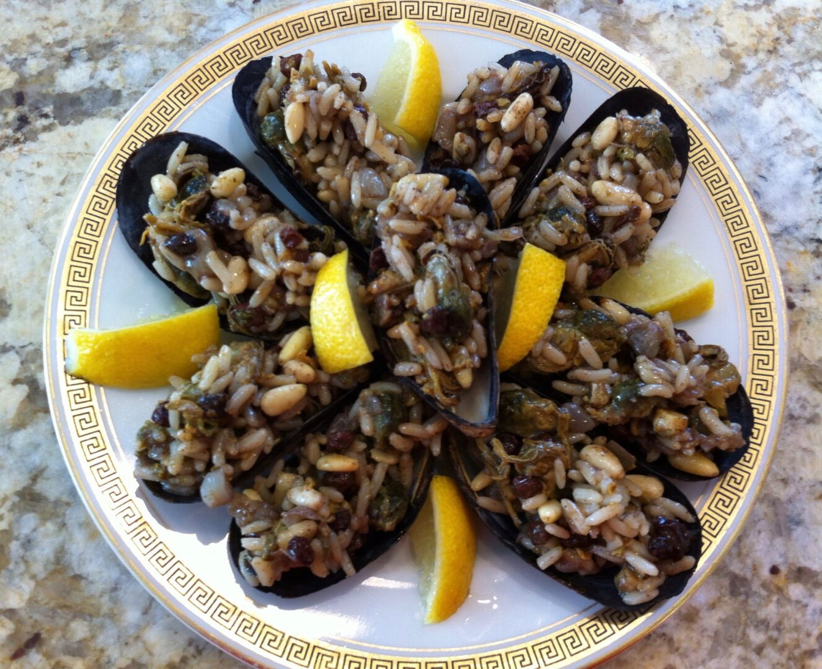
Janice Dzovinar Okoomian’s Great-Grandmother Khosrofouhi’s Midia (Mussels) Pilav

Janice Dzovinar Okoomian’s Great-Grandmother Khosrofouhi’s Midia (Mussels) Pilav

6
0

PROVIDENCE, RI — “This photo is of my great-grandparents, Mgrdeech and Khosrofouhi Mardirosian with my grandmother, Goldie, in Everett, Massachusetts in the 1920s,” says Janice Dzovinar Okoomian, Ph.D., Associate Professor of English and Gender & Women’s Studies at Rhode Island College in Providence, Rhode Island, as she is pointing to a picture.

“My grandmother, Voski Takouhi Victoria Nakashian (neé Mardirosian), was named after Queen Victoria of England, whom her beloved mother, Khosrofouhi Arzoumanian admired. ‘Golden Queen Victoria’ is the translation of her name; she was known as Goldie, says Janice.
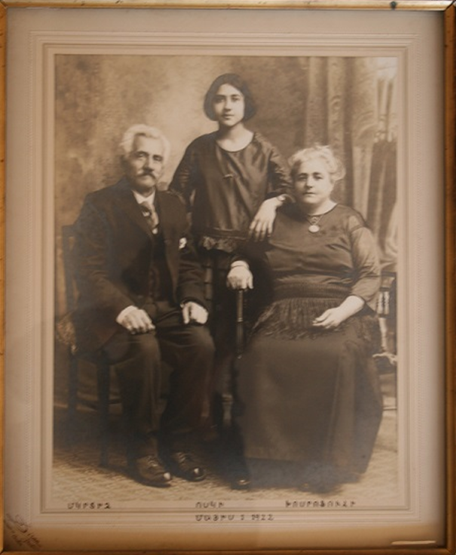
Mgrdeech and Khosrofouhi Mardirosian

“I learned to cook at my grandmother’s (Goldie’s) elbow. We collected many rose petals from her garden and made rose syrup; she taught me to make ‘shekher lokhom’ (kourabia), paklava, and many other Armenian delights. My grandfather Ludwig was creative and inventive; he often made the family’s madzoon on the steam radiator in their kitchen, and we always put his madzoon on our pilav. When I cooked with my grandmother, she would measure her ingredients by eye and feel,” adds Janice.

Goldie was born in 1907 in Everett,, where she lived for her entire life. “Her mother, Khosrofouhi, was the niece of Bishop Drtad Balian, the Bishop of Gesarya. Her father Mgrdeech was from Kharpert. He was a cooper (a barrel maker) and performed with a touring wrestling team in the United States. Khosrofouhi believed in education for women, so she sent my grandmother Goldie to college, where she completed one year of study. Goldie later married Ludwig Nakashian in 1926, and they had two children, Phyllis (Janice’s mother), and Martin,” says Janice.

“Goldie was also an amateur oil painter and poet. I have many of her seascapes hanging in my house, and some of her poetry was published in magazines. She also developed a hobby of entering contests, and she got very good at winning them. On the way home from the hospital after the birth of her son, in 1931, she stopped by an airfield and won the prize for the youngest baby. The prize was a ride in an airplane. My childhood home was full of transistor radios, kitchen appliances, skateboards, and other objects that my grandmother had won in contests. Often, Goldie would have to write a jingle or poem for the contest.  She also adapted her Armenian recipes for an American context. In the 1960s, when Jell-O ran a contest for recipes using Jell-O, Goldie was one of the winners, with a recipe she called ‘Mediterranean Jell-O Delight,’ which was basically a Jell-O mold version of jajek – madzoon, cucumbers, and mint.”

The Armenian Museum of America in Watertown features Goldie’s Koulenje recipe from Gesaria (Kayseri) on its website. Koulenje is an Armenian quickbread which originated in the region of Gesaria in Armenia. Janice contributed the recipe to the museum in honor of her grandmother.
Get the Mirror in your inbox:

Khosrofouhi’s Midia (Mussels) Pilav

Midia Pilaf, photo courtesy The Armenian Kitchen

“This is my great grandmother Khosrofouhi’s Midia (Mussels) Pilav. It is a delicious appetizer or mezze dish that our family always enjoyed. Khosrofouhi was born near Gesarya but the family relocated to Smyrna, so she spent much of her youth living on the coast of the Mediterranean, where seafood was plentiful. When she came to Boston she continued to love the water and to be by the ocean. My mother Phyllis remembered going to Revere Beach with her grandmother Khosrofouhi, in the early 1930s when my mother was quite small. Khosrofouhi would pack sardines for lunch and they would ride the bus to go to the beach.”

Ingredients:

2 lbs. mussels in the shell

2 1/2 pounds (about 5 cups) chopped onions

1/2 cup olive oil (Greek is best)

1 cup long-grain white rice (basmati is best) OR medium grind (#2) bulgur

1/2 cup pine nuts

1/2 cup currants

1/2 teaspoon salt

1/4 teaspoon black pepper

1/2 teaspoon allspice

1/2 teaspoon cinnamon

1/4 teaspoon paprika

1/4 teaspoon dill weed

1/4 cup chopped parsley

1/2 cup tomato sauce

1 1/2 cup water

Juice of 1/2 lemon, more to taste

Lemon wedges for garnish

Preparation:

Put the mussels in a bath of cold water. Discard any mussels that are open or cracked. Scrub the remaining mussels, removing any visible beard fibers. Put them in a clean bowl with fresh cold water until you are ready to use them.

Sauté the onions in olive oil until transparent. Add all other ingredients. Cover, and simmer on low for 20-30 minutes. Discard any mussel shells that did not open during cooking.

Chill the pilav. To serve, stuff each mussel shell with some pilav and arrange on a plate. Garnish with lemon wedges.

Also see: https://thearmeniankitchen.com/nobody-can-out-mussel-armenians/ 

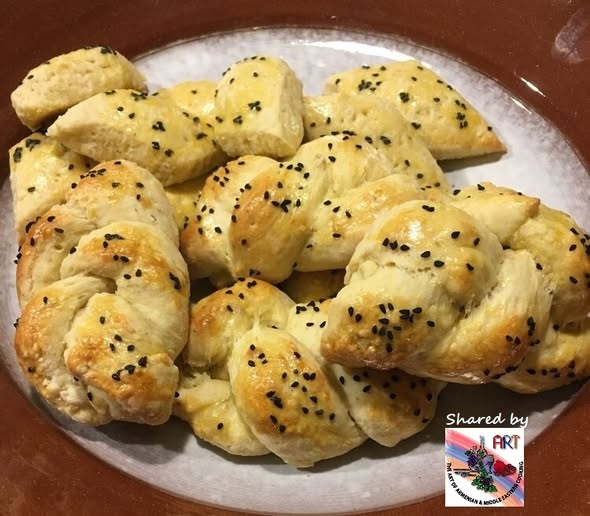
Goldie Nakashian’s Koulenje from Gesaria

Goldie Nakashian’s Koulenje from Gesaria


“This is an Armenian quick bread which originated in the region of Gesaria in Armenia. Koulenje is not well known among Armenians in the United States — most Armenians are more familiar with choreg, which is a similar bread but made with yeast instead of baking powder. The seeds on the koulenje we called ‘sev dzandig,’ which translates literally to ‘little black seeds.’ This is the Western Armenian term for nigella seeds (also called black cumin or black caraway seeds). My grandmother measured ingredients by eye and feel; this version approximates her amounts,” says Janice.

Ingredients:

All ingredients for this recipe should be at room temperature.

6 1/2 cups flour, or a little more

6 large eggs

6-7 heaping teaspoons baking powder

1 cup melted butter

1 tablespoon salt

1 to 1-1/3 cups milk

1 cup sugar

1 tablespoon ground mahleb

1 tablespoon sev dzandig (black seeds), if using

Glaze:

1 egg

About 1 additional tablespoon black seeds

Preparation:

Sift flour, baking powder, salt, and sugar together. In a separate bowl, beat 6 eggs, then blend in the butter and milk.

Sprinkle one tablespoon of black seeds and all the mahleb on top of the dry ingredients. Make a hole in the center of the dry ingredients and pour the wet ingredients in all at once, mixing with a few strokes until the dough can be turned out onto a floured board. Add more flour if necessary; it shouldn’t be too sticky.

Knead the mixture gently, just a few times, and then roll it out until it is 1/2-inch thick. Cut it into diamond shapes, circles, or long strips which can be rolled and braided into loaves. Prick each piece several times with a fork.

Glaze: Beat the egg with additional black seeds. Brush each piece of koulenje with this glaze and place on cookie sheet covered with baking parchment.

Bake at 400°F for 12-15 minutes until slightly golden. Cool on a rack. These are best eaten warm. You can reheat them by wrapping in foil.

To read more about the important role that choreg has played in Armenian cuisine, tradition, and identity, please visit: https://www.diningindiaspora.com/food/2018/3/30/choreg-for-armenian-americans-identity-is-braided-into-this-bread

For this recipe, go to: https://www.armenianmuseum.org/armenian-recipes/koulenje-from-gesaria

This recipe is also featured at: https://www.facebook.com/armenianandmiddleeasterncooking/posts/%EF%B8%8F-armenian-koulenje-from-gesaria-%EF%B8%8Fthis-is-an-armenian-quickbread-which-originate/1426417932853232/

Dr. Okoomian’s recent publications include an article about the connections between masculinity, nationalism, and militarism the novel Orhan’s Inheritance; an article about feminist activism in the Republic of Armenia, based on oral history interviews she conducted in summer 2019; and an article about an Armenian feminist group in the United States. She specializes in intersectional feminist theory, gender in the U.S. culture, and Armenian and American diaspora feminism.

For more information, go to: https://www.ric.edu/people-directory/janice-okoomian


Get the Mirror-Spectator Weekly in your inbox: