

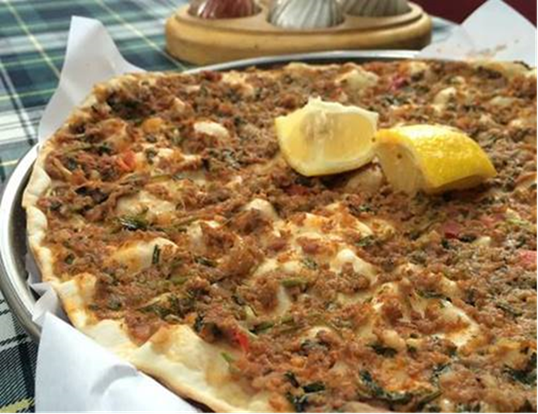
Lahmacun served at Mer Taghe in Yerevan, Armenia. Photo Benjamin Kemper

Simply Armenian: Barbara Ghazarian’s Lahmejun

623
0

“’No one knows for certain whether lahmacun’s roots lie in Armenia, Turkey, or elsewhere in the Middle East. The race to find where these ancient foods originated is not fruitful territory,’ cautioned Naomi Duguid, author of Taste of Persia: A Cook’s Travels Through Armenia, Azerbaijan, Georgia, Iran, and Kurdistan. After all, meat-enhanced flatbreads are ubiquitous throughout the region (we’re looking at you, Georgian kubdari and Turkish kiymali pide).”

“George Mardikian, the beloved restaurateur, chef, philanthropist, and author of Dinner at Omar Khayyam’s and Song of America, wrote that lahmacun (spellings vary) was first prepared by the wives of wealthy traders along the Silk Road who cooked the dish over open flames in roadside inns or caravanserais. A far cry from today’s low-budget lahmacun culture, he claims the dish was historically a ‘food of the elite,’ since it called for meat, a luxury the poor couldn’t frequently afford.” Greg Keraghosian at SFGATE says, “Mardikian’s Omar Khayyam’s — an Armenian restaurant with elegant Middle Eastern decor named after an epicurean Persian poet — was destination dining for San Franciscans for more than 40 years at its underground location near the corner of Powell and O’Farrell streets. Celebrities and professionals paid upscale prices while armed service members and refugees ate for free. Its shish kebab and bulgur pilaf were the main draw for a largely white clientele unfamiliar with such food. But the restaurant drew its life force from, as William Saroyan called him, ‘the big man with the bright face coming over to your table.’”

According to chef, food writer, and author Barbara Ghazarian, who wrote Simply Armenian, an indispensable Armenian cookbook, the meat used in this dish goes a long way. One pound of lamb, she explained, makes 12 lahmejun, enough to “feed a small army, Armenian or otherwise.”  That small army is quickly becoming an ever-growing horde of international lahmejun fans. “Lahmejun is a story of culinary assimilation,” Ghazarian said, “of how one simple dish invented in or around Armenia has won over diners around the globe, from Yerevan to Beirut, to Los Angeles and Fresno, to Paterson, New Jersey.”
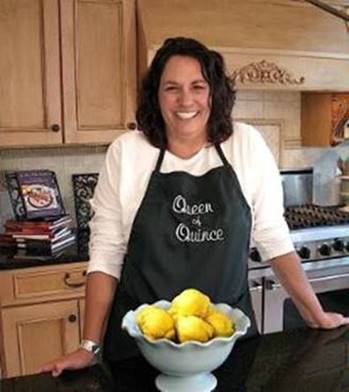
Barbara Ghazarian

Here is Ghazarian’s fail-safe recipe from Simply Armenian:


Dough:
Get the Mirror in your inbox:

1 package (1/4 ounce) active dry yeast

1 cup warm water (about 105 degrees)

1 tablespoon olive oil, plus additional for greasing bowl and baking sheets

1/2 teaspoon sugar

1/4 teaspoon salt

2 1/4 cups white bread flour, plus additional for rolling


Topping:

1 pound ground lamb

1 can (14 1/2 ounces) tomatoes, peeled, diced, and drained well

2 tablespoons tomato paste

1/2 red bell pepper, finely chopped

1/2 green bell pepper, finely chopped

1/2 onion, finely chopped

1/3 cup finely chopped fresh flat-leaf parsley

1 teaspoon salt (to taste)

1/2 teaspoon ground black pepper

1/4 teaspoon crushed red pepper flakes

Pinch of cayenne (optional)

Fresh lemon juice


Special Equipment:


Tabletop mixer with dough hook (optional)

Food processor or blender

Heavy rolling pin


Preparation:

To prepare the dough, dissolve the yeast in water in the bowl of the tabletop mixer. Stir in the 1 tablespoon olive oil, sugar, salt, and 1 1/2 cups flour. Mix the dough with a dough hook until smooth, about 3 minutes.

Knead in the remaining flour until the dough is smooth and elastic. This will take about 10 minutes by machine, 20 minutes by hand. Shape the dough into a ball and place in a large bowl greased with olive oil. Turn the ball once to coat it completely with oil. Cover with a clean kitchen towel and let stand in a warm place for about 1 1/2 hours, or until doubled in size.

While waiting for the dough to rise, combine all the topping ingredients together in the bowl of a food processor (or blender) and pulse until just smooth. Set aside. When the dough has doubled in size, turn it out onto a floured work surface and punch it down. Knead the dough into the shape of a log. Cut the log into 12 equal pieces. Then roll each piece out into a 7-inch circle.

Preheat the oven to 375°F. Lightly grease 2 to 4 baking sheets with olive oil. Arrange the circles on the prepared baking sheets. Allow the dough to rest and rise slightly, about 15 minutes. Then, spread the meat mixture evenly over the entire surface of each round. Bake in the middle of the oven for 25 to 30 minutes. Cool the pizzas on a wire rack. Serve warm with a splash of fresh lemon juice for a quick lunch or snack.

Simply Armenian: Naturally Healthy Ethnic Cooking Made Easy in its 6th printing (Mayreni Publishing), with over 16,000 copies sold. Barbara Ghazarian is passionate about sharing her Armenian ancestry with others. She draws on personal history and her ancestors’ culinary traditions to present a basic, solid overview of Armenian cuisine. The author, who is half Armenian and is married to an Armenian man, presents a number of recipes that will be familiar to lovers of Greek, Turkish and other Middle Eastern foods, such as Parsley Salad (Tabouli), Rice-Stuffed Grape Leaves, Lamb Shish-Kebab, Rice Pilaf, and Eggplant with Tahini (Baba Ghanoush). Armenian cuisine, she explains, relies heavily on bulgur (cracked wheat) and lentils, as well as vegetables (especially eggplant) and flatbread, and while this is not a vegetarian cookbook, many dishes are meat-free (when Ghazarian does include meat, it’s often lamb). Written for the novice and spiked with yarns about Ghazarian’s childhood and family traditions, this book should make Armenian cooking accessible to any home cook. Helpful notes and introductions accompany each recipe, explaining foods that may be unfamiliar to American cooks, such as quince, baharat spice and purslane.

In 2009, with the publication of Simply Quince (Mayreni Publishing), she became known as the Queen of Quince. The bounty of quince recipes in the collection are widely credited as establishing the base line for cooking with the near-forgotten fruit in the U.S. and around the globe.

To order Simply Armenian, go to: https://www.armenianvendorstore.com/category-s/52.htm

Or contact:

Baykar “Ed” Dervishian

211 Fountain St.

Framingham, MA 01702

Phone: (508) 667-2980

Email: baykar@armenianvendor.com

(Armenian Vendor is both the wholesaler and retailer of the book.)

Simply Quince can be purchased on Amazon Marketplace, Armenian Vendor, and Abril Bookstore in Glendale.

Go to: https://www.amazon.com/Simply-Quince-Barbara-Ghazarian/dp/1931834318/ref=pd_vtp_h_vft_none_pd_vtp_h_vft_none_sccl_1/138-2976284-9769635?pd_rd_w=N1wr0&content-id=amzn1.sym.a5610dee-0db9-4ad9-a7a9-14285a430f83&pf_rd_p=a5610dee-0db9-4ad9-a7a9-14285a430f83&pf_rd_r=PCCV1DTT9JC9GH239NEF&pd_rd_wg=N5LL5&pd_rd_r=42f741c3-202e-45e0-a144-c6e1c4c9648c&pd_rd_i=1931834318&psc=1


Also order at: http://www.abrilbooks.com/books/cookbooks.html

This recipe is featured at:

https://www.facebook.com/284103605793/posts/10156705430530794/

https://www.facebook.com/armenianandmiddleeasterncooking/photos/a.301637150793/10158966360040794/?type=3

https://www.smithsonianmag.com/travel/armenian-pizza-comfort-food-you-didnt-know-you-were-missing-recipe-180967676/

Connect at:

https://www.facebook.com/simplyarmenian/

https://www.facebook.com/QueenOfQuince/

References:

https://mirrorspectator.com/2020/01/02/recipe-corner-candied-quince/

https://thearmeniankitchen.com/tag/lahmajoun/

https://thearmeniankitchen.com/hungry-for-lahmajoun-take-shortcut/

https://www.momsnotes.me/recipe/armenian-lahmajun

https://www.npr.org/2009/11/11/120288799/demystifying-the-quince

https://www.smithsonianmag.com/travel/tastes-memory-lavash-and-armenian-identity-180958673/


For more articles about Armenian food, culture, and history at Smithsonian Magazine, go to: https://www.smithsonianmag.com/search/


Get the Mirror-Spectator Weekly in your inbox: