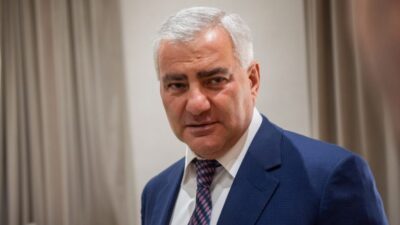


Noubar Afeyan, Anthony Barsamian, Lord Ara Darzi of Denham, Eric Esrailian, Vahe Gabrache, Vatche Manoukian, Joseph Oughourlian, and Berge Setrakian, all descendants of Armenian Genocide survivers and members of the global Armenian Church, issued the following statement concerning the current conflict between the Armenian government and the Armenian Apostolic Church.
Armenians are one of the oldest peoples in the world, historically inhabiting our ancestral lands in the South Caucasus. We also practice one of the oldest Christian denominations in the world, dating to A.D. 301 when Armenia became the first state to adopt Christianity as its national religion. Since then, a vast majority – today nearly 97% – of Armenians are members of the Armenian Apostolic Church.
At the fall of the Ottoman Empire, Armenians were driven from our native lands and slaughtered in a horrific genocide. Those who were not massacred were forced to flee, collectively becoming the Armenian diaspora. As Armenians scattered throughout the world, we turned to our Church as a source of comfort and connection to our homeland. Wherever we lived, Armenian communities became known for building churches and schools to preserve the faith and ethnic heritage that our persecutors had tried to stamp out.
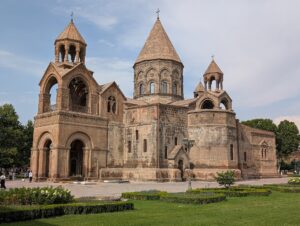
Later, when the Soviet Union fell and a new independent Republic of Armenia began to emerge, the diaspora provided substantial support for the Church to resuscitate itself after decades of Soviet oppression. Today, Armenian Apostolic churches throughout the world – including the Catholicosate of the Great House of Cilicia in Lebanon and Patriarchates in Jerusalem and Constantinople – are interconnected, united, and recognize His Holiness Karekin II as the global leader of the church, based in Armenia at the Mother See of Echmiadzin. An estimated 3 million Armenians live within the Republic of Armenia while the vast majority of the estimated 10 million Armenians live in the diaspora, with over one million living in the US.
Recently, persistent political discord in Armenia – including increasing conflict between leaders of the Armenian Government and the Armenian Apostolic Church – has reached a boiling point with government-led demands to oust the leader of the Church, despite his due election by the regulations of the Supreme Ecclesiastical Assembly. Several Archbishops have been imprisoned while accused of making political statements, and a prominent Russian-Armenian philanthropist and businessman has been imprisoned for publicly stating support for the church’s position.
Persistent attacks on the Church leadership, and the threatened forcible or mandated removal of its leader, pose direct threats to all Armenians around the world who rely on the Church for spiritual sustenance.