

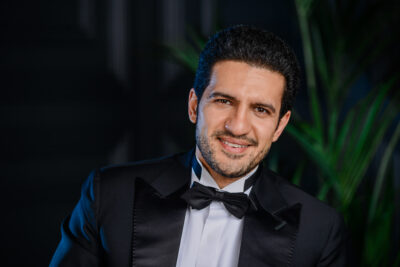
Khachatur Badalyan

Khachatur Badalyan: The Armenian Voice of Russian Opera

286
0

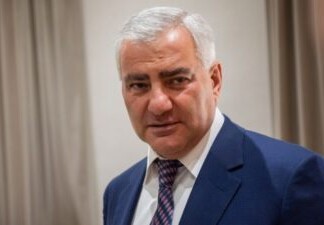
YEREVAN/MOSCOW — Khachatur Badalyan (born 1982, Ordzhonikidze, currently – Vladikavkaz) is a Russian operatic tenor and a soloist of the Novaya Opera Theatre in Moscow (since 2007, with a break) and the Mariinsky Theatre (since 2012). Born into a family of academics, he moved to Rostov-on-Don in 1996, initially studying economics before turning to music and enrolling at the Rostov State Conservatory. He also attended master classes with leading international opera singers.

From 2004 to 2006, Badalyan was a soloist of the Rostov Regional Philharmonic. He has performed at major Russian stages, including the Bolshoi Theatre, where he sang Rodolfo (La Bohème) and Vaudémont (Iolanta).

Badalyan is a laureate of the Luciano Pavarotti International Tenor Competition in Saint Petersburg (2008) and the winner of the Galina Vishnevskaya International Opera Competition in Moscow (2010). His international appearances include the Puccini Festival in Torre del Lago (2017), where he performed Alfredo in La Traviata. His repertoire features leading tenor roles such as Rodolfo, Alfredo, Don José (Carmen), Faust, Foresto (Attila), Charles VII (The Maid of Orleans), and Vladimir Igorevich (Prince Igor).

Dear Khachatur, in 2013, a critic wrote about you that you were more of a chamber singer than an opera singer. Perhaps he was strongly influenced by your performance at the Luciano Pavarotti Tenor Competition, where you received a special prize for the best performance of Neapolitan songs. However, you have successfully established yourself in opera. How do you respond to such an opinion?

Criticism is always very subjective. My opera debut was in the role of Lohengrin in Wagner’s opera of the same name, at the age of 25. I have performed many other opera roles on the world’s largest opera stages. A singer’s voice is always developing. With age, the voice becomes bigger and stronger. I would even say that I regret having so few chamber works in my repertoire, because I am more often invited to perform large-scale works.

What role does knowledge of languages play for a classical singer?
Get the Mirror in your inbox:

Knowledge of languages is very important for opera singers. I speak English and Italian fluently, and French a little less well. For opera, Italian is the most suitable language. It has bright, clear, and close vowels, which are important for singing in order not to strain the voice. These vowels give the singer the most vivid and beautiful timbre. Consonants in Italian are soft, and the correct combination of vowels and consonants creates the Italian legato — this is exactly the smooth, connected sound of the voice. Next, I would place French. It has nasal vowels that you need to learn to sing. German is more difficult for singing; German legato is different from the classical Italian school. In German, consonants play a very important role. I would say this is a higher level of vocal mastery: when you already know how to sing vowels, you can maintain legato even through hard consonants. Russian vowels are deeper. But since I have spoken Russian since childhood, of course, it comes naturally to me.

Apart from the classical repertoire, you have also performed in contemporary opera productions. How close do you feel to contemporary opera — is it a matter of artistic interest or more of a professional necessity?

Yes, I have participated in many contemporary productions, and probably even more than classical ones nowadays. I think this is because audiences are accustomed to cinema, the internet is full of interesting content, and AI is everywhere. A traditional classical production can only attract audiences in very wealthy theaters that can afford elaborate, colorful stagings with embroidered costumes, huge expensive sets, and world-class singers. Less wealthy theaters often appeal to audiences by creating contemporary, unusual productions that bring something new. For me personally, the most important thing is that everything is suitable for singing, that nothing is vulgar or obscene, and that the production does not contradict the opera’s story or the composer’s intention.

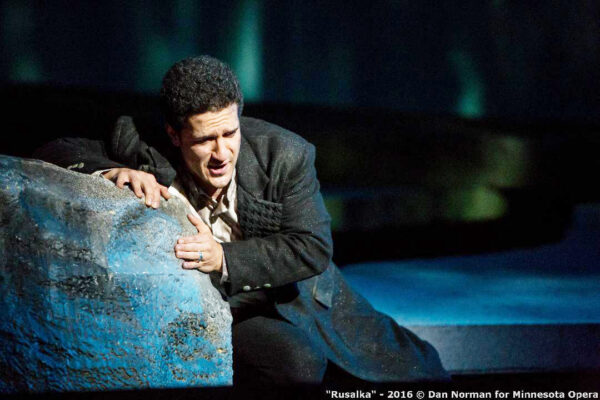
Khachatur Badalyan as Prince in Rusalka

Many years ago, when I sang tenor in a chamber choir myself, I often heard jokes about tenors. How do you feel about them? And if positively, could you share one?

There’s a stereotype that for tenors nothing is more important than their own voice, and that tenors are often not very bright. I think this comes from the fact that singing as a tenor is harder than other voice types. Tenors always have very challenging parts, usually the lead roles. There are many high notes and a lot of responsibility. From my experience, the most technically skilled singers are usually tenors, because if you succeed as a tenor, you’ve mastered the subtleties of vocal technique.

Here’s a joke I remember: In an Italian village, a boy was born who, instead of crying, immediately began to draw out a single word—“una… uuuuna.” His parents took him to the local doctor, asking him to remove part of his brain, as such an “intellectual” was not needed in a simple village family. After the operation, the boy woke up and again began to draw out “una… uuuuna.” The doctor removed a little more brain tissue, leaving only a small piece. The whole village gathered to see what would happen. The boy woke up, looked around, started “Una… uuuuna” again—and suddenly sang “Una furtiva lagrima” (we laugh). By the way, orchestra players have just as many jokes about violists!

Topics: opera

Khachatur, you always seem to be in excellent physical shape, even though tenors are often stereotyped as chubby. How important is physical fitness for a classical singer?

Physical fitness is very important for opera singers. Singing on stage involves a lot of movement. Sometimes you have to sing right after running, or even carry your partner in your arms while maintaining proper breathing. I practiced Taekwondo and Aikido for many years, then bodybuilding, and now I enjoy boxing. The main thing for vocalists is not to overstrain the abdominal muscles, but in general, sport is always beneficial.

Was it difficult for a young singer with a non-Russian name and surname to establish himself in the Russian capital?

I did not face such problems. In Russia, Armenians are loved and respected. There is a very large Armenian community in Russia. Armenians have always been known as a talented and hardworking people. Since the late 18th century, Empress Catherine II encouraged the resettlement of Armenians to the south of the Russian Empire to develop crafts. Armenians founded the city of Nor Nakhichevan (now part of Rostov-on-Don) and several other villages. As for musicians, one can recall the talented Lisitsian family, as well as my dear colleagues of international fame such as Kristina Mkhitaryan, Anna Aglatova, and others.

Do you include Armenian songs in your chamber repertoire?

When I lived and studied in Rostov-on-Don, I sang small cycles of Komitas’ works. I love his music very much and try to include some pieces in my solo concerts.

In North Ossetia there has long been a significant Armenian community. How long has your family lived there, and do you preserve Armenian traditions?

My grandfather Khachatur Badalyan was originally from the village of Gemur in the Shahbuz district of the Azerbaijan SSR. After the end of the Great Patriotic War (World War II), he studied in Moscow at the Frunze Academy and rose to the rank of colonel. Later, after serving in Germany, he moved with his family to the city of Ordzhonikidze (now Vladikavkaz), where my parents met. My mother’s family had already been living there for many years. Even today, many relatives still live there. Armenian traditions are always preserved. I was baptized in the Armenian Church in Vladikavkaz. All Armenian holidays and celebrations are always observed.

Do you feel (or do others notice) Armenian temperament in your singing?

Of course. My temperament helps me in roles like José in Carmen or Turiddu in Cavalleria Rusticana, among others. But it’s also important to control yourself and not get carried away, in order to keep a clear mind and protect your voice.

If I’m not mistaken, you performed in Yerevan last year.

Yes, I have been fortunate to perform in Yerevan almost every year. It began with the anniversary of the great Armenian tenor Gegham Grigoryan, where I was invited to sing. Since then, I have performed many operas there, including La Traviata, several productions of Carmen, and Turandot. I am always happy to visit my historical homeland, and I especially love sunny Yerevan.

In conclusion, I would add that music is the best diplomat. Despite political conflicts, musicians have always been and will always be a connecting link for the world. Unfortunately, in recent years, Russian singers—including those of Armenian descent—have found it harder to perform abroad due to sanctions. I sincerely hope this will improve soon. I know this interview will also be published in the United States, where I had the pleasure of performing the role of the Prince in Rusalka by Dvořák in Minnesota. Wherever I perform in the world, it is always a great joy when Armenians in the audience come to congratulate me after the performance.

Thank you for your answers, Khachatur, and we hope to see you again on the Yerevan stage!


Get the Mirror-Spectator Weekly in your inbox: