

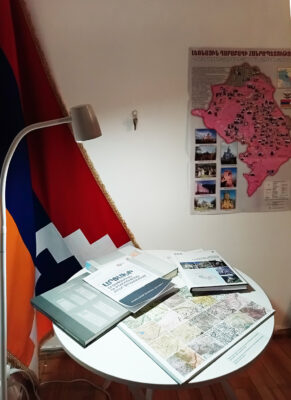
The banner of the Artsakh Republic, keys from the National Parliament building, and other objects at the 'Mapping Loss' exhibition in ACCEA

From European Culture Capital Chemnitz to Yerevan’s Forum of Armenian Art and Culture

186
0

By Archi Galentz

In the beginning was the word. More precisely, it was a call to gather experiences after the group exhibition in honor of film director Sergei Parajanov at the Berlin project space InteriorDAsein. A call to join forces to organize a new group exhibition based on selected artists’ positions and presenting the breadth of Armenian artists working in Germany.

The exhibition marking the 100th birthday of the noted film director (from November 29, 2024, to January 9, 2025) was new in many ways. Initiated by the Armenian Cultural Community of Leipzig e. V., a proper traveling exhibition was put together with three stops in Leipzig, Halle an der Saale and Berlin. Participation was open to everyone. Many artists who had lived in Germany for decades met each other for the first time. Efforts were made to compile a list of biographical information and there were even promises to set up a website so that the relevant information could be found later. Not all participants could afford to travel to the exhibitions.

For outsiders, the exhibition was a colorful festival; for us artists, it was a risk. The exhibition was first opened in Leipzig with 25 participants in a studio called Eduart Auftragsmalerei (Eduart Commissioned Painting), as Eduard Panosian calls his workshop. The exhibition then continued under the auspices of Ararat Kultur Halle-Hoffe Saale e. V. and opened on November 29, 2024, at the InteriorDAsein project space in Berlin.

‘On the Occasion of the 100th Birthday of Sergei Parajanov’ 29.11.2024 – 09.01.2025, Project Space InteriorDAsein, Berlin

Subsequently, two of the participants in the traveling exhibition honoring Parajanov came up with another exhibition project. Since Chemnitz had been named European Capital of Culture for 2025 and Zorik Davidyan was able to quickly organize a floor of his family home as an exhibition space, Ararat Haydeyan contacted fellow artists and, after brief discussions, the exhibition concept was finalized.

“Sichtbar Verflochten – Armenische Kunst im Dialog der Kulturen. Sieben in Deutschland lebende Künstler:innen stellen aus” (Visibly Intertwined – Armenian Art in Cultural Dialogue. Seven Artists Living in Germany Exhibit) opened on September 13 at Davidyan’s Studio on Reichsstrasse 21  and was scheduled to remain open to the public for three months. Karine Abel, Zorik Davidyan, Archi Galentz, Sam Grigorian, Ararat Haydeyan, and Hasmik Hovsepyan-Haydeyan — three female artists and four male artists all hailing from Armenia — share the walls of the studio, which was previously also used as office space. The project is curated by the artists themselves. Some, like Zorik, moved to Germany before the fall of communism, while others came later. Narine Zolyan only moved to Quedlinburg in 2012. It is an exhibition of experienced artists. All of them are well integrated into society and have established themselves as independent artists. This project is a further step toward presenting Armenian visual art in Germany on a more regular basis and remaining in creative exchange.

Roksana Vikaluk gave a lecture during the exhibition

Get the Mirror in your inbox:

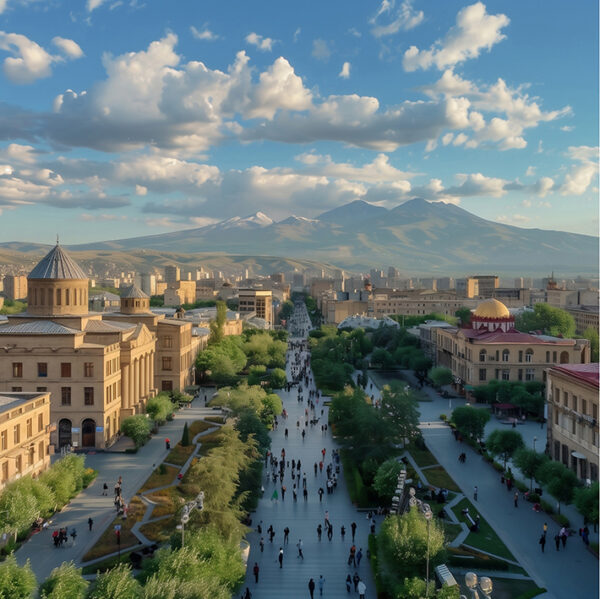
The exhibition participants engage with Armenian art in different ways. On display are photographs, watercolors, oil paintings, and works on paper. The structured wall objects by Ararat Haydeyan, who has also made a name for himself as an architect, correspond in the first room with Narine Zolyan’s figurative paintings full of social tensions. Next to them are abstract works on paper by Sam Grigoryan, which, as décollages, address the creative process itself. In another room, Zorik Davidyan and Archi Galentz deal with realism and figuration between myth-making and expressionism. In another cabinet room, Karine Abel’s photographs, reminiscent of documentary films of the 1960s, are on display, as well as Hasmik Hovsepyan-Haydeyan’s delicate watercolors with floral motifs, which, even though restrained in their appearance, possess allegorical depth. A small room with catalogs, small formats, and limited edition prints, rounds off the exhibition. There you will also find my provocative, AI-assisted cityscape of Yerevan as a (nightmare) dream. An oriental city under peaceful blue skies in a multicultural, car-free existence. The small picture sparked heated discussions and was considered too horrific by some of my colleagues.

The exhibition has turned out to be colorful and controversial — provocative rather than pleasing, and refusing to cater to any clichés. The best proof of the genuine interest of the visitors at the opening was the large number of children who not only discussed the pictures, listened to the opening speeches, and enjoyed the accompanying musical program, but also completely forgot about playing on their cell phones. Special thanks go to the family of Zorik Davidyan, who supported us at the opening, and to pianist Narine Mardoyan, who improvised on well-known melodies throughout the opening.

The opening on September 13 was very well attended. Guests traveled from all over Germany to be there. We were particularly delighted by the presence of former German ambassador to Armenia Hans-Jochen Schmidt, who traveled to Chemnitz especially for the opening. The local media were present, and the media portal Freie Presse found a fitting headline for its article: “Chemnitz 2025: When culture reaches from Europe to Armenia.”

Guests at the opening of the group exhibition on 13 September. Front: the former German ambassador to Armenia, Mr Schmidt

The only downside for us was the complete lack of interest from the Armenian embassy. Although we sent a personalized invitation, we received no response.

Perhaps the wording in the press release focused too much on the harsh reality. For example, it stated: “Armenia is an ancient cultural region in the Caucasus that has always had to fight for its survival. For over a thousand years, it was divided between Persia, the Ottoman Empire, and, since the beginning of the 19th century, expanding Russia. However, the identity of the Armenians has remained intact thanks to their own Christian church and their ancient Indo-European language and culture. Today, Armenia is an independent state that is once again plagued by war, and fear for its continued existence. It is quite possible that life in the diaspora and culture in general will become the most important cornerstones of survival as a separate nation … An exhibition in this year’s European Capital of Culture is a sign of the Armenians living in Germany’s commitment to openness and inclusion in the artistic process, as well as their attachment to their own national tradition, which has always been characterized by tolerance and curiosity towards global developments.”

On our return from Chemnitz, to our surprise we received an invitation to the Armenian Culture Forum in Yerevan.

The objectives of the forum were stated as follows:

– Promoting mutual recognition and cooperation between artists from Armenia and the diaspora,

– Supporting inclusion in the development and implementation of Armenian cultural policy, involving diaspora experts where appropriate,

– Promoting cultural diplomacy as an important component of Armenia’s “soft power.”

Another insight into an exhibition by artists from Artsakh

On November 20 and 21, people active in the cultural sector from the Armenian diaspora, as well as numerous prominent figures from Armenia, gathered in the Arno Babajanyan Concert Hall in Yerevan. According to some forum participants, this was the first event of this magnitude ever. The two-story building with a converted basement, where events were also held, impressed with its modern renovation work, which left the impressive stained-glass windows with Soviet symbolism, designed by Martiros Saryan, in full effect.

The forum was organized by the Office of the High Commissioner for Diaspora Affairs, an agency that has replaced the former Ministry of Diaspora Affairs, and the little-known International Coordinating Council for Armenian Culture and Arts. The organizers welcomed each participant with a bag containing a pin in a fine gift box and an A5 booklet with the program and key information in four languages: Armenian, English, French and Russian.

High Commissioner Zareh Sinanyan gave the welcoming speech at the opening of the event, emphasizing the role of the Armenian diaspora in promoting awareness of our nation around the world and stressing the importance of preserving our identity. He was followed by the Minister of Education, Science, Culture, and Sports Zhanna Andreasyan. She pointed out the newly upholstered seating and the new grand piano in the concert hall, as well as the new elevators in the National Gallery.

The forum itself was divided into three discussion panels and several seminars, which unfortunately took place simultaneously. The 250 participants from 35 countries could choose between literature, performing arts, as well as visual arts: listening to the writers, attending master classes in music or acting, or enjoying the visual artists’ debate on taste and talent and fueling it with their own questions. There was an exhibition of new publications, which were probably brought along by the writing forum participants themselves, as well as a film screening. The feature film was about the expulsion from Nagorno-Karabakh and was one of the few mentions of this historical loss. Unfortunately, the name of the film and the filmmaker could not be determined and is no longer traceable today.

It is not possible to describe individual discussion panels in detail in one article. The easiest way would be to refer to the event website, where participants, events, and video recordings can be found. Unfortunately, no such website exists. Even the co-organizer of the forum, the “International Coordinating Council for Armenian Culture,” which wanted to register all cultural figures of Armenian origin online, does not provide a web address in the forum’s accompanying booklet or on its own business card.

Artists at the exhibition opening: Narine Zolyan, Zorik Davidyan, Hasmik Hovsepyan-Haydeyan, Ararat Haydeyan, Sam Grigoryan and Archi Galentz

The old communication problems of the Armenians also remained at the forum. While Armenians from the Middle East and Latin America were hardly represented and younger diaspora Armenians from the US or Europe did not even speak Armenian, many of the participants were obviously native speakers of Western Armenian. Thus, many interesting discussions took place in small groups of people with a shared language.

I had intended to record one or two interviews. As a result, I missed the poets’ meetings. I also had to give a presentation myself in the visual arts seminar and shared the stage with fellow artists who liked to put on a show but had little to contribute to the topic. Many speakers improvised on stage, and it was clear that the main topics and emphases had not been discussed in advance.

It would have been more important to listen to Panel Discussion II on cultural diplomacy, but long monologues in French without proper translation and not enough headphones with translation made the panel difficult to follow. And it is almost impossible to switch between several languages in real time at a high level.

The problems of the diaspora are well known, as are those of cultural workers in in particular. It is gratifying that the Armenian government, represented by Deputy Minister of Education, Science, Culture, and Sports Daniel Danielyan, demonstrated its openness and willingness to accept the suggestions and guidance of the experts right from the start of the discussion. However, it sounds strange when he parries criticism with retorts such as “You have no idea.” Or announces that the event is not intended to be a “complaint book.”

AI-generated image of Yerevan by Archi Galentz

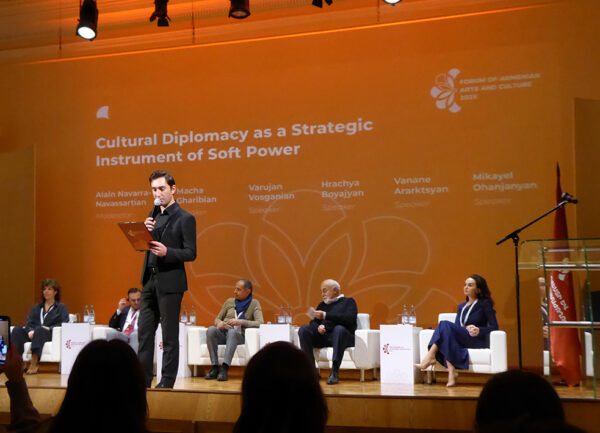
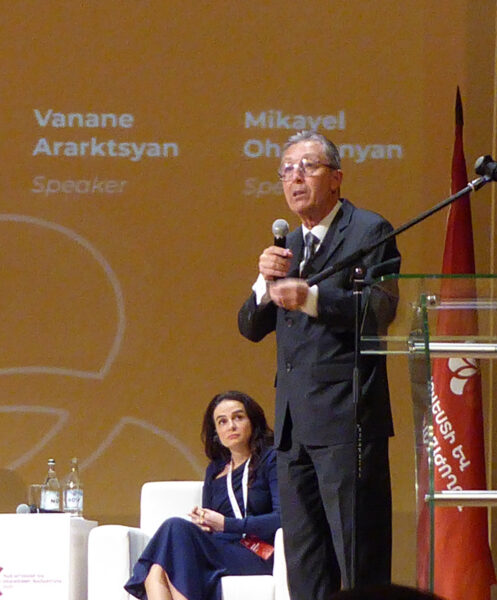
As a guest at the forum, one felt well cared for and welcome. The food was lovingly served and there were plenty of helpers to guide guests through the buildings. However, during each panel discussion, there was a palpable tension between the idealism of the guests and the management mentality of the hosts. Many hopes had to leave with the guests. This became particularly clear during Discussion II on cultural diplomacy as a key soft power: Varujan Vosganian, a Romanian writer and head of the Armenian community in Romania, called for the creation of appropriate national structures to make studying in Armenia attractive, while at the same time establishing appropriate cultural institutions such as the German Goethe Institute or the Chinese Confucius Institute. These cultural centers would promote Armenian culture worldwide. However, he was contradicted by Hrachya Boyajyan, who holds numerous positions in Poland, including publishing the magazine Munetik and acting as Honorary Consul of Armenia. In his opinion, creating new structures would result in unnecessary bureaucracy. His success story is presented as a counterexample. He organized six million dram (less than $16,000) for his project at a ministry in Yerevan and consequently received a commitment from the local government in Krakow to receive €100,000 annually to establish a new chair for Armenology at the university.

When Zareh Arevshatian, a film critic and producer from the US and an invited guest at the event, called for Armenia to build its own film studios, given that many filmmakers are practically forced to shoot outdoors, Danielyan responded with a “no,” adding, “We want to create conditions so good that the business will take care of itself.” That sounds good, but good intentions are not enough.

The actual discrepancy between declared intentions versus implementation capacity becomes clear when we look at specific cases: during the forum, I spoke again with Sinanyan about the regulation of tax-free imports of cultural goods on a temporary basis. This is very important in order to facilitate international exchange. I had already discussed this with him in June at the German-Armenian Cultural Days in Berlin. Armenia signed the international “Carnet ATA” regulation in 2017. There are still 900-page documents from this pre-revolutionary period available online. The regulation is very convenient and is used internationally to transport sports equipment, exhibition exhibits, etc. across borders for up to six months without having to evaluate each item, pay customs duties, and then reclaim VAT. We urgently need this. Sinanyan agrees, but he regrets that there are often laws that have been passed but are not implemented at all. Even after a renewed inquiry, it remained unclear whether the “Carnet ATA” regulation applies in Armenia today. “There must be some kind of regulation,” Sinanyan finally tells me. The cooperation between Yerevan and Paris is cited as an example, specifically the current exhibition “Sacred Dialogues: From the Louvre to the History Museum of Armenia.”

Hayk Petrosyan moderates a panel discussion on cultural diplomacy

Of course, dear Commissioner, it is wonderful that you have reached an international agreement at ministerial level and that customs authorities are no longer an obstacle for you. However, this is of little help to us cultural workers, who are sole traders for tax purposes. We don’t want to apply for a ministerial regulation for every project and have an external curator present during import. It’s not just a matter of importing exhibition goods into Armenia, but also of taking them back again — without conditions and renewed customs terror. Without clearly defined regulations, serious cultural exchange in the field of visual arts becomes almost impossible.

During the two-day meeting and at the reception, there were both new acquaintances and long-lost friendships that were rekindled. Those who can, take full advantage of such an event for networking, and that’s a good thing. But whether it was absolutely necessary to gather so many people in Yerevan is another question. Given the generally tense situation in Armenia and the awareness that tens of thousands of compatriots have had to flee and start a new life, or are even being held hostage in Baku, one might ask whether a certain asceticism in celebration would not have more symbolic power than yet another celebration of “cosy get-togethers.”

After the forum, the media, e.g., Haradj, asked how one could organize a cultural forum without the most important cultural institutions. One example is TUMO, especially since the platform gratefully acknowledged the digitization achieved through 3D scanning of architectural monuments in Artsakh. Or the Cafesjian Center, which has practically taken over Armenia’s representation at the Venice Biennale and operates an important exhibition center and sculpture park in the center of Yerevan. Or the NPAQ Center (ACCEA), which organized the first national pavilion in Venice in 1995 and operates a representative office just a few minutes’ walk from the concert hall where the forum was held. Right at the start of the forum, the exhibition “Mapping Loss” by artists from Artsakh opened there. On display are not only moving personal experiences of the new refugees, but also a flag from the National Assembly and, according to curator Tereza Davtyan, even the original keys to the main entrance of the government building in Stepanakert.

Another exhibition in the National Gallery right next to the concert hall was even included in the forum program. Unfortunately, there was no information about when the opening and guided tour took place, but the exhibition itself is highly recommended. Curated by Hasmik Badalyan and Vigen Galstyan, “Currents of Modernism: Armenian Art of the Diaspora Beyond the Iron Curtain” brings together more than 100 works by 40 artists from the National Gallery’s collection in a unique retrospective.

Vanane Araratskyan, a panel speaker, and Krikor Ajderhanyan, head of the International Coordinating Council for Armenian Culture

A few days after the forum ended, the organizers emailed a detailed questionnaire to gather feedback and suggestions for improvement. According to the questions, there will be another forum for art and culture. It would be desirable to strengthen direct exchange with the professional audience so that, for example, the important question of the contradiction between the goal of culture as tool for international communication and completely ignoring the national pavilion at the world’s most important exhibition in Venice does not get lost in the chat window. During the forum, there was also no opportunity to present the group appearance of artists of Armenian descent from Germany at the European Year of Culture in Chemnitz and to achieve greater integrity in the embassy structures in cultural work. At the end of the forum, there was another speech. Krikor Ajderhanyan from the International Coordinating Council for Armenian Culture appealed: “Learn to work together and love one another.”

Then buses took the participants to the ballroom of the “Megerian Center” carpet factory, where the practical exercise took place over food and dancing.

Insight into the ‘Currents of Modernism’ exhibition at the National Gallery of Armenia

(This article was first published in the ADK (Armenisch-Deutsche Korrespondenz) magazine, issue 209. Translated from German and edited by Dr. Anna E. Wilkens.)

Get the Mirror-Spectator Weekly in your inbox: