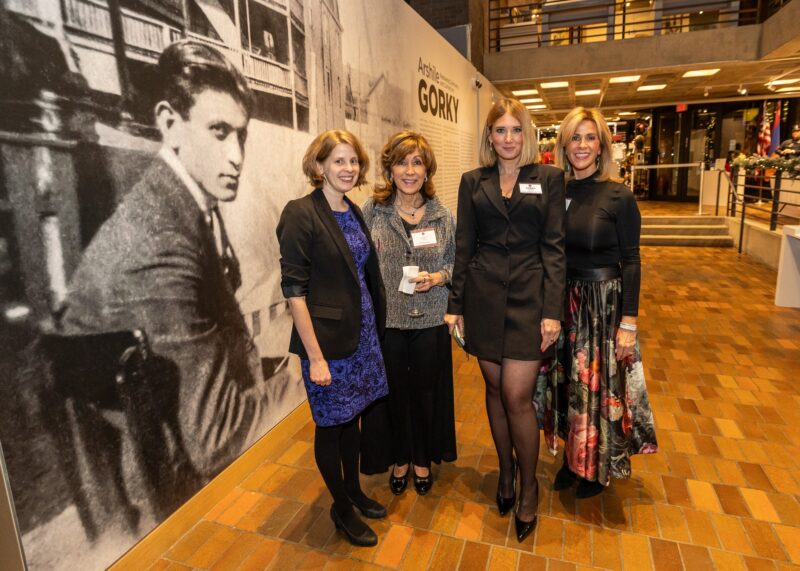


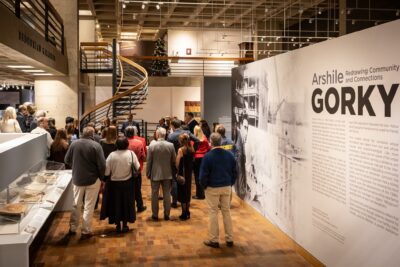
Overview of the start of the exhibition (photo Natalie Nigito)

Watertown’s Armenian Museum Presents Blockbuster Gorky Exhibition

473
0

WATERTOWN — This year has been an exceptional one for Armenian Museum of America. After two intriguing exhibitions devoted to the art of Varujan Boghosian and then Serj Tankian, it concluded the year with a blockbuster titled “Arshile Gorky: Redrawing Community and Connections.”
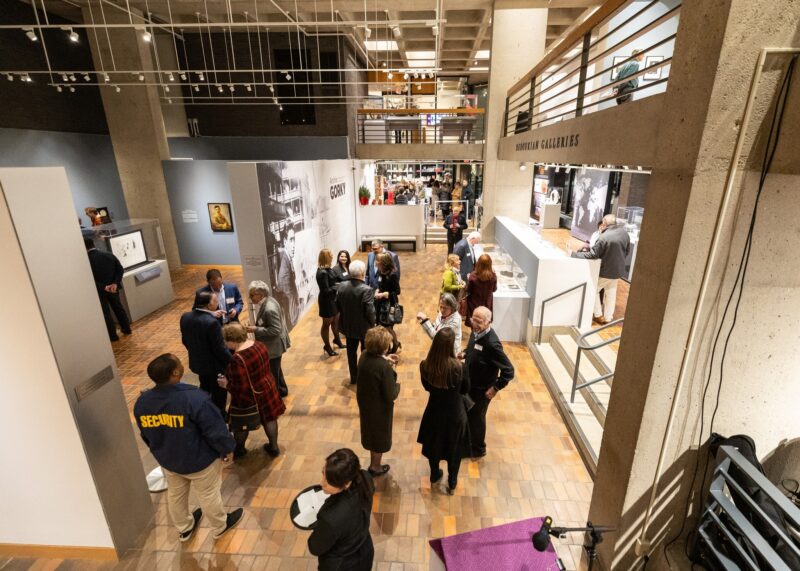
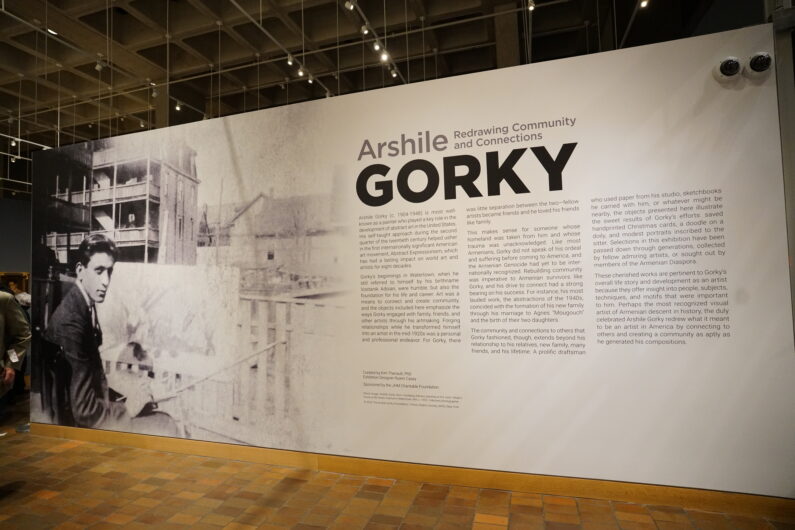
Gorky, whose birthname was Vosdanig Adoyan, is one of the most famous Armenian artists of modern times.
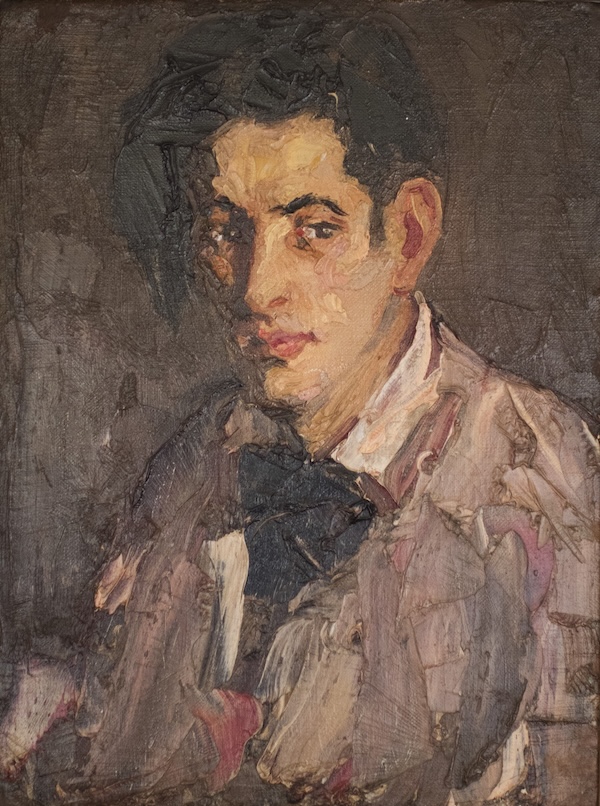
Arshile Gorky, “Self-Portrait,” 1923–1924, oil on canvas board, 16 x 12 inches, private collection (photo courtesy Armenian Museum of America)

The museum had over 250 guests, both Armenian and non-Armenian, on the opening night of December 11, for this first presentation of Gorky’s oeuvre by an Armenian museum. The event also served as the museum’s annual members’ Christmas party.
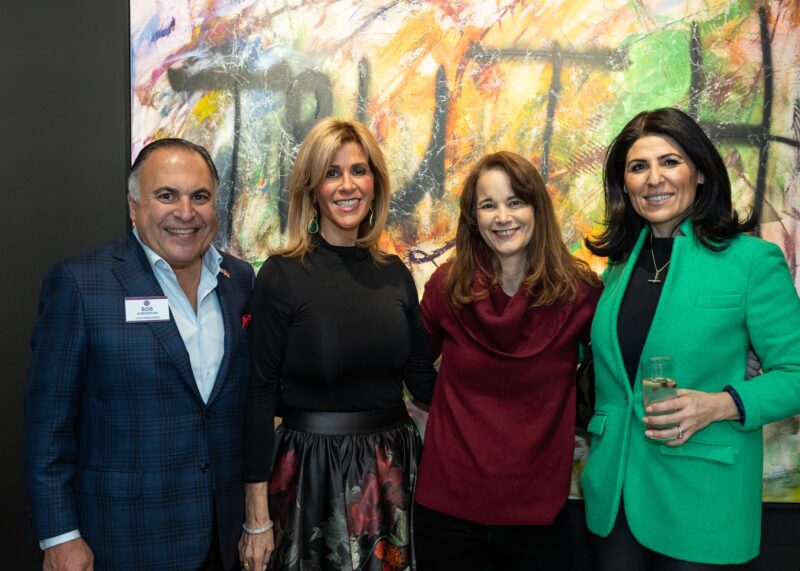
From left, Bob Khederian, vice president of the Board of Trustees of the Armenian Museum of America, Museum President Michele Kolligian, CEO of Triangle, Inc. Rachel Kaprielian, and Armine Hovhannissian, senior director of the Enterprise Project Management Office (photo Natalie Nigito)

This exhibition is the culmination of various programs in Watertown commemorating “100 Years of Arshile Gorky,” as the artist had lived in Watertown for about four years after arriving in the US in 1920. Curated by Dr. Kim S. Theriault, author of Rethinking Arshile Gorky (Penn State University Press, 2009), and designed by Ryann Casey, the show is sponsored by the JHM Charitable Foundation.
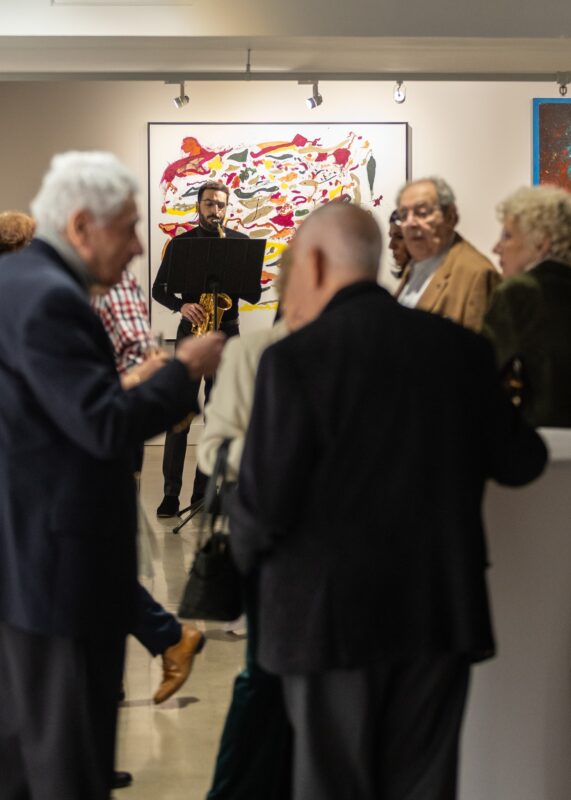
Haig Hovsepian performing on the saxophone (photo Natalie Nigito)

While there have been many exhibitions of Gorky’s art over the years, one unique aspect of the current show is precisely the emphasis on Gorky’s local connection as well as his interactions with family, friends and other artists through his art. Furthermore, many of the 26 items in the exhibition have not been displayed publicly before, as they belong to various private collectors. Loaning institutions include the Whitney Museum of American Art, the Housatonic Museum of Art, Yale University Art Gallery and the Eastern Diocese of the Armenian Church of America.
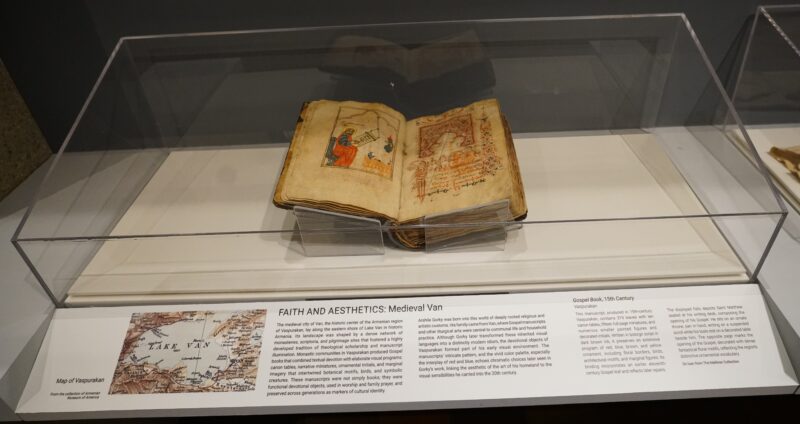
A 15th century Armenian illuminated Gospel book on display in the Gorky exhibition (photo Aram Arkun)

The exhibition starts with Gorky’s roots in his native Van. It displays a 15th-century illuminated manuscript, on loan from the Melikian collection, as an example of what the artist may have seen as a child, along with an embroidered outfit from 1915 which belonged to a child of Van (on loan from Adrienne Amirian) and early 20th century needle lace doilies (gifts of Vicki and Paul Bedoukian).
Get the Mirror in your inbox:

It then provides a little of the background to the life of Armenian immigrants like Gorky to Watertown in the period after World War I and the Armenian Genocide. One rubber shoe produced by the Hood Rubber Company (on loan from Roger Hagopian), along with a number of pamphlets and photos of the rubber factory, symbolize the hard work the Armenians carried out. Gorky worked at the factory himself for a short time in 1921.

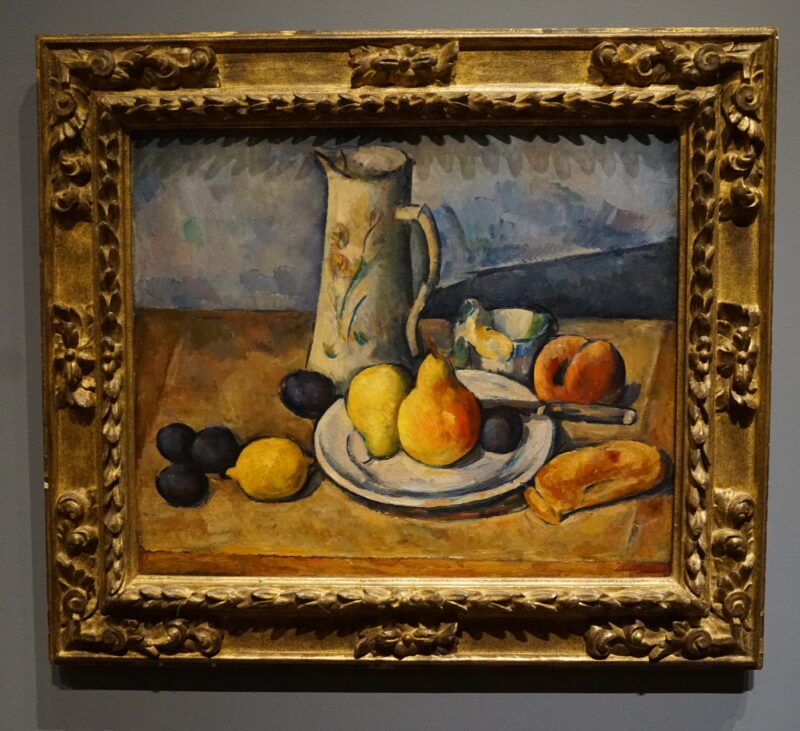
Gorky’s “Still Life with Pitcher and Pears” c. 1926-27 (photo Aram Arkun)

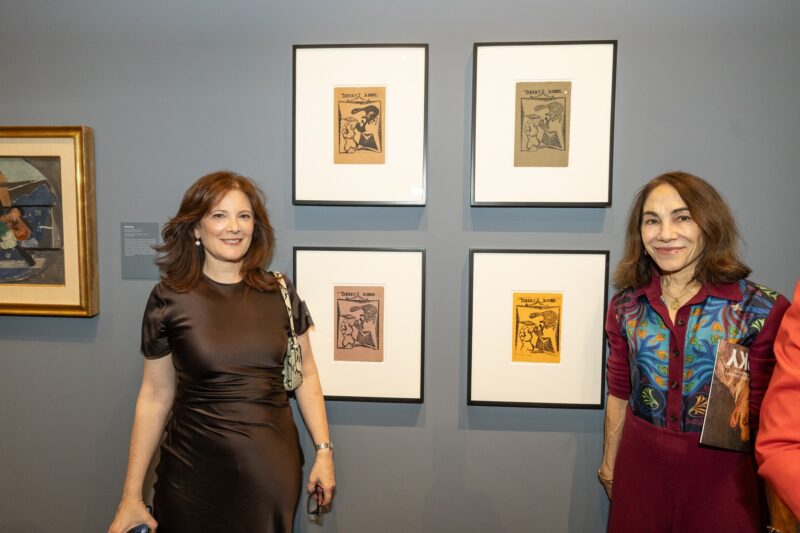
Three interesting works from Gorky’s early period show how the artist rapidly learned various styles of representation, starting with a self-portrait (1923-24) on loan from a private collection. Two still life paintings from the late 1920s are influenced by the post-Impressionist French painter Paul Cezanne while the creation of another still life in this period was affected by the works of Pablo Picasso in his Cubist period. Even later, four “Christmas Card” variations from 1941 indicate inspiration from the biomorphic forms of the Catalan Surrealist painter Joan Miro.

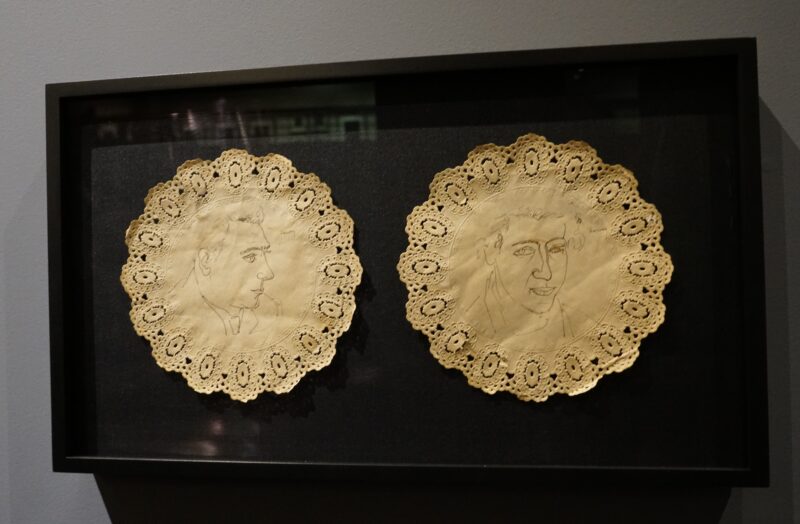
Arshile Gorky’s ink portraits of Mr. and Mrs. De Hirsh and Blanche Margules on paper doilies, c. 1937-1938, 8-inch diameter, on loan from the DerKazarian Foundation (photo Aram Arkun)

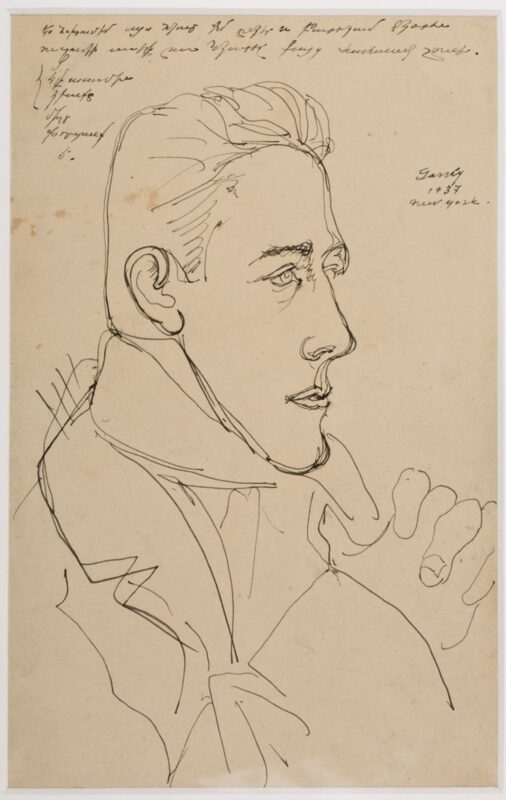
The exhibition includes portraits of family, friends and Gorky himself, such as “Portrait of a Girl” (c. 1927), “Study for Mother and Son” (c. 1936, referring to Gorky’s mother whom he frequently sketched or painted), the sketch “Portrait of a Man” (1937) and the profile ink drawings of Mr. and Mrs. De Hirsh and Blanche Margules on paper doilies. Gorky’s friendship with artist Saul Schary is shown through their portraits of one another, as well as Gorky’s ink drawing “Mountain Landscape” (1942), which curator Theriault writes is representative of outings Gorky made with Schary from the latter’s house in New Milford, Connecticut for outdoor painting.

Gorky’s “Portrait of a Man,” 1937, ink on paper (8 1/2 x 5 1/4 in.) on loan from Raffi M. Manjikian (photo courtesy Armenian Museum of America)

One particular element of interest in “Portrait of a Man,” on loan from Raffi M. Manjikian, is that it bears a personal dedication written on it in the Armenian language.

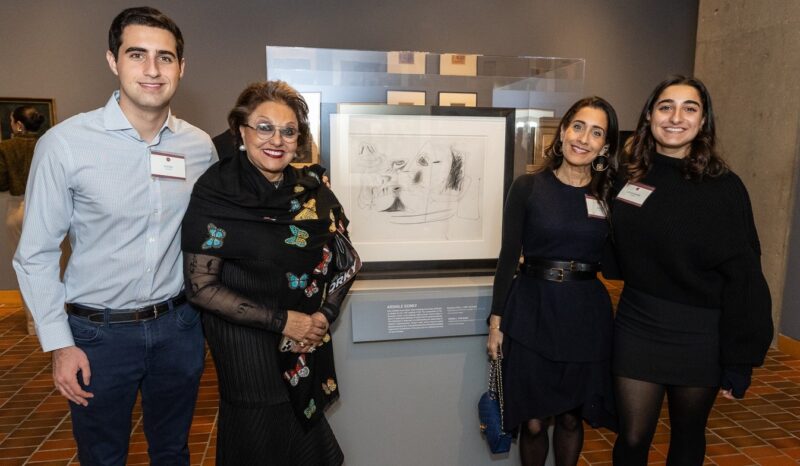
4 P.M.,” the front of a two-sided drawing by Arshile Gorky from 1945-1946 on loan from Aileen Agopian (graphite pencil and crayon on paper, 14 3/8 x 21 ½ in.). Pictured are, from left, Alexei Agopian, Cultural Advisor of the Embassy of the Republic of Armenia Vicki Shoghag Hovanessian, Aileen Agopian and Alessandra Agopian (photo Natalie Nigito).

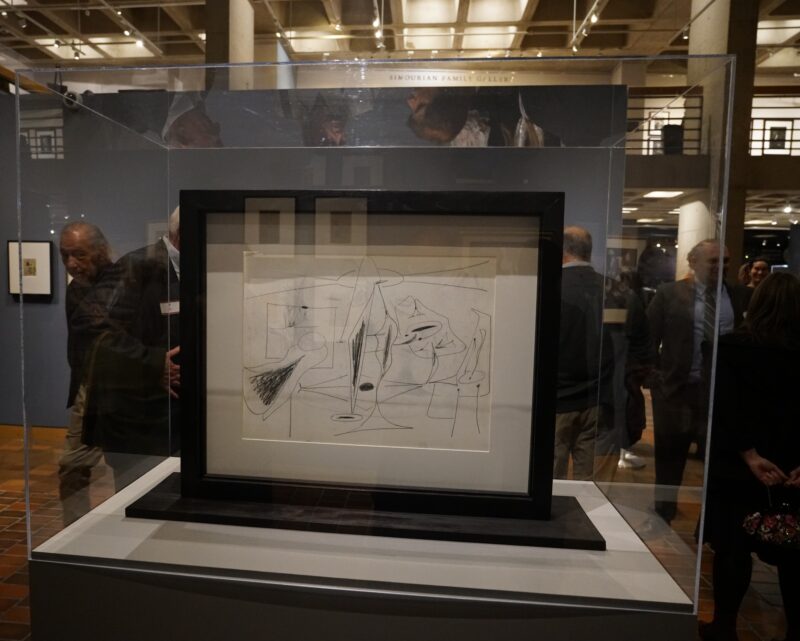
A highlight of the exhibition is a piece of white paper 17 3/8 by 21 ½ inches with graphite pencil and crayon drawings on both sides from the 1945-1946 period. The drawings are considered preparations for Gorky’s painting “4 P.M.” completed in 1947 and are on loan from Aileen Agopian.

The untitled reverse of a two-sided drawing by Arshile Gorky from c. 1946 (graphite pencil and crayon on paper, 14 3/8 x 21 ½ in.) on loan from Aileen Agopian (photo Aram Arkun)

In a small quiet corner of the museum, in the Rose and Gregory Archie Kolligian Media Room, visitors can also view Atom Egoyan and Mary Kouyoumdjian’s film “They Will Take My Island” (2020, 31 minutes). Its name is that of a 1944 painting by Gorky, and the film, envisaged as a “musical documentary hybrid,” explores Gorky’s life through that painting. This short film was commissioned by the Metropolitan Museum of Art in New York, where it premiered in 2020.

Opening Night

The evening started with a small reception for lenders of artworks and special donors. A little later, as guests already arrived and had a chance to see the exhibition, a larger reception took place upstairs on the third floor of the museum, where multitalented musician Haig Hovsepian inspired guests with his saxophone performance during a reception on the museum’s third floor.

Jason Sohigian (photo Aram Arkun)

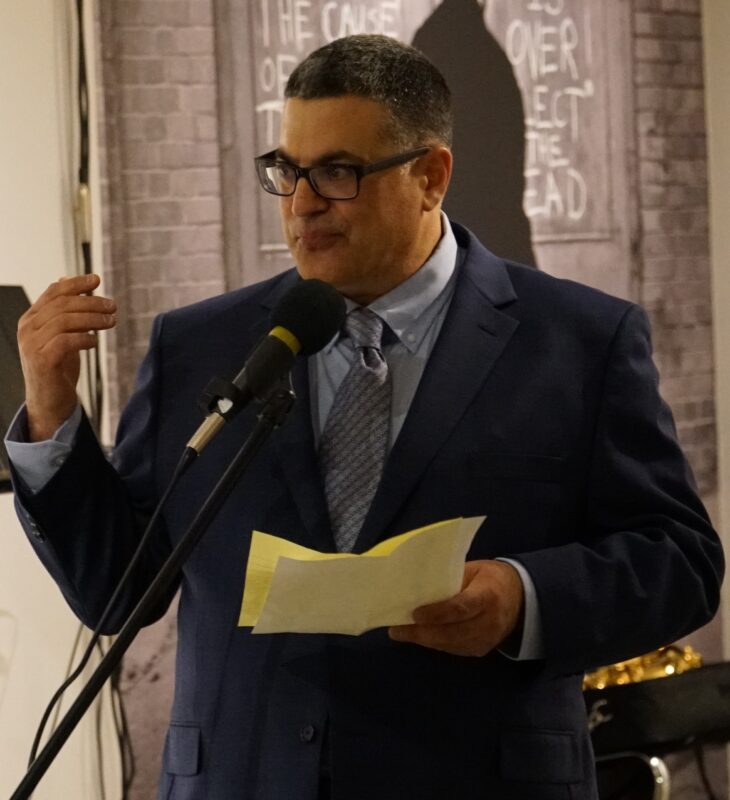
Museum director Jason Sohigian welcomed guests to the exhibition there and acknowledged members present from the museum’s board of trustees, lenders and staff, as well as Theriault, the curator of the exhibition. Sohigian declared that the exhibition was more than two years in the works and “it was a real leap of faith for our museum.”

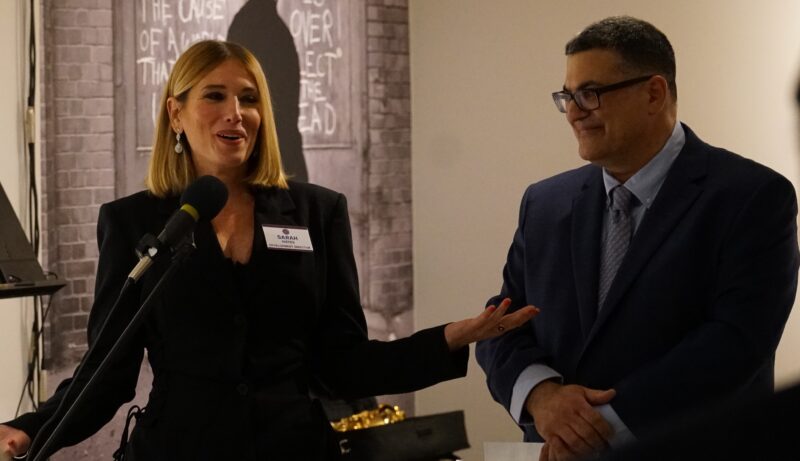
Sarah Hayes and Jason Sohigian (photo Aram Arkun)

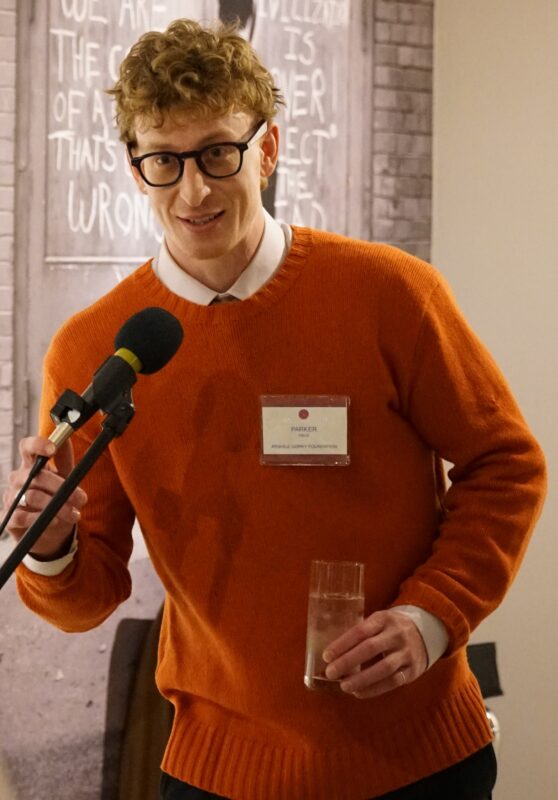
Development Director Sarah E. Hayes thanked those present for becoming members and showing their support, and encouraged people to keep coming back to the exhibition and get others to see it too. Arshile Gorky Foundation Managing Director Parker Field expressed his thanks as well to all those involved in the exhibition.

Parker Field of the Arshile Gorky Foundation (photo Aram Arkun)

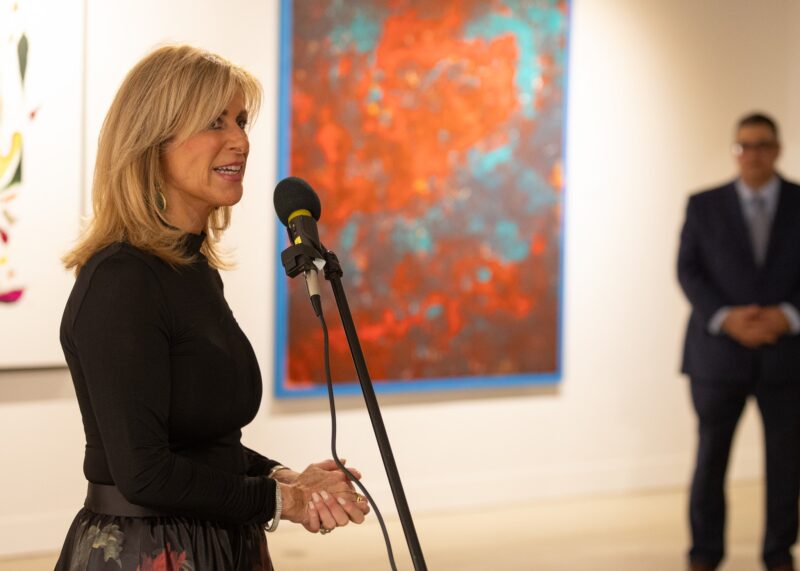
Michele M. Kolligian, president of the museum, took the microphone and recognized many of the behind-the-scenes people, including Collections Curator Gary Lind-Sinanian. She recalled the memory of his wife, Susan, formerly the textile curator/conservator at the museum, who sadly passed away this year. Kolligian also introduced a new member of the museum board, Yelena Ambartsumian, and noted the presence of representatives of the Museum of Fine Arts of Boston.

Michele Kolligian speaking at the opening reception (photo Natalie Nigito)

Kolligian recalled an interesting coincidence in her life with regard to Gorky. As a young girl, her mother took her family to visit her mother’s elder sister in Chicago. One of the latter’s girlfriends was a woman named Vartoosh with her son named Karlen [Mooradian]. At the time, Kolligian only knew that Vartoosh’s brother was a man named Gorky but didn’t know much else about him. She only later learned about Gorky’s accomplishments.

The Preparation of the Exhibition

A few days after the inaugural evening, Sohigian related that the idea of the exhibition came when Watertown resident Jack Dargon approached the museum in 2023 to honor Gorky’s Watertown roots. Sohigian said that he himself had thought about doing this since the two-family house Gorky lived in remains standing on Dexter Avenue. The city and a number of partners, including the Mosesian Center for the Arts and the Arshile Gorky Foundation, quickly got involved.

From left, Director of Annual Programs Lucia Marconi of the Museum of Fine Arts of Boston, Nancy Kolligian, Sarah Hayes and Michele Kolligian (photo Natalie Nigito)

As part of the plan for “100 Years of Arshile Gorky,” aside from this exhibition, the city council announced an Arshile Gorky Day, installed plaques in front of the two houses where he lived, a mural project was completed and the Mosesian Center held two events.

After the 2022 exhibition of the collection of Jack Quinn and Joan Agajanian Quinn in the museum, several more exhibits were mounted of modern art. Sohigian said that the JHM Charitable Foundation, which was supporting the museum, encouraged a focus on contemporary art as a way of bringing new people into the museum, and to complement the existing exhibits of artifacts from earlier periods of Armenian history on the first and second floor galleries. Consequently, the foundation as well as the museum’s own president and board of trustees were enthusiastic about the Gorky project.

Artworks were obtained from 15 lenders and three works were donated to the Armenian Museum. All this, Sohigian said, was largely driven by Hayes, who was supported by Theriault as curator, Field from the Arshile Gorky Foundation, and various art collectors, including the new museum trustee Ambartsumian. Theriault then wove a compelling narrative around the 26 works to be displayed, Sohigian said.

Melanie Dadourian and Sandra Shahinian Leitner, present at the opening on behalf of the Diocese of the Armenian Church of America (Eastern), which loaned 3 Christmas cards made by Arshile Gorky (photo Natalie Nigito)

Kolligian in turn concluded, “As the first Armenian museum to host an exhibition of Arshile Gorky’s work, we are honored to share this remarkable collection with our members and visitors to the Museum. Gorky’s life and art reflect resilience, creativity, and the enduring power of community. This exhibition celebrates his extraordinary contributions to modern art and offers us an intimate look at the relationships and experiences that shaped him and his art. The entire Museum organization is filled with deep pride and excitement in being given the opportunity to present these rarely seen works and to invite visitors to engage with Gorky’s story in a meaningful way. We extend our profound gratitude to the JHM Charitable Foundation for their sponsorship of this very special exhibition, and for their continued support of our mission.”

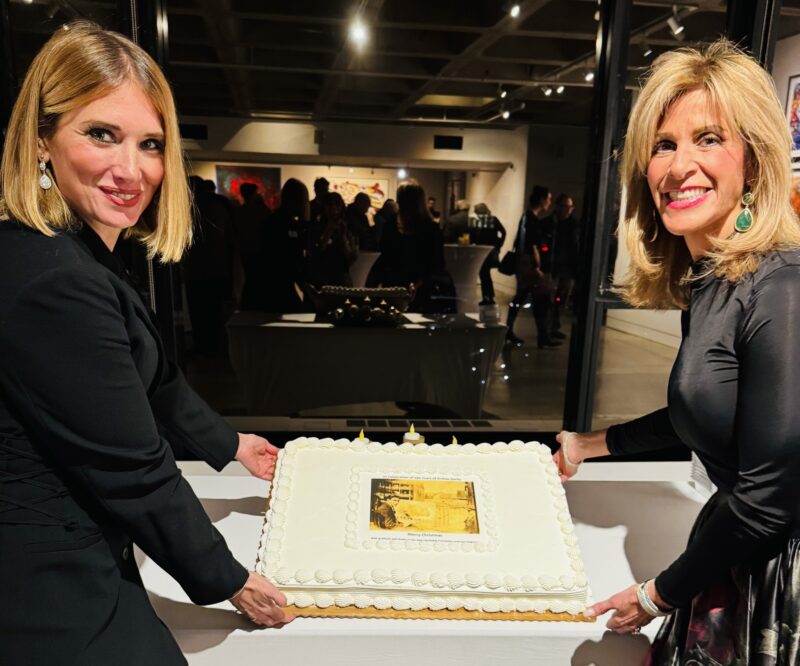
Sarah Hayes, at left, and Michele Kolligian present the special Gorky exhibition cake (photo Natalie Nigito)

“It is our hope,” she added, “that visitors — from near and far — feel how delicately and intentionally Gorky’s life and art were woven together in ‘Redrawing Community and Connections,’ and how his vision continues to foster dialogue, connection, and shared understanding.”

The exhibition runs from December 12 to April 26, 2026. See armenianmuseum.org/arshile-gorky for more information.

Get the Mirror-Spectator Weekly in your inbox: