

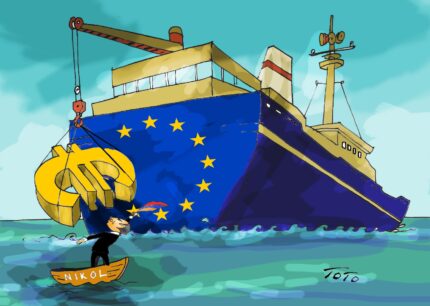
This week, Prime Minister Nikol Pashinyan traveled to St. Petersburg, Russian Federation, on a working visit to participate in the meeting of the Supreme Eurasian Economic Council. The Eurasian Economic Union (EAEU), of which Armenia has been a member since 2013, continues to remain a unique economic bloc of its kind. Despite ongoing public and political debates suggesting that Armenia is moving toward withdrawal from the EAEU and deeper integration with the European Union, such assumptions have not materialized in practice.
In fact, Pashinyan participates every December in the EAEU leaders’ annual year-end summit. The messages he delivered during his speech at this year’s meeting were particularly noteworthy. “The current meeting of the Supreme Eurasian Economic Council is taking place at a stage when EAEU integration processes have reached a qualitatively new phase. The implementation of the Strategic Directions for the Development of Eurasian Economic Integration through 2025 has enabled the accumulation of not only significant institutional and regulatory experience but also the identification of structural constraints that continue to affect the depth and effectiveness of integration. Under these circumstances, the reassessment of future development benchmarks has moved to the forefront — particularly with regard to maintaining a balance between the application of supranational mechanisms and the preservation of national sovereignty and jurisdiction, which remains a key prerequisite for the sustainability of the integration process,” Pashinyan stated. Concluding his remarks, he reaffirmed Armenia’s commitment to cooperation within the EAEU framework, stating that it is aimed at “the benefit of economic stability and sustainable development of our region.
Such statements indicate that Armenia’s prime minister is not only refraining from discussing Armenia’s withdrawal from the EAEU but is instead emphasizing the Union’s expansion, further development, and the need to address existing problems and barriers. They do not indicate the intention to steer Armenia toward the European Union but rather leave the opposite impression — that Armenia feels more comfortable operating within the framework of the EAEU. Although Armenia often uses tough rhetoric and sharp formulations in its relations with Russia, it has consistently refrained from taking concrete steps that could be perceived in Moscow as actions against Russia’s vital interests. Despite persistent discussions about Armenia potentially withdrawing from the CSTO and the EAEU since the 2018 change of government, none of these narratives have materialized in practice over the past eight years.
In the short to medium term, Armenia has very limited room to pursue major foreign policy realignments. A number of constraining factors stand in the way – most notably the absence of a common border with the European Union, which significantly complicates Armenia’s prospects for EU membership. Among EU member states, only Ireland, Cyprus, and Malta lack a land border with another EU country. However, all three have direct maritime access, which substantially mitigates this limitation.
Admittedly, Armenia also lacks a land border with the EAEU. Nevertheless, within the EAEU framework, specific mechanisms have been developed to address and manage this issue. Consequently, Armenia’s potential withdrawal from the EAEU and accession to the EU faces not only political obstacles, but also serious geographic and structural constraints.
The situation would be fundamentally different if either Turkey or Georgia were EU member states, which would naturally alter Armenia’s strategic environment. However, as of today, such a scenario appears highly uncertain.