


Joel A. Martin: With Jazzical Komitas and Love for Armenia

307
0

YEREVAN/NORWALK, Conn. — Joel A. Martin is the creator and registered trademark owner of “Jazzical,” an internationally renowned and award-winning classical and jazz pianist, producer, composer, and arranger. At age 17 Joel was the youngest and the first African-American pianist to compete in the 1985 Van Cliburn International Piano Competition (the Olympics of classical piano). Trained as a classical pianist at the Hartt School of Music and SUNY-Purchase, he created his registered trademark “Jazzical” in 1995 as a celebration of creative fusion.

In 2016, inspired by Jazzical, he created the Sonicals, a piano duo with George Lopez. In 2017 he joined with Paul Winter Consort multiple Grammy-winning cellist Eugene Friesen to create the Friesen and Martin Cello/Piano Duo, playing composed and improvised music infused with pop, jazz, rock, and world folk styles. In 2019 Joel debuted a concert reading of his first opera, HIPOPERA at the Darien Arts Center in Connecticut. On December 23, 2024, Martin’s original Christmas song Christmas Will Soon Be Here premiered on ABC TV’s “Live with Kelly and Mark” for 3 million viewers. The song was performed by the Grammy Award Winning Brooklyn Youth Chorus with Joel at the piano. As a result, a three-year licensing deal was signed for this song. He has collaborated with, and/or written music for, Grammy Award-winners Alan Menken (Disney composer), Fergie of the Black Eyed Peas, Brooklyn Youth Chorus, among many others. For the last 13 years he toured as pianist with 5-time Grammy-winning MET Opera legend soprano Kathleen Battle.

With all that he has done, his greatest achievement was discovering and creating two Jazzical Komitas albums, a journey of music celebrating Komitas and Armenia’s cultural heritage in jazz and classical for the 21st century and beyond! Since its debut in December  2019 at St. Vartan Armenian Cathedral in New York, Jazzical Komitas concerts have been presented in Yerevan, NYC, Clayton Piano Festival (Raleigh, NC), San Francisco and Los Angeles. A world tour and documentary are planned for Jazzical Komitas in 2025-2026.

He added, “I believe in the music of Komitas with all my heart. If I, a non-Armenian with no affiliation to Armenia, can be entranced and changed for the better because of the music of Komitas and the Armenia experience, then there are millions more who need to bear witness to the uniqueness of the music, art and culture of Armenia.”

Dear Joel, your “Jazzical Komitas “concert on June 14 truly energized the Yerevan audience. I believe even those who were initially skeptical about hearing Komitas interpreted through jazz left the hall impressed. Were you satisfied as well?

YES, I was quite pleased for a variety of reasons. Seeing my vision coming to life, a celebration of Armenian folk music and Komitas, capturing the visuals of Armenia past present and future with Ardean’s unique set design, it is a one-of-a-kind experience for the mind, heart and soul. Soon the world will be able to touch through this concert that which I already know and love, Armenia.
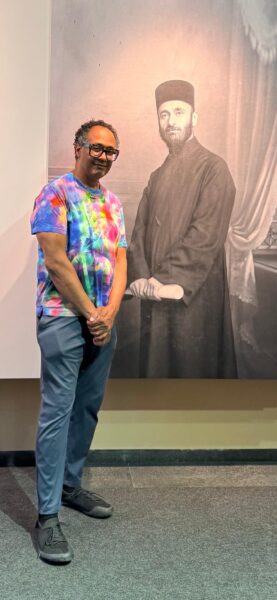
Joel A. Martin before a photo of Komitas

Get the Mirror in your inbox:

Although the concert was titled “Jazzical: Komitas,” you also performed works by other Armenian composers. From a professional standpoint, what makes Armenian music so well-suited for jazz interpretation?

To be honest, I do not approach it as a “jazz” or “classical” thing. Yes, classical is the foundation of my playing, jazz is an expansion of that foundation with creativity, but to me it is about the song, the melody, and what supports it. My journey is one of musical exploration, a spiritual, musical, artistic and aesthetic journey of self. Here only MUSIC rules, the culmination of 45+ years of playing classical, jazz, funk, pop, R&B, world music and musical theater. And I want to apply the experiences I have learned and mastered over the years to Armenian music. With “Jazzical Komitas” I start with the melody itself and move from there. Then I look at the underpinnings of the song, the harmonies and rhythms, the ebb and flow of the lead line, then I think of ways to enhance that. Whatever is available musically, if it serves the song I will try and incorporate. All the while I am thinking about form, structure, telling a story through the music, so the classical and jazz forms merge into one experience. Jazzical.

You’ve visited Armenia 12 times and call yourself ABC – Armenian by Choice. What inspired this choice?

If you had told me over five years ago that Armenia would become a central part of my life, I probably would have said, “No way.” It happened by chance — or perhaps it was divine intervention — that I met Emma Arakelyan, a successful businesswoman, entrepreneur, and fundraiser for Armenian startup tech companies. At a party in Queens NY, she introduced to the man called Komitas and Armenia. I listened, and then that evening I went back to my normal life of recording and writing. But 6 months later, the name Komitas was still in my mind and so finally, to come to any conclusion about this man and country I knew nothing about, I listened this music on YouTube thinking that it would only be 15 minutes. My listening session lasted about 2 hours wherein I pulled my daughters in and said: “Now you must listen to THIS.” My youngest daughter said “Well Dad, I think another CD project is starting.” She was absolutely correct. I had never heard anything like this before, and so I started setting this music to Jazzical sensibilities. After I had created the broad strokes of music that would be part of my first CD, I came across a fundamental problem: I had no real experience with Armenia because I had never been to Armenia. So, I called up Emma and told her that I could not finish this recording until I stepped on Armenian soil. She suggested I come to the WCIT conference in Yerevan in 2019 and we would figure it all out. That week changed my life starting with this sentence upon reaching Yerevan “I am home.”

Komitas’s music is often described as magical.

I believe in the healing power of Armenian /Komitas music. I have first-hand knowledge. Two years ago, I was diagnosed with Margi Splenic Lymphoma Cancer. While undergoing chemotherapy for 1.5 years, I listened to Komitas and created my second recording “Jazzical Komitas – Intimate Healing” while I was in bed. It is largely responsible for my healing through this cancer journey. And past that…Komitas and Armenian folk music just makes me “FEEL” good inside. Even the painful parts of the music have a positivity about it because there is something imbedded in the music that is so inherently beautiful. If one knew the history behind some of the songs, that person would only think it is so pure, simple, and moving.

During the concert, you mentioned you would like your children to grow up in Armenia. Could you elaborate on that?

YES. In America I wish we placed greater value on the role of the arts in our nation, our cities and towns. I was most impressed with Armenia’s emphasis on education and arts for the youth. This emphasis begins “in utero” (in the womb) when babies coming into the world are consistently being sung to, music playing all around them. Then as the babies become kids they are brought to the Komitas Museum for education about their art and culture. This continues on and on until they become adults, and they in turn share in and celebrate Armenia’s art and culture with their children. We do not value the arts in the same way in America which I believe stymies the ability to create well-rounded individuals and adults. A few days after my concert I toured the Tumo Center and was blown away by the fact that 20,000 students, Armenians and non-Armenians alike, had access to the finest in digital technologies, with a complete learning mechanism in place to foster imagination and creativity of its youth. I wish we had centers like this in America. Maybe if my daughters had these kinds of experiences they would achieve much more in life (and they are already doing well in my humble opinion).

Joel Martin’s painting by Mher Evoyan

You also spoke about the parallels between Black and Armenian histories. That reminded me of an article by American-Armenian writer Hripsime Ivison about Alex Haley’s novel Roots: The Saga of an American Family. Drawing comparisons, Ivison noted that while the gravest injustices against Black people occurred in the 17th–18th centuries, those against Armenians took place in the so-called “enlightened” 20th century. Would you like to comment further on this?

I said this in the concert, “Black people and Armenians have much in common if we can only get past the language.” Both groups of people have been through unspeakable horrors, with some of the permutations of these atrocities continuing to this very day. However, I do not believe that the pain and suffering that both groups have gone through are the culmination of who they are today. Yes, it is a part of their experience but not the totality of it. Before slavery, before the Armenian Genocide, they were already strong people with a great set of values and understanding about who they were. These atrocities did not take its place. Armenians and Black people are here BECAUSE they are strong people, because of their culture, because of their faith, because of so many factors. If the disenfranchised could band together on a human level, we would have much more power to make our world a better place. I know that sounds a little “cheesy” (and one might mistake these words as naïve), but if you look deep into what I am saying you will see that we all have many similarities, and we must use that to impact society. We cannot do this alone. We must show the world that it can be achieved. I feel very close to the Armenians because they are so nice, smart, respectful, trying to do the right thing by their neighbors, being strong and resilient. I want Armenians to see and appreciate my world just as much as I want the world to see and appreciate Armenia. It is reciprocal in its cumulative impact.

Besides music, what else do you love about Armenia?

I love everything about Armenia. It is about the people, the culture, the faith, the music, the impact of the Caucasus region surrounding them. Nature, old world values on family units while still trying to adjust to a new capitalist world. I am not saying that Armenia does not have its share of problems, everybody does. But what I am saying is that the great outweighs the negative by 10-1 margin. I am not Armenian by blood, but I am deeply connected to Armenia. It is my mission to spread what I know throughout the rest of the world. There is much to learn, like, and love about Armenia. And remember this: If there is one of me that has been touched to the core by Armenia, there are millions more like me that need to bear witness to this great country. And how do we achieve this lofty goal? By reaching out to one person at a time through music, good deed, and hard work. Until there is a groundswell of positive thinking.

Get the Mirror-Spectator Weekly in your inbox: