

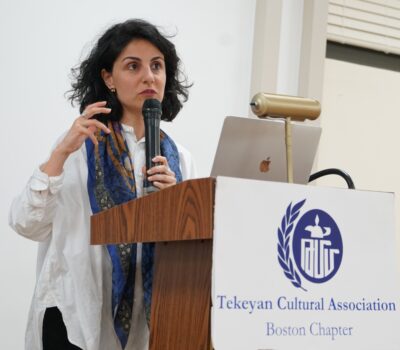
Nairi Khatchadourian (photo Aram Arkun)

Curator Nairi Khatchadourian Presents Process of Co-Creating the Matenadaran Garden

225
0

WATERTOWN — Curator Nairi Khatchadourian, visiting from Yerevan, spoke about the Matenadaran garden project on Friday, March 6, at the Baikar Building in Watertown. Her English-language presentation was sponsored by the Armenian Tree Project and the Tekeyan Cultural Association of Boston.

Guests were welcomed by Tekeyan Cultural Association of the US and Canada Executive Director Aram Arkun, who introduced Judy Saryan, a philanthropist and supporter of the Armenian Tree Project’s Matenadaran Garden project. Saryan pointed out the importance of the Matenadaran, or Mesrob Mashtots Institute of Ancient Manuscripts, as the repository of one of the largest collections in the world of Armenian manuscripts, as well as a research center.
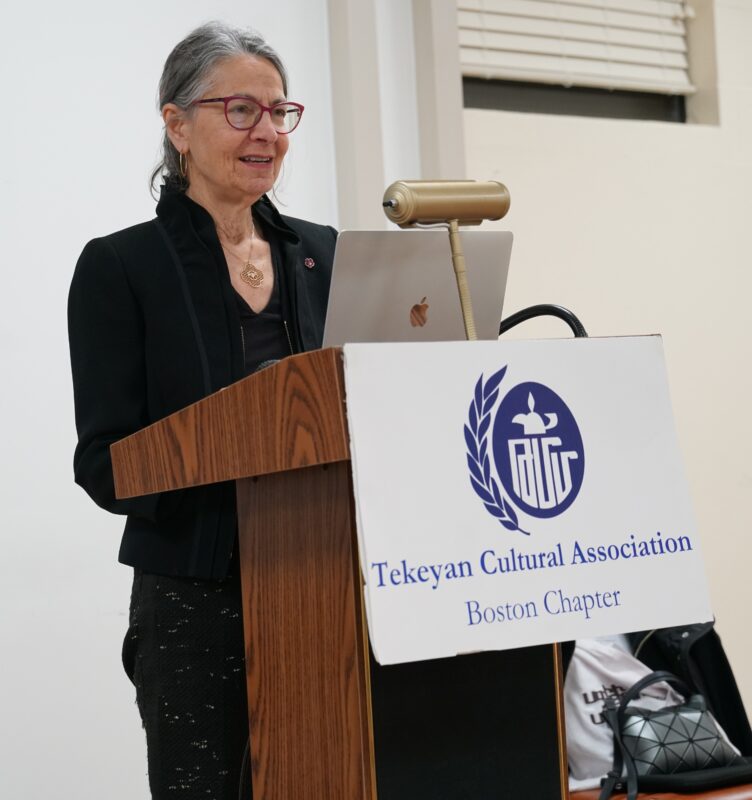
Judy Saryan (photo Aram Arkun)

The Armenian Tree Project has undertaken the transformation of the barren hillside behind the Matenadaran into a public garden, with Khatchadourian involved in the design process, Saryan said. Khachadourian, an art historian and curator born and raised in Paris, France, founded the AHA collective in 2019 in Yerevan.
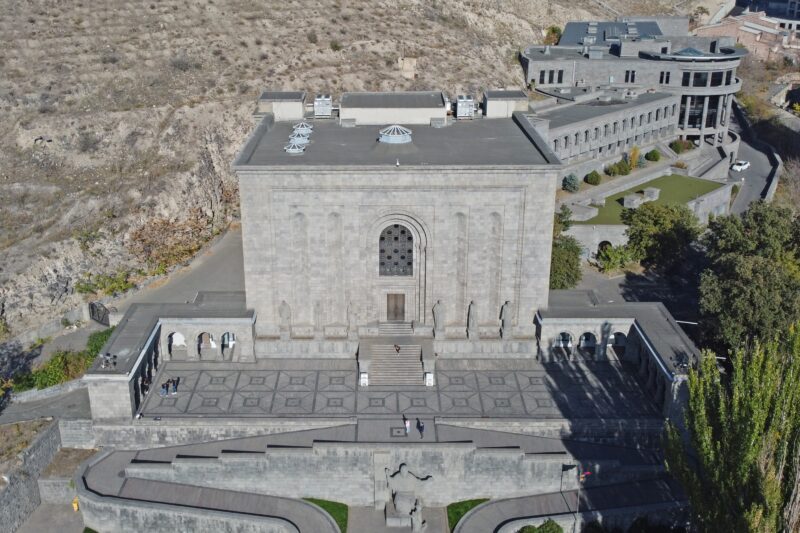
An aerial view of the Matenadaran, November 5, 2023, indicating the current arid nature of the land around the building (Yerevantsi, Wikimedia Commons)

Khatchadourian related that when she first moved to Yerevan in 2015 she worked at the Komitas Museum Institute. She found the contemporary art scene to be very fragmented, as none of the contemporary artists were collaborating with museums or public institutions. As a curator she created the nonprofit AHA collective as a structure to serve as a bridge between scholars and artists and public institutions like museums.

Khatchadourian said that she also opened a small gallery space in Yerevan, and attempted placemaking, which she explained as, “we, through inclusive projects, create new senses of places, or reactivate or revive public space or abandoned spaces in Yerevan and throughout the regions.”

For example, she related that during the evacuation of the Kelbajar (Karavachar) region, they created different artistic imprints on paper or clay which later were exhibited at the Cafesjian Center for the Arts in Yerevan. During this 2022 exhibition, children who came collectively wrote poetry on a long paper roll, which was read at the end of the exhibition. They also did projects in Goris and at the Golden Apricot Film Festival, and international projects such as a big design biennale in 2025 in Saint-Etienne, France, at which Armenia was the country of honor.
Get the Mirror in your inbox:

Khatchadourian indicated that Aleksandr Tamanyan, the chief architect of Yerevan, around 100 years ago planned to have a forest behind the Matenadaran, while she showed slides and maps.

While preparing a co-creation workshop to discuss designs for the Matenadaran garden, Khatchadourian and colleagues realized that there are very few publications about gardens in Armenia. They began to question Armenians’ relationship with nature and found out that both in Western Armenia and the Republic of Armenia there have been many districts or cities that have the word ayki/aygi as a component of their names (e.g. aykestan or aykedzor), which does indicate a specific relationship with gardens.

All participants in the workshop — scholars, botanists, artists, or just local residents — were asked what a garden is, and what does it mean to create a garden within a museum.

Khatchadourian said that in the West – in Europe and the US – co-creation has been going on for decades. The main question Khatchadourian, the AHA collective and ATP faced was how to introduce co-creation into Yerevan’s urban planning, especially when there actually has not been real urban planning going on for the last few decades and the city has been expanding chaotically.

She said that a public space like a garden should have a conceptual framework and its basis. AHA and ATP followed several principles in their conceptual phase. First, the co-creation approach has to be site-specific. In this case, the site is approximately 1.5 hectares (3.71 acres) in Yerevan on a slope facing south. Then it has to be context-specific in the questions and exercises for the workshop.

Third, it has to be interdisciplinary. When an architect’s studio is asked to design a public space, that does not resonate with people, she said. Instead, in addition to architects and designers, urban planning representatives from the Yerevan municipality, environmentalists (from ATP and elsewhere), scholars who work at the Matenadaran and know the surroundings, technical and development specialists and irrigation specialists were invited to the workshop. The aforementioned were both established professionals as well as younger emerging practitioners. Local residents, including people born in Armenia, Artsakh and the diaspora, were invited.

The workshop took place on November 22, 2025 at the Matenadaran with 40 participants. They examined the garden from cultural, social and ecological perspectives. They were divided into six groups, with six different facilitators, to whom Khatchadourian had given worksheets and an agenda to follow. Each group included a variety of different professionals.

First, they examined the social aspect, which is defining shared values. What value do they see in a garden? What are the values that they want to put in the garden? Then came the cultural aspect, to explore the essence of what the modern garden is. Then they went to walk on the slope to think about the spatial and urban perspective. we went and walked on the slope. Each participant was given one envelope to collect from the site any element, any item, they wanted. Everyone was asked to write labels, like museum labels, for each object.

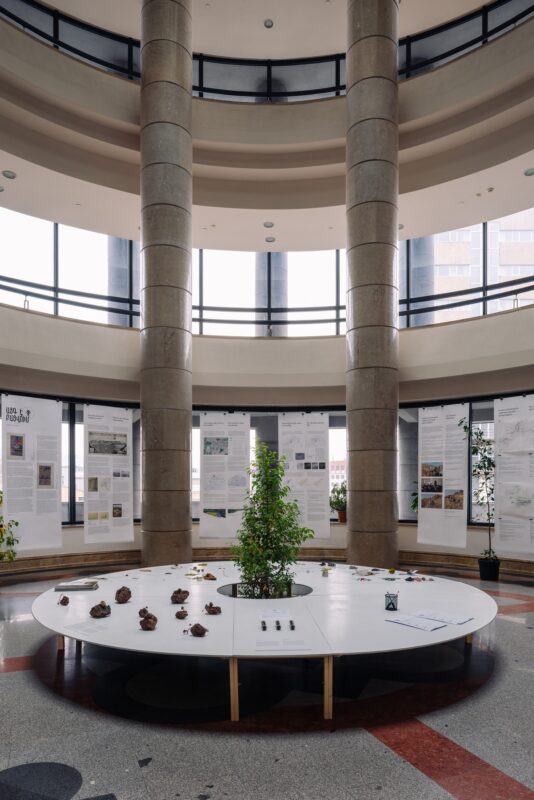
Each of the six groups at the end of the workshop day produced a map that reflected their social, cultural, ecological, urban, and design views. Khatchadourian presented some of these maps and the ideas of the groups. A report was created for ATP and then AHA prepared an exhibition titled “Ayg e batsvum/The Sun Is Rising: The Matenadaran Garden Vision.” It opened on February 6 in the Matenadaran’s academic building.

Khatchadourian said, “After 11 years living in Armenia, I think this is the most fruitful opening — fruitful, interesting.” This was because there were all sorts of people present who don’t generally interact with each other, just as during the co-creation process.”

Moreover, out of the six maps and ideas, three garden visions were later prepared. The first combines elements from four of the maps, with an Armenian orchard and a pathway organic to the topography. Khatchadourian said that it would have a rich biodiversity highlighted in the garden, different facilities to see it, and then a viewing platform. There would be water elements like fountains. Climbing up the garden would be like a pilgrimage and also an educational zone.

The second vision is of a very geometric urban vineyard. That group thought there should be roses along with the vineyard and the wind that comes from the north towards the heart of Yerevan would carry their scent. There would be some seating areas and access from different parts of the site.

The third vision is of a contemplative garden, which is like the modernist approach of big open spaces. It would have a water element and more wide spaces that would serve like a city forest type of greenery serving as block to the dust and noise from the city avenue outside.

In the exhibition at the Matenadaran, visitors were given the opportunity to vote for their preferred versions, and the first one received the most votes. The Matenadaran board, ATP and the AHA collective also preferred this one. Number three got the second most votes, followed by number three.

The exhibition at the Matenadaran

Khatchadourian said, “This project has a value that has to be shared internationally.” She proposed that the Sun Is Rising project be presented at the Venice Biennale, which next year will be dedicated to architecture. There is time to invite new practitioners to reflect on the garden design process, she said, and to also draw a connection between it and the San Lazzaro monastery of the Mekhitarist monks. She suggested a mirror project between the two sites of the Matenadaran and San Lazzaro, with the garden project “a prototype of collective intelligence and co-creation, as a shared living space that awakens all the senses.”

Get the Mirror-Spectator Weekly in your inbox: