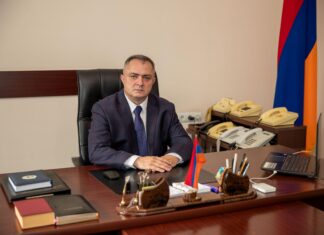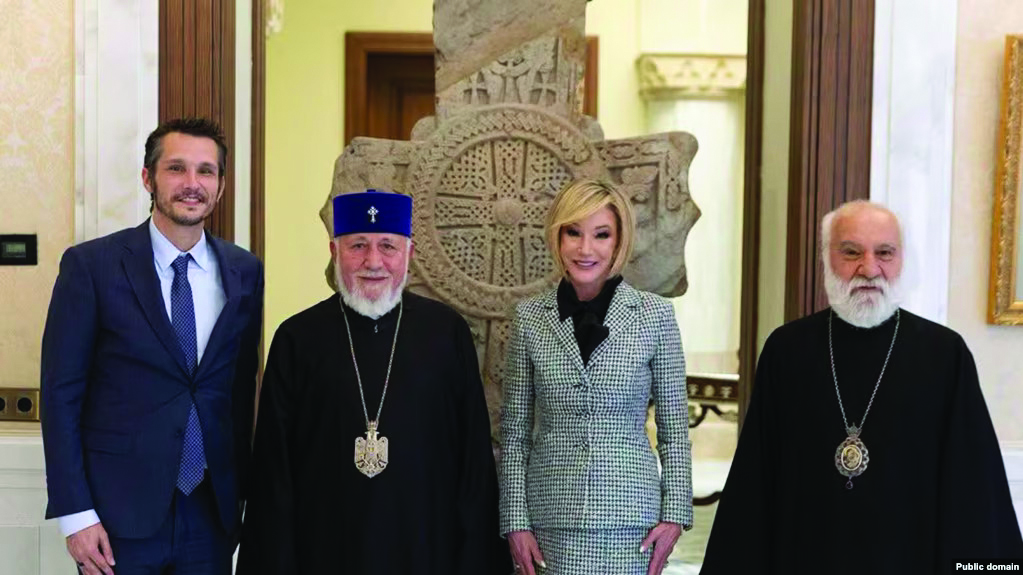

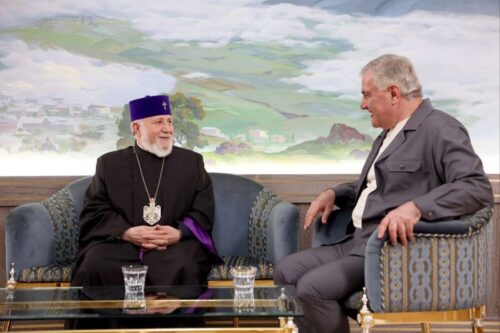
Samvel Karapetyan (right) meets with Catholicos Karekin II, at left (official photo)

Pashinyan Suggests Parliamentary Investigation into Armenian Church ‘Crisis’

97
0

By Arshaluys Barseghyan

YEREVAN — Armenian Prime Minister Nikol Pashinyan has suggested that parliament could establish a commission to investigate what he described as a “crisis” in the Armenian Apostolic Church, potentially leading to legislative changes affecting the Church’s governance.

The comments came in an interview with Boon TV published on September 19, amid tensions between Pashinyan’s government and the Armenian Apostolic Church. The Armenian leader had made it clear that he wants to oust the Catholicos — who is now facing criminal charges along with several senior clergy members — surrounding their refusal to reinstate a bishop, who supported Pashinyan’s reforms. The case against Karekin II has been mired by three judges dropping out, as well as a prosecutor.

Pashinyan said on September 19 that at his instruction, the Public Relations and Information Centre under the Prime Minister’s Office had prepared a report on the “crisis” that emerged in the Church and “ways to resolve it.” Pashinyan said he had reviewed the draft, but the report has not yet been published.

He described the situation in the Church as “terrible,” claiming that it had been “åseized” by Karekin II, whom Pashinyan refers to by his civilian name, Ktrich Nersisyan.

Pashinyan said he had discussed the issue with the board of his ruling Civil Contract party and did not rule out that parliament could establish an investigative commission after the report is published. He said such a commission could make proposals for legislative changes based on the report.
Get the Mirror in your inbox:

Pashinyan did not directly answer a question about Russian influence over the Church leadership, but said that the report also addressed the issue.

Amid the ongoing crisis, Russian officials and the Russian Orthodox Church have made statements directly or indirectly supporting the Armenian Church. Moreover, in November 2025, Karekin II’s brother, Ezras Nersisyan, received a state award from Russian President Vladimir Putin, which critics perceived as evidence of his ties to the Russian authorities.

Ezras Nersisyan serves as the head of the Russian and New Nakhichevan Diocese of the Church, and according to declassified documents published by the Armenian National Security Service (NSS) in December 2025, he was recruited by the Soviet Union’s KGB and cooperated with the agency from 1986–1988.

During the interview, Pashinyan also claimed that the Church had committed at least one electoral violation, saying that religious organizations are not permitted to engage in political campaigning. He said there should be consequences for such violations, but did not elaborate.

Ahead of the June 2026 elections, Karekin II met with the opposition leader, Russian-Armenian tycoon Samvel Karapetyan.

According to the Armenian Constitution, Armenia is a secular state. Despite the separation of the Armenian state and the Church, ousting the Catholicos has been included in the new government’s 2026–2031 program. Many of Pashinyan’s critics, as well as constitutional experts, deemed the move as unconstitutional, a claim Pashinyan rejects.

In the same interview, he argued that the Constitution states that relations between the state and the Church “may be regulated by law.”

“The church is not the Catholicos; the church is the community of believers, which, moreover, according to the traditions of our church, participates in the governance of the church,” Pashinyan said.

He went on to say that parliament could initiate legislation to provide the faithful with “genuine opportunities” to participate in the governance of the Church.

As possible mechanisms, Pashinyan mentioned establishing parish councils and allowing believers to participate in discussions over the nomination of their “leaders.”

On September 17, the Supreme Spiritual Council — the highest executive governing body of the Church — “deemed unacceptable” the government’s policy of “interference in the internal life of the Church, as well as the measures of pressure, persecution, and restriction imposed upon the Church through the use of state mechanisms.”

“It was noted that such actions violate the constitutional guarantees of the Church’s autonomy and the freedom of conscience and religion of the faithful,” the statement read.

(This article originally appeared on www.oc-media.org on September 21.)

Get the Mirror-Spectator Weekly in your inbox: