

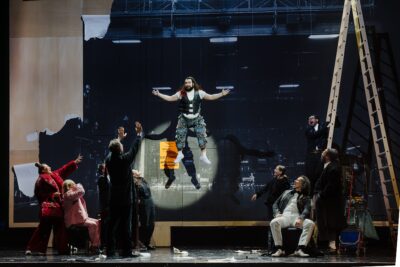
As the saying goes, “Italians are born actors.” But Italians have no monopoly on this talent. In a review of an opera currently drawing capacity audiences at the Wiesbaden State Theater, the Frankfurter Neue Presse wrote. “With bass-baritone Hovhannes Karapetyan in the title part, director Wolfgang Nägele can rely on a natural born comedian.”
The title role is Mamma Agata in a comic opera by Gaetano Donizetti (1797-1848) entitled “La Mamma: convenienze ed inconvenienze teatrali” (roughly: “proper and improper behavior/harmony and disharmony/good and bad manners in theater”). Donizetti’s original is not one but two works, opere buffe — or comic operas — on a similar theme. Both are very short, and the current production represents a recasting, with material and music. The arrangement by Tony Burke includes selections from Donizetti, Bernstein, Stravinsky, Tchaikovsky and Verdi.
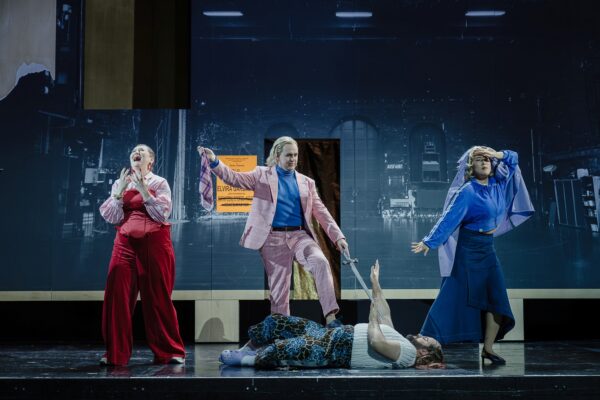
The subject of the opera is opera: an ensemble is rehearsing an opera, “Romolo ed Ersilia,” in which the main characters are designated by their roles: The Primadonna, Her Husband, The Female Singer of Lead Male Romolo [Trouser role], The Tenor, The Composer, Poet, Director, and Theater Manager. Then there is La Mamma, a cleaning woman, who is a passionate fan of the opera, and Her Daughter, an aspiring singer. Donizetti cast the role of La Mamma as a bass (!) and ensemble member Hovhannes Karapetyan fills the role brilliantly, with the name Agata Hovhannisyan; the daughter, Aida Hovhannisyan.
The plot is straightforward; characters and events often reflect clichés then and now. Aida arrives at the rehearsal to audition for a part, and as she feared, Mamma Agata, whose job is to clean the place, appears on the scene, not to clean but to intervene. The Primadonna shows off her talents, then strife breaks out — over the number of solos assigned, who gets what; singers want more, or some demand cuts of the Composer; they argue about the place of their names on the poster. The female singer in the trouser role Romolo abandons the troupe. Mamma Agata forcefully demands her daughter be included in the cast, to the chagrin of the Primadonna. Then, La Mamma offers to solve the crisis by singing the lead role herself, except it turns out that she can’t read music. Chaos ensues, threats to quit abound, daughter Aida receives a job offer from the Frankfurt opera, time is pressing for the dress rehearsal.
Following a timely break, the action resumes with astounding developments: The lover of opera Mamma Agata, though untrained, can indeed sing beautifully. Karapetyan, dressed in an outrageous costume with furry white boots, oversized quilted bloomers and what looked like a ballet tutu, delivered a masterful performance. Mamma Agata’s music inspires the entire cast, the mood shifts, and reconciliation prevails. The set, now remarkably enlarged,
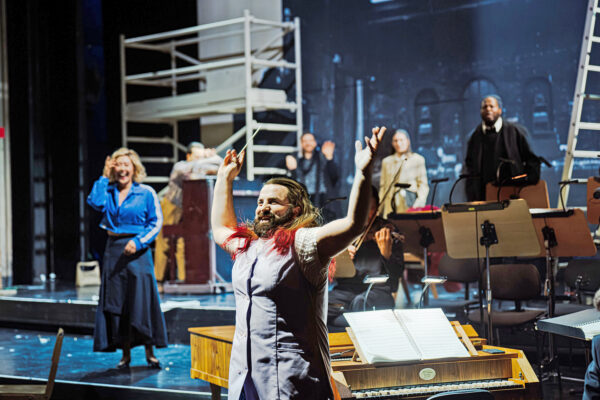
provides the stage for a multilayered procession of all players, dressed in vastly differentiated, garish costumes (everything to be found in the costume room, said Lisa Dässlaer, responsible for set and costumes), bizarre, cliché-filled, and uproariously funny. The magic of the opera has overwhelmed the environment and its players … until the fateful news arrives that the theater management has cancelled the performance and no one will be paid! The moral of the story, as the performers know, is that “Now people throughout the city will say, there is no theater any longer!”