

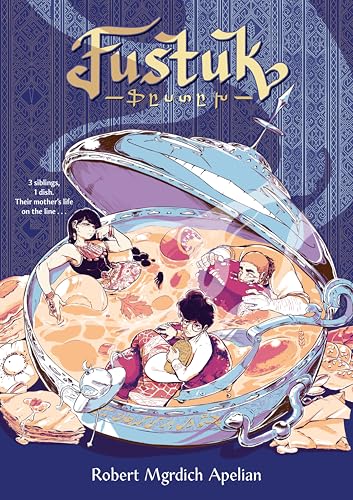
Robert Mgrdich Apelian’s graphic novel Fustuk (“pistachio”) takes a fascinating look at an imagined episode in Parskahye or Armenian-Iranian history, while providing a fun overview of some of the culinary traditions shared by Iranians and Armenians.
Set in a mythical Pars kingdom amidst a family of Armenian chefs who have survived as a minority through their talent and hard work, the story is theoretically straightforward though at times the details may seem a bit challenging for those not familiar with Iranian and Armenian history. For example, a lot is made of certain kitchen instruments being jadoo or magic, but it’s unclear why family members choose to use them at certain times and not at others. Told from the perspective of the youngest 17-year-old son Katah and his siblings Noori and Garo, the Armenian family portrayed is disconsolate about the fact that their mother is dying of a serious illness. The story moves back and forth between different timelines which one must be careful to follow to fully understand the backstory.
A handsome sensitive young man, Katah is also the only one in the family to have not inherited his father’s legendary talent for cooking — in fact he is a veritable klutz in the kitchen, at least at first. Desperate to save their beloved mom, Katah and his siblings decide to enlist the help of an evil Div known as Az to save their mother. Az agrees to cure her, but only if they can cook him a dish as good as the one their father made him years ago before he mysteriously passed away.
Meanwhile, Katah experiences a series of dreams which lead him to believe that he too may have powers of divination.
As the story progresses, the children begin to experiment with meals that could potentially satisfy the mean-spirited little Az. These include dolma and sarma (stuffed grape leaves and vegetables) and madzoon abour (yoghurt soup) which will be most recognizable to Armenian readers, while those of Iranian-Armenian background will drool as they watch the family prepare such Iranian specialties as makluba (upside down potted meat and vegetables), halim (wheat and lentil stew) and khoresh-e-gheysi (apple stew with dried apricots).
Apelian also includes Armenian and Fasi vocabulary and alphabets throughout the book: for those who read either or both, it’s an added visual and linguistic treat. Mythology, anthropology and culinary history mix in a unique way in Fustuk. What makes the book unique, however, are Apelian’s lush illustrations, from his renderings of historical fashions to the meals that the family recreates together. As they race to find that one ultimate meal to satisfy an evil spirit who may just be pulling a fast one on them, the reader also prays that their mother will be saved — and that someone will soon cook them some of the fabulous recipes displayed in the book. On a deeper level perhaps, this graphic novel also offers a sustained meditation on how food shapes our sense of self and sparks deep, lasting connections.
In an author’s note Apelian — who grew up in New Jersey and Maryland — writes that like many Armenians growing up the diaspora, he often found works on Armenian history and culture unnecessarily lachrymose and tragic. This book — drawn in luscious oranges, pinks/reds and blues — is certainly one antidote to that tendency. The author does include some background on Armenian history — and the difficulties his people experienced under the Persians, but he limits it to what is strictly necessary to understand the story at hand. Apelian has obviously been heavily influenced by the Japanese manga tradition, which makes the work even richer on a cross-cultural level. While being a manga fan is certainly not necessary to enjoy Fustuk, it seems to me that those who are will enjoy this beautiful volume even more. Fustuk makes a fascinating addition to contemporary Armenian and Middle Eastern arts — a most satisfying way to celebrate a rich and too often stereotyped culture.
The book is available on the Penguin books’ website as well as Amazon.