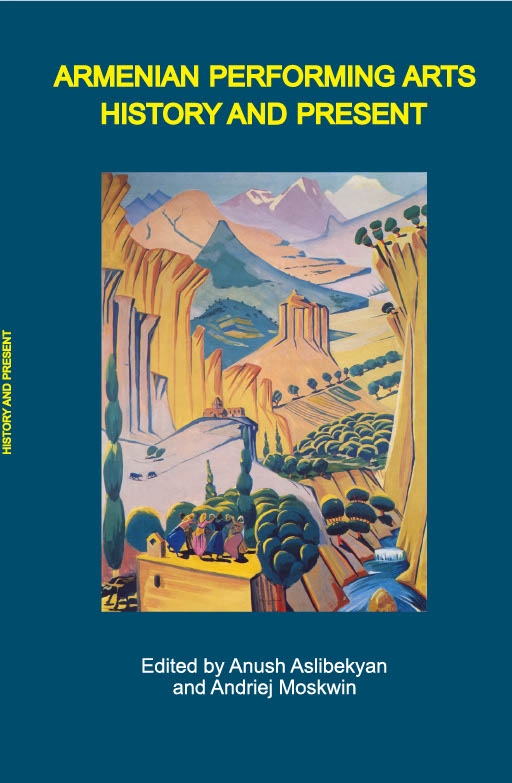


An English-language volume titled Armenian Performing Arts: History and Present has recently been published in Warsaw. It was compiled and edited by Anush Aslibekyan (Armenia), a theatre scholar who is senior researcher at the Institute of Arts of the National Academy of Sciences of the Republic of Armenia, and Andriej Moskwin (Poland), a theatre scholar and professor at the University of Warsaw. The book is the result of years of painstaking collaboration between the Laboratory for the Study of Theatre and Drama of Central and Eastern Europe at the University of Warsaw and the Institute of Arts of the National Academy of Sciences of the Republic of Armenia.
The publication is an important initiative aimed at presenting research on the history of Armenian theatre and its contemporary developments to an international readership. The two editors’ prefaces and 14 articles address the history of Armenian theatre, prominent figures, contemporary dramaturgy, the art of stage direction and the development of independent theatres.
The contributors are: Anush Aslibekyan’s “Armenian Performing Arts: From Past to Present”; Andriej Moskwin’s “My Friendship with Armenia and Armenian Theatre”; Artsvi Bakhchinyan’s “Sarah Bernhardt and the Armenians”; Anna Asatryan’s “Stage Director Yervand Ghazanchyan and Dikran Tchouhadjians’ Comic Operas”; Armen Sahakyan’s “The Social Problems of Contemporary Theatre in the Transition from the Ethical to the Liberal Paradigm”; Anush Aslibekyan’s “ ‘Goy’ Theatre-Laboratory: The First Theatre with an Independent Theatre Model in Post-Soviet Armenia”; Gor Vanyan’s “The New and the Traditional in the Art of Armen Gulakyan (Dedicated to the 125th Anniversary of Armen Gulakyan)”; Elfik Zohrabyan’s “Genre Directions of Modern Armenian Drama (2010–2022)”; Armen Avanesyan’s “The Literary Hero (Character) of Modern Armenian Drama”; Mane Mkrtchyan’s “Trends in the Development of Armenian Theatre (by the Example of the Gabriel Sundukyan National Academic Theatre)”; Andriej Moskwin’s “National Drama Theatre of Armenia: In Search of Its Own Path”; Grigor Ordoyan’s “The Evolution of Modern Theatrical Representation”; Nazenik Sargsyan’s “Ashot Asatryan’s Symphonic Dances”; Anahit Bekaryan’s “The Georgetown Boys Phenomenon in Toronto”; Naira Shahvaladyan and Gor Vanyan’s “Play with the Audience”; and Narine Sargsyan’s “The Role of Education in the Formation and Development of Independent Theatres in Armenia.”
The volume also includes two assessments of the book, written by Ararat Aghasyan, an art historian, Doctor of Art Studies, Professor, and Corresponding Member of the National Academy of Sciences of Armenia, and Angelina Rosca-Ichim, a Moldovan theatre scholar and playwright, Doctor of Art Studies, and Professor at the Academy of Music, Theatre and Fine Arts in Chișinău. The cover features Martiros Saryan’s painting Armenia, with the cover design by artist Artur Manukyan.
For various objective and subjective reasons, the past and present of Armenian theatre have received comparatively little attention in foreign professional circles and non-Armenian-language environments. In this respect, the significance of the English-language volume Armenian Performing Arts: History and Present is indeed considerable. It is also worth noting that, in Moskwin, contemporary Armenian theatre and theatre studies have gained an enthusiastic friend and a deeply knowledgeable specialist. In collaboration with Aslibekyan, he had previously brought the collection Contemporary Armenian Drama (2019) in Polish. In the second volume of the academic journal Studia Teatralne Europy Środkowo-Wschodniej (Theatre Studies in Eastern and Central Europe) of 2022, edited by him, he also devoted a substantial section, entitled “Focus Armenia,” to English- and Russian-language articles by Armenian authors on theatre, cinema, and dance.