
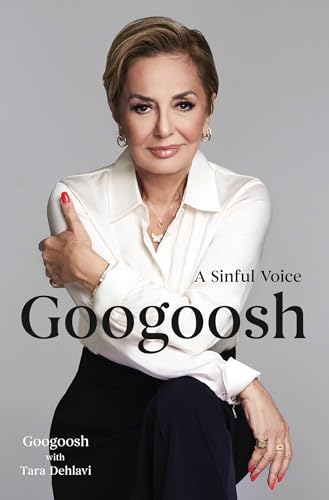
At the end of last year, the English-language autobiography of the renowned Iranian singer and actress Googoosh was published in the United States under the title Googoosh: A Sinful Voice (Gallery Books, co-authored with Tara Dehghani).
The number-one pop star of pre-revolutionary Iran, the first and greatest diva, Googoosh, now 75, was detained for about a month during the Islamic Revolution in Iran in 1979, after which she was declared an undesirable person by the regime and remained absent from the stage and screen for 21 years. Having settled in the United States in 2000, she resumed her career as a singer.
Googoosh’s connections with Armenian song and with Armenian-Iranian artists are well known. Although they are not mentioned in the book, among her many songs she has also performed in Armenian, including the Zepyur kdarnam (“I Will Turn into a Breeze”) by gusan Shahen, Tsaghikner, tsaghikner (“Flowers, Flowers”) by Hasmik Manaseryan, as well as Hazar yernek (“A Thousand Alas”). The book does not mention that when an attempt was made in 2011 to organize a Googoosh concert in Baku, she refused to travel to Azerbaijan without her Armenian friend, as a result of which the concert was cancelled. It is also regrettable that Googoosh did not mention her concert in Yerevan on August 31, 2017, for which thousands of spectators arrived from Iran and during which the singer spoke several sentences in Armenian.
Among her Armenian connections, Googoosh first mentioned the Armenian origin of her name. “My parents called me Googoosh from the moment I was born. They had made some Armenian friends in the earlier days of their marriage, the happier days, with names like Lidoush, Minoush, and Googoosh. They liked the ring of the two melodious syllables put together and didn’t mind that it was a boy’s name. When Papa went to apply for my birth certificate, no less than eighteen months later, they told him that they couldn’t register a non-Iranian and non-Muslim name. so my first name was officially Faegheh (Victorious), but everyone called me Googoosh” (page 13).
By the way, in 2017 in Yerevan the singer met her father’s Armenian friend, the well-known Tehran-based singer Googoosh (Gurgen) Vanakian, in whose honor she received her name.
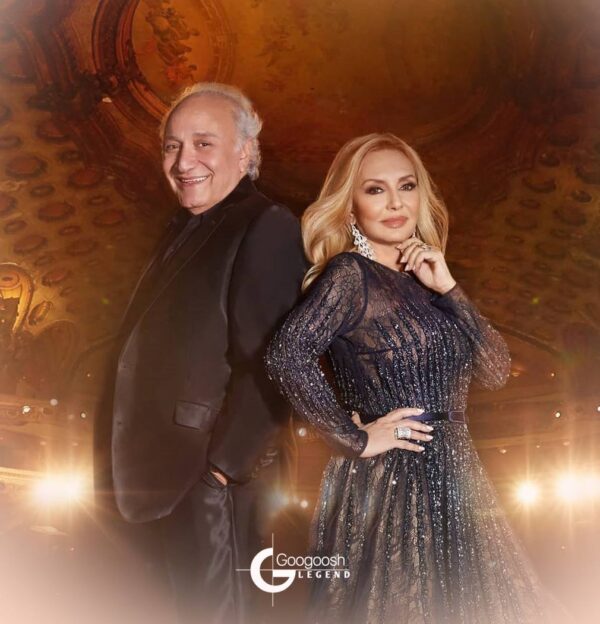
The book mentions Iranian-Armenian artists, including the singer Viguen, the “Sultan of Pop,” whose songs blended Western influence with Persian spirit, lit up the stage with his electric charisma. I was too young to understand what they were saying, but I loved how the lyrics flowed along with the incredible melodies, especially Viguen’s upbeat rhythm that was revolutionary at that time – he was the first to introduce pop music to Iran” (p. 17-18). The Persian-writing poetess Zoya Zakaryan is mentioned three times (pages 12, 240, 253); she is the lyricist for a number of Googoosh’s songs. An Armenian family friend is also mentioned, whom the author refers to as Aper (“kind, Armenian sound engineer from L.A.” (p. 110).