

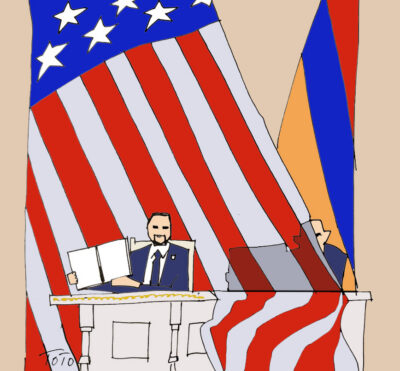
The historical visit of US Vice President James D. Vance to Armenia and Azerbaijan should be neither underestimated nor overestimated. While this is the highest-level visit of any American official to Armenia or Azerbaijan, there is a need to correctly understand the nuances of politics and US interests in the South Caucasus.
Unfortunately, there was very limited coverage in the American media about Vance’s historic visit. It did not become an important topic, and the core substance of the visit was not widely discussed, since it was not of interest to the average American. However, the deletion of his tweet regarding the recognition of the Armenian Genocide became the subject of quite serious criticism. It was criticized both by leading American media outlets and by US congressmen and other public figures. In other words, the main emphasis of the American press regarding the visit was precisely on that issue, rather than on the substance of the visit itself.
Nevertheless, Trump’s second administration has brought the United States closer than ever to its long-held goal in the South Caucasus: establishing influence and diminishing Russia’s sphere of influence. Previous attempts, such as leveraging the Georgia factor under President George W. Bush, were unsuccessful, but current conditions with Armenia and Azerbaijan may prove more fruitful. As a matter of fact, Vance is not supporting Armenia or Azerbaijan; he is advancing American geopolitical interests from Central Asia to Europe, part of which encompass the Trump Route for International Peace and Prosperity (TRIPP) through southern Armenia. This is a normal part of international politics.
However, the vice president’s visit sparked a number of contentious discussions in Yerevan. Investment possibilities in Armenia were widely discussed, especially due to misinterpretations in Armenia. Vice President Vance did not say the US would invest billions of dollars in Armenia. The interpreter misspoke, saying there would be American investments when the VP actually stated the US government may greenlight American companies selling several billion dollars’ worth of technologies and products to invest in Armenia. As a matter of fact, the Trump administration is focused on attracting investment to the US by selling American goods, weapons, and technologies globally. This became a cause for serious debates, especially in the context of the Armenian authorities trying to use this visit to their advantage, as their own achievement.
Vance’s statement that he knows that there will be elections in Armenia soon, and in essence, addressing words of support to the incumbent candidate Prime Minister Nikol Pashinyan elicited further controversy. It was wrong for Vance to address Armenia’s elections at all. After all, over the past decade the number one political topic in the United States has been interference in elections by Russia or other states and the unacceptability of such interference. At the same time, it may be understood that US support is not for Pashinyan specifically, but for whoever advances the agenda that benefits the United States — a normal aspect of realpolitik. From the perspective of cooperation, Armenia and Azerbaijan are on the same level for the United States.
Another topic of discussion concerned the Armenian prisoners held in Baku. Vance’s statement about raising the issue remained purely rhetorical in practice, which is regrettable for a leading candidate for the next US president. It would have been highly meaningful and symbolic if Vance had brought with him some of the prisoners held in Baku. However, the fact that he traveled from Baku to Yerevan — instead of the opposite — clearly indicated that such an initiative was not planned.