

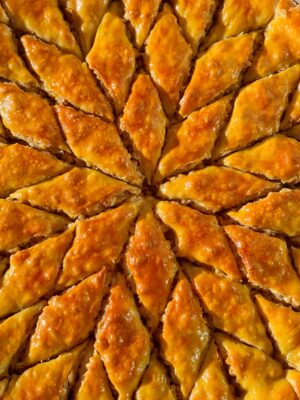
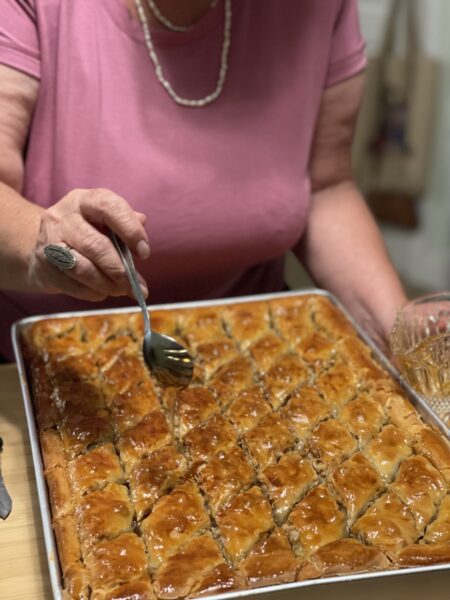
Tertanush or Qyavari pakhlava (photo courtesy Kristine Grigoryan)

Tertanush: The Unique Pakhlava Produced in Qyavar

119
0

By Kristine Grigoryan

Special to the Mirror-Spectator

In one of the most beautiful corners of Armenia, along the scenic, sapphire-blue shores of Lake Sevan, lies the town of Gavar, home to warm, hospitable, generous, and deeply traditional people. Gavar, known in earlier times as New Bayazet, has long been affectionately called Qyavar by the locals. Its history as a settlement reaches back to the Urartian era, when it was the site of the fortress of Khaldi. It is one of the rare Armenian towns whose founding is documented: an inscribed cuneiform tablet left by King Rusa I of the Kingdom of Van at the Berdikhlukh fortress, dated to 732 BC, serves as its “birth certificate.”

Throughout the centuries, amid turmoil and invasions, this settlement, along the other parts of Armenia, was repeatedly depopulated and left desolate. However in 1828–1830, when Eastern Armenia came under Russian rule, the abandoned lands were repopulated with Armenians from Persia and Western Armenia. During this period, several hundred families from the fortress-city of Bayazet in Western Armenia, led by Barsegh Agha Artsruni, migrated to Eastern Armenia. By imperial decree, they were granted permission to settle in the Gavar/Gavarreni district of Gegharkunik, renaming it New Bayazet.

The people of New Bayazet brought with them their dialect, customs, rituals, and, of course, their culinary heritage. The masterpieces created by the women of New Bayazet — Qyavari pakhlava (also known as tert’anush), kyufta, gata, and shakarlokhum — have become treasured jewels of Armenian cuisine. The great-grandmothers of the Bayazet Armenians perfected the art of baklava-making, and their descendants faithfully preserved this tradition in New Bayazet. Nowhere in the world does there exist a pastry quite like Qyavari pakhlava; it is unique both in its method of preparation and in character.

The origins of baklava or pakhlava trace back to ancient Mesopotamia — Babylonia and Assyria — where early texts describe layered pastries filled with nuts and sweetened with honey. These can be considered the prototypes of today’s baklava. Through trade routes it spread across the Mediterranean, the Middle East, and the Armenian Highlands. Linguists suggest that the word baklava/pakhlava is rooted in Persian, Arabic, or even Mongolic languages, all conveying the idea of layering or dividing. The old Armenian names for pakhlava included tsagh, tsaltsul, and tert’anush. Tsagh meant “sweet,” while tsaltsul derived from the root tsal — “to fold.” The name tert’anush, meanwhile, referred directly to its manner of preparation: thin sheets (tert) of dough are paired with honey (anush).

Get the Mirror in your inbox:

In Qyavar, pakhlava was traditionally called tsagh. This name survives in the wedding custom of preparing a large tray of pakhlava — tsaghi pakhlava — sent to the groom’s home as part of the bride’s dowry. Today, the “tsagh basket” customarily includes not only pakhlava, but also elegant gifts for each member of the groom’s family.

In old times, tert’anush was prepared only in wealthy households, as sugar, butter, honey, and walnuts were expensive ingredients. Ordinary families made it only for New Year celebrations or weddings. To create this exquisite pastry, women with the greatest skill would gather together, following age-old techniques and rituals. The recipe for Qyavari pakhlava was revered almost like a sacred heirloom, passed down faithfully from grandmothers to their children and grandchildren.

Qyavari pakhlava stands apart from all versions made in other regions of Armenia or in world cuisines. Its uniqueness begins with the preparation of walnuts, which is the most labor-intensive step. The walnut kernels are scalded in boiling water, and the thin brown skins are meticulously removed. This step ensures both the unmatched flavor of the baklava (the skin can impart a slight bitterness) and its beautiful, light color (the skin darkens the pastry).

The dough must be made with natural sourdough — never with dry yeast, which produces an entirely different texture. In the final stage of kneading, the baker dips their hands into melted butter and finishes the kneading with buttered hands. This prevents the addition of excess flour and preserves the dough’s delicate lightness—a technique reminiscent of French brioche-making. Once matured, the dough is divided into 22 or 24 balls, each rolled into paper-thin, nearly transparent sheets.

And the final touch: as soon as the pakhlava is removed from the oven, it is brushed with pure honey while still hot. This unites all the flavors into a harmonious whole. This, too, distinguishes Qyavari pakhlava, for most other traditions use simple syrup rather than honey.

My childhood memories of witnessing the creation of this “queen of pastries” — Qyavari pakhlava — are lovingly captured in my cookbook Tales from the Armenian Table: Recipes, Traditions, and Heritage. There, I have also included its detailed recipe, which follows below.

Qyavari Pakhlava ‘Tertanush’ Recipe


Ingredients:

(The size of the pan is 30×40 cm)

For the dough:

6 eggs

50 g of sourdough starter

150 ml of warm water

100 g sour cream

50 g of plain yogurt

¼ teaspoon of baking soda

100 g softened butter

1 kg of all-purpose flour (more or less depending on the quality of the flour)

2-3 tablespoons of melted ghee


For the stuffing:

700 gram cleaned and skinned walnuts

500 gram of sugar cubes, broken into smaller pieces

500 gram of melted ghee

500 gram of pure melted honey

1-2 egg yolks


Method of preparation:

Put the softened butter in a large bowl and whip it by hand until it turns white.

Add the eggs and mix well.

Dissolve the sourdough starter in the water and pour it on the resulting mass. Stir well, add sour cream and yogurt, mixed with baking soda.

Gradually sift the flour, kneading to get a very soft dough. You now need to look at the density of the dough. If the dough does not stick to the hand, then stop adding flour.

At the end, dip your hands in melted ghee and continue kneading for another 6-8 minutes. Put the dough in a bowl, cover it with plastic wrap and a kitchen towel and put it in a warm place for 3-4 hours.

Heat the oven to 200°C.

Lightly sprinkle flour on the surface of the table. Transfer the proofed dough to the table, knead it slightly, divide it into 18 balls, making 4 of them slightly bigger.

Cover the pan (30×40 cm) completely with ghee.

Roll the first 2 big balls very thin, and spread them carefully on the pan, rubbing 1-2 tbsp melted ghee onto the entire surface of each layer and sprinkling sugar between them.

Starting from the second layer, pour 2-3 tablespoons of ghee and 1-1.5 cups of filling on all the layers until you have two large balls left.

Roll out these balls thinly, lay them carefully onto the pastry top. Spread ghee and sprinkle a little sugar between these layers (as you did with the first two).

Cut the pastry into diamonds with a sharp knife.

Add 1-2 teaspoons of water to the egg yolk and whisk well.

Brush the egg wash carefully on the surface of the baklava.

Put the pan with Tertanush in a hot oven. Cook for 10 minutes at 200 °C, then lower the heat to 180 °C and continue baking for another 15 minutes, until golden.

Remove the ready Tertanush from the oven, and immediately pour honey over the entire surface and the cuts. Return to the oven for 3-5 minutes.

Take it out and leave it to cool until lukewarm. Then, with the help of a sharp knife, cut and separate the pieces, and transfer them to an enameled dish or a glass bowl. Cover with a lid and store in a cool place until serving.


Tip:

Tertanush can be stored in a cold place for a long time, thanks to honey, which has preservative properties.

It can also be stored in the freezer. 1 day before serving, take it out of the freezer and put it in the refrigerator. Then heat it in the oven for 5 minutes and serve.

In Qyavar, Tertanush is often eaten wrapped in lavash, especially by men.


(Recipe credit: Tales from the Armenian Table: Recipes, Traditions, Heritage by Kristine Grigoryan)

Tertanush or Qyavari pakhlava (photo courtesy Kristine Grigoryan)

About the Author

Kristine Grigoryan, born in Gavar, Armenia, is a historian, researcher, and author of the culinary book Tales from the Armenian Table. A graduate of the Faculty of History of Yerevan State University, she began her career as a television host and history teacher, later co-authoring three books developed through an IREX fellowship at George Mason University. Now based in Colorado, USA, she serves as the Administrative Coordinator of the Aero-Digestive Program at one of the nation’s top children’s hospitals and is a certified member of the American Association of Professional Medical Coders (AAPC).

For more than two decades, Kristine has dedicated herself to researching and preserving Armenian culinary heritage. Through her longstanding blogs and cultural work, she introduces global readers to Armenian traditions, flavors, and the art of wholesome, meaningful cooking.

Get the Mirror-Spectator Weekly in your inbox: