

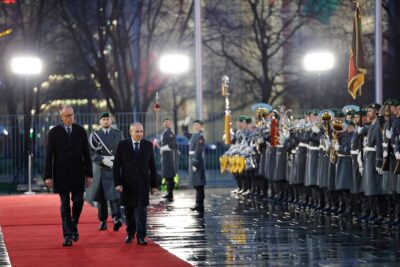
BERLIN — Armenian Prime Minister Nikol Pashinyan’s recent two-day visit to Germany signaled a major advance in bilateral relations, but grave concerns about his domestic and regional agenda dimmed the glow of this achievement. His official German hosts rolled out the red carpet for him, but as his motorcade was approaching government quarters, Pashinyan could not avoid seeing a group of 30 demonstrators protesting his domestic and regional policies. They represented German and international human rights organizations, Society for Threatened Peoples (GfbV), Working Group Recognition, Against Genocide, for International Solidarity (AGA), Christian Solidarity International (CSI), and also the Central Council of Armenians in Germany (ZAD). And they had a different message of welcome.
Arriving on December 8, Pashinyan had a packed schedule of high-level meetings, which began with a private session with Federal President Frank-Walter Steinmeier, and was followed by a discussion and joint press conference with Chancellor Friedrich Merz. On December 9, he delivered a keynote speech at the German Council on Foreign Relations (DGAP), and a round table discussion with international experts, then spoke at the German Chamber of Commerce (DIHK) in Berlin. The third day took him to Hamburg, where Mayor Peter Tschentscher received him, followed by a session with the local Chamber of Commerce. In conclusion, he met privately with the Armenian Community in Hamburg.
A Strategic Partnership with Germany
Although the content of Pashinyan’s private meeting with President Steinmeier, followed by an extended format, has not been made public, topics covered included bilateral relations and the ongoing peace process with Azerbaijan. The centerpiece of the visit was the ceremonial signing of a joint Declaration on the Strategic Agenda for Bilateral Partnership between Armenia and Germany. As part of the introduction, the document states that the parties share a positive assessment of the Armenian-Azerbaijan peace agreement and promote normalization of relations between Armenia and Azerbaijan as well as Armenia and Turkey. As detailed in the points, the agreement covers political and diplomatic cooperation, economic and trade relations with emphasis on developing capacities in the energy, climate, and water sectors, as well as rule of law and constitutional reform. A key item relates to the cultural and educational realm, with cooperation in academic work, research and scholarship, as well as in science and technology. The last item, significantly, relates to security and defense.
After the two heads of government had signed, and exchanged the documents, Merz officially welcomed his guest. He cited Steinmeier’s recent visit to Armenia and his own planned visit next May, to attend the European Political Community Summit in Yerevan, as examples of rapidly developing bilateral relations. Merz focused in the press conference on the Armenia-Azerbaijan peace talks which he characterized as “a great achievement” and seemed to link a successful outcome to chances for EU membership, for “Armenia and Azerbaijan.” Merz also warned of Russian destabilization efforts through cyber-attacks and drones, an oblique reference to the geopolitical thrust of the matter.
His Armenian guest lauded the strategic partnership as “truly historic.” Pashinyan thanked Germany for its continuing support, also regarding the peace talks.