

Adrineh Mirzayan

Adrineh Mirzayan Amplifies the Armenian Voice through Film Production

1584
0

By Mariam Pashayan

Special to the Mirror-Spectator

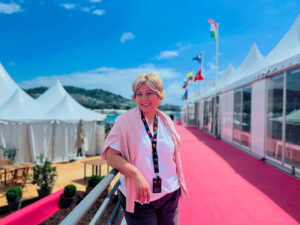
LOS ANGELES — “We each have to write our own narratives and tell our stories,” Adrineh Mirzayan says, her voice steady but filled with conviction. “We have so many incredible stories that need to be shared with the world.” Adrineh has had a 25-year hospitality career spanning positions with InterContinental, Omni Hotels, and Four Seasons Hotels and Resorts in Los Angeles, but she has chosen as her vocation to promote the Armenian story through film, and in particular supports the work of film director Jivan Avetisyan.

Adrineh was born in Tehran, the youngest of three siblings, but moved with her family when 8 to Germany. She lived there for three years before relocating to the United States, where she attended Holy Martyrs Ferrahian Armenian School in Encino. She graduated from California State University, Dominguez Hills, in 1993, and obtained a master’s degree in public administration from California State University Northridge in 1998, before beginning her career in the hospitality field.

Complex Family Background

Her family history played an important role in her decision to promote Armenian causes and cinema. Her paternal grandparents were survivors of the Armenian Genocide; her grandfather was born in Erzurum, her grandmother in Kars. To escape the massacres, her grandfather fled to Krasnodar, Russia, but the oppression of communism soon pushed the family to seek freedom in Iran. After moving to Tehran, to better integrate, he changed their last name from Gobalian to Mirzayan. Adrineh’s father was just 10 when they arrived in their new country.
Get the Mirror in your inbox:

On her mother’s side, her grandmother was born in Russian Armenia near Gavar, while her grandfather was born in Karadagh in Iran, just across the Araks River from Karabakh — a region that shared the same dialect. “I grew up in a household that spoke the Karabakh dialect,” she recalls with a smile. She laughs, “People say, what type of Armenian are you? I always say, I am an Armenian — a citizen of Armenia — because that’s the reality of it.”

She paused, declaring, “My story is not necessarily an original one — there are many stories like mine,” before relating the story of Hovhannes, her maternal grandfather. He was only 4 when his family moved from Karadagh to Baku in the early 1900s. Aleksander Mantashev, an Armenian oil magnate, had created many jobs through the oil industry, and many Armenians from Karadagh, including Hovhannes’s family, moved there to take advantage of these opportunities (just as Adrineh’s maternal grandmother’s family moved from Gavar (Kavar) to Baku for the same reason).

Afterwards, Adrineh said, Hovhannes “was sent to Shushi before World War I to study at a prestigious school called Ryal, (established in 1881). He studied there for eight years, but when war broke out, he fled with an Armenian family and became an orphan. He ended up in Zaqatal [today Zaqatala, a city in northwestern Azerbaijan], losing touch with his family for two years — until one day, a woman who knew his family saw him. She recognized him and notified his family. Fortunately, he was reunited with his mother. Adrineh concluded, “Every time I tell this story, I get teary.”

While in Baku, her maternal grandmother’s father and brothers bought an oil well and became prosperous but all that came to an end when the Bolsheviks took over in 1920. Adrineh’s maternal grandparents got married in Baku but left to live in Iran, which is where Adrineh’s parents married.

Adrineh’s family later owned a villa on the coast of the Caspian Sea in Iran. Many of her childhood memories are tied to that place, as she would spend three months there every summer with her big Armenian family. “Even the smell of a flower can bring back moments we shared with our grandma, aunts, uncles, and cousins,” she recalled.

When asked about her parents’ effect on her life, her face lights up: “My dad was a very influential man… I always looked up to both my parents.”

Topics: film

Her father was a Ph.D. graduate in electrical engineering who studied in Germany and went on to become CEO of the German company Siemens. Her mother devoted herself to humanitarian work for Armenia and Armenian communities.

“It’s no coincidence that I became a producer,” Adrineh said. “I didn’t just wake up one day and decide to become a film producer. Being Armenian is a full-time job. You just do it — and do it well and be proud of being Armenian.”

In 1998, she traveled with her family across Armenia and Artsakh — a journey that would soon shape her role as a cultural influencer in the Armenian community. What she saw reminded her of the stories of survival of her own family and she recalled that she decided she wanted somehow to let the world know about the resilient Armenians.

Adrineh’s work as an executive in hospitality allowed her to develop strong leadership and communication skills in cross-cultural settings. She worked for the Armenian community in California for many years before she was asked to be part of the distribution committee for the film “Tevanik,” in 2014, which marked the beginning of her collaboration with Avetisyan.

From Hospitality to Film Production

When she viewed “Tevanik” in 2014 for the first time, she said, “I cried the entire time watching the movie. It reminded me so much of my grandmother, of my childhood, of the stories I had heard. I felt alive.” Adrineh recognized Jivan’s potential immediately, though “Tevanik” was the first film he had directed. “I wanted to invest my time in someone with vision who was doing something meaningful for our people.”

Her role as a producer was born out of what she called Armenian patriotism. She became involved in every stage of production, from contracts to the creative process. She said: “Sometimes we rewatch takes several times to choose the best one. I’m emotionally attached. This isn’t just one project; this has been an 11-year journey. I’m part of multiple films.”

When asked about the casting process for the actors for Jivan’s movies, she responded that the casting is never about seeking celebrities. She said: “We have so many stories that need to be told. It’s not about how famous the actor is — it’s about who can truly embody the character that Jivan envisioned.”

As far as the financing of the films is concerned, she noted “at the end credits, all the names are Armenian names.” A non-profit organization was created to accept donations. The Armenian government’s National Cinema Center reviews film proposals and if it accepts a film, often it provides the greatest financial support.

She added, “the way our strategy works is one film brings in the budget for the next film.” Currently Jivan’s team has grown to six people, working alongside four volunteers, many of whom are from the Birthright Armenia program.

When she started speaking about their upcoming film, “Revival,” Adrineh’s voice lifted with excitement: “It’s about emotional intelligence. There’s a powerful force behind it. Armenia is becoming a hub for AI, and we’re showcasing that talent in this film. I believe something big and beautiful will come from it.”

In addition to her deep dedication to Armenians, Adrineh attempts to connect with all types of people and communities across the world.  “To understand people better — to connect with humanity — you must travel,” she said. She has traveled across the globe, including China and Vietnam, and even twice to Africa. She has one more destination remaining on her list of places to visit: Antarctica.

However, Adrineh remains focused on a key mission: “Armenia needs the diaspora, and the diaspora needs Armenia. We must build that bridge.” She is optimistic for the future and, in harmony with the message of Jivan’s forthcoming film, declares “Our Armenians are going to be revived.”

Get the Mirror-Spectator Weekly in your inbox: