

Lydie Belmonte

Lydie Belmonte: The Artist in Soul and in Life

13
0

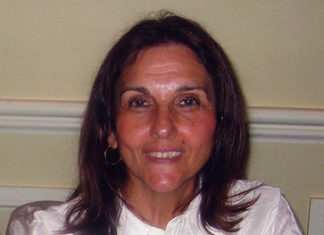
YEREVAN-MARSEILLE — Lydie Belmonte (born in Marseille) is a French actress, writer, singer, historian and multidisciplinary artist. Born to an Armenian mother and a Spanish father, her multicultural background has strongly shaped both her artistic sensibility and her intellectual interests. Trained in dramatic arts at the Conservatory of Dramatic Art in Marseille, she was awarded a gold medal early in her career. Alongside her acting career, she pursued academic studies and in 1991 earned a master’s degree in history from Aix-Marseille University, focusing on the history of the Armenian community in Marseille. As a stage actress, she has performed in numerous productions and has also written, directed, and performed her own original works. Her creativity extends to cinema and television, where she appeared in several films and TV projects in the late 1990s and early 2000s. Lydie Belmonte is also an acclaimed author, particularly known for her historical and literary works on Provence and the Armenian diaspora  (“Little Armenia,” “Marseillaises le dictionnaire,” “The  Armenian Blue Cross women”) as well as theatrical pieces The Entrance  (L’Entracte), The Caregiver (La garde-malade) and  “Sacred Souls” (“Sacrées F’Ames”).

Dear Lydie, your career spans theatre, playwriting, jazz and chanson singing and historical research. How do your colleagues in the arts respond to your academic work? And do your academic peers ever see your artistic pursuits as a kind of diversion?

I have always been atypical, highly sensitive, multi-potential, and multidisciplinary. I am passionate and curious. You can also add dance and drawing, painting as well. I know I can be unsettling because I don’t fit into boxes, but when I commit to something, I give it my all, with all my heart. If others don’t understand, so be it.

Your book From Little Armenia to Boulevard des Grands Pins (Éditions P. Tacussel, 2000) received wide recognition—including a mention at the Grand Prix Historique de Provence and the Georges Goyau Prize of the Académie Française. It was also the first work on an Armenian subject to receive such an award. There was a second edition, La Petite Arménie (Little Armenia), winner of the Academy of Marseille Price, and you currently preparing a third edition, while seeking a national and international publisher. What do you think makes your study unique?

Its uniqueness lies in its soul. With a glowing foreword by Charles Aznavour, it combines scientific rigor with a rich collection of archival documents and intimate testimonies, offering an authentic and deeply human portrait of Armenian Genocide survivors.

Written as a duty of memory and published at a historic moment, just before the disappearance of the last witnesses of the genocide, an excerpt from the book was read at the French National Assembly when France officially recognized the Armenian Genocide. I was profoundly moved to learn that the book has found its place in universities across the world and at the U.S. Senate.

Get the Mirror in your inbox:

Beyond your historical research on the Armenian community in Marseille, do Armenian influences appear in your acting or singing — apart from performing Komitas, of course?   

My Armenian influences are, without a doubt, modesty and hypersensitivity — an empathy that makes me feel everything with depth and intensity, and an oriental, nostalgic undertone. These qualities led me to earn a gold medal in Tragedy and a silver medal in Classical performance. My Armenian grandfather was a gifted storyteller, and my Armenian grandmother sang in Armenian. I never knew them, yet their souls walk beside me and guide my path.

Can you tell us about your Armenian roots—where does your family come from?

My grandfather, Nechan Ghougassian (Tatossian), hailed from Palou, near Kharpert. A grain farmer by trade, he narrowly escaped death three times during the Armenian Genocide — a man marked by survival. My grandmother, Elvanik Kevorkian, twenty years his junior, came from Antalya. They met after the genocide aboard a ship carrying survivors to Greece. In Athens, they had two children, and in 1924 they settled in Marseille, where they built a life and welcomed three more children, including my mother, Takouie Georgette. Their journey, etched in loss and resilience, continues to guide me.

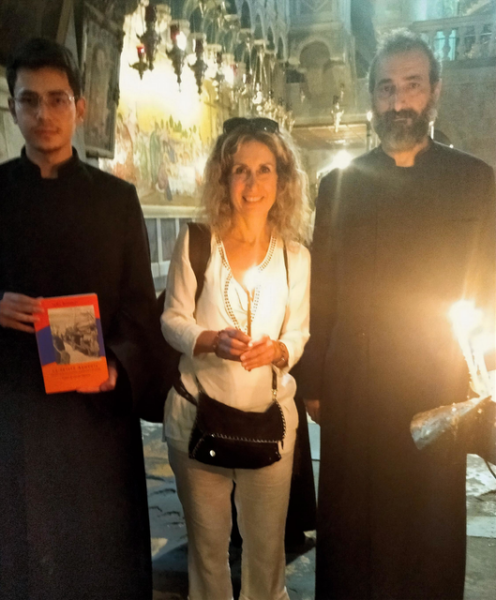
Lydie Belmonte at the Holy Sepulcher in Jerusalem in September 2022 with the Armenian priest Vahagn and a young seminarian from Yerevan. The seminarian is holding Belmonte’s book Little Armenia, which was a gift to the Armenian community of Jerusalem.

Even if you are French, what consider you Spanish in you and what – Armenian?

My heart is Armenian, French and also Spanish. I carry my paella side, with a rising influence of beurek and vine leaves! What unites all three heritages? The love of food. From my Spanish pied-noir side comes humor, passion, warmth and intensity. From my Armenian side flows modesty, hypersensitivity, tireless worker, and a wistful nostalgia that lingers like a quiet melody.

Topics: Authors

Would you say your Armenian heritage has shaped your artistic identity more consciously, through deliberate choices? Or more subtly, as an inner sense of belonging?

Yes, both, undeniably! Inside and out, in my conscious and unconscious self, I resonate as ‘Western Armenian,’ of the Diaspora, inheriting a culture and mindset that stretches from before to after the genocide, with its family and intergenerational traumas, its wounds, fears, and doubts. My whole life has been dedicated to ‘rendering Justice’ through the recognition of the Armenian Genocide, to healing through Art, to creating, transforming, elevating, and transmitting the Armenian, and above all, French, soul and culture, which are entirely my own. I am an Artist in soul and in life. It is a marginal path that demands courage and strength, talent, and also immense work, values inherited from my Armenian grandfather, a genocide survivor I never knew, who guides and protects me, and from my paternal grandmother, the Spanish pied-noir Carmen, exiled from Oran in Algeria, whom I knew and who accompanied me until the birth of my two sons. My sons spent their childhood, up to the age of 11, at the TIVOLI Armenian Cultural Center in Marseille. They speak Armenian, studied in an Armenian association, and carry both French and Armenian names.

So, I assume the Armenian traditions still shape your daily life and influence your personality.

Yes, undeniably. I sometimes cook Armenian dishes, attend the Armenian church, and remain deeply committed to the Armenian cause—within the community, through the transmission of its history and culture. Like blessed bread, my heart multiplies rather than divides, except in the face of injustice and the horrors endured by Armenia and Artsakh. I have even fallen into depression because of it. That is why I have dedicated my next show “Sacrées F’Ames” to the Armenian soldier and martyr Anush Apetyan, who was massacred by Azeri soldiers on September 13, 2022. The play tells the story of women from the dawn of time to the present day, through different archetypes. It is a musical theatre piece combining drama, singing, dance, video, and live performances with dancers. This musical performance is scheduled for March 6, 2026, in Auriol near Marseille, in celebration of International Women’s Day, and I dream of performing it one day in Yerevan.

By the way, have you ever visited Armenia?

Unfortunately, I have never been to Armenia. Yet I carry it in my heart and soul. I will go one day. When I see the mountain landscapes of Armenia on TV reports, or its historic sites, its energy speaks to me. I feel as if I already know it perhaps from another life. It must be incredibly vibrant!


Get the Mirror-Spectator Weekly in your inbox: