


BERLIN — What can civilians do to stop, or at least provide aid to victims of war or genocide? By no means an academic question today, it can be best addressed by learning from attempts made in the past, from those rare individuals who had the morality and courage to intervene. This was the approach taken by civil society proponents in Berlin last weekend, who viewed a film documenting one person’s attempt to stop the Armenian Genocide, then opened discussion on the implications for our world today.
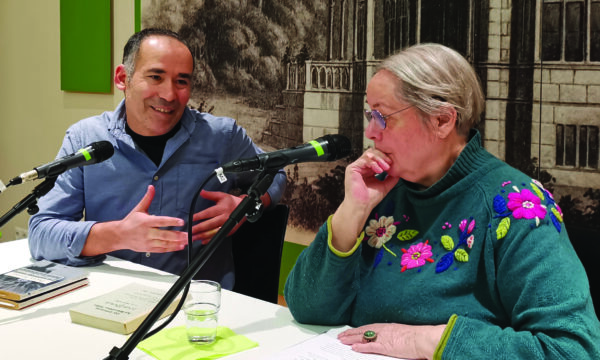
The film, “Homo Politicus,” which is Latin for political man or activist, was presented on January 23 and 24, at the Lepsiushaus in Potsdam and the AKEBI civil society group office, respectively. In addition to hosts and moderators Ulrich Rosenau and Öndercan Muti, filmmaker and director Hacı Orman and genocide scholar Tessa Hofmann provided historical background to the film and the parameters of legal and institutional initiatives developed since World War II.
“Homo Politicus” reenacts an encounter between Johannes Lepsius, a German pastor and humanitarian and Ottoman War Minister Enver Pasha on August 10, 1915. Enver had been a member since 1913 of the so-called “triumvirate” leading the Committee of Unity and Progress (CUP), with Interior Minister Talaat and Naval Minister Cemal, in a government allied militarily with Imperial Germany. The Young Turk regime, as it was known abroad, used the First World war as cover for dealing with the “Armenian question,” eliminating Armenian hopes for reform, by eliminating the Armenian population through genocide.
Lepsius, who had provided humanitarian aid to victims of the Hamidian massacres in the 1890s, returned to Constantinople in 1915, in an effort to stop the genocide and succeeded in getting a private meeting with Enver on August 10, 1915. By then, the death marches were in full swing, as German Ambassador Wangenheim had reported to Berlin. Denied access to the interior, Lepsius conducted interviews with diplomats and humanitarian helpers arriving in the capital, who reported in detail on the ongoing deportations and massacres; the resulting documentation appeared in German as, The Death March of the Armenian People: Report on the Fate of the Armenian People in Turkey during the World War.
It was not this account that first acquainted filmmaker Orman with the story, but Franz Werfel’s adaptation of Lepsius in his novel The Forty Days of Musa Dagh. In an exchange with Hofmann, the director confirmed that his was the first film in Turkey that “dealt with the theme of genocide directly – and that remains so today.” There had been documentaries as well as films about Armenians, though on other themes. “Almost all of them,” he added, “were made possible especially thanks to support by Anadolu Kültür and Osman Kavala.” The former is a cultural association founded by Kavala (who has been jailed for the past eight years), dedicated to intercultural dialog, cultural cooperation, and regional peace initiatives. Officialdom in Turkey opposed the film, so it has never been shown in the country. Although, as Orman related, it had been chosen for the Istanbul Film Festival, it was never presented in festivals or normal movie theaters and could be seen only in private viewings. This “unpleasant story” of its fate in Turkey ended with the “curious” disappearance of the raw material from the hard disk. Elsewhere, it has met with positive reactions, he added, in Armenia, Canada, the US and several European countries. “At the moment,” he remarked, “the film is even the subject of a Ph.D. dissertation in France…”
Currently, Orman, who fled to Switzerland four years ago, where he is “free to work,” has two projects on his agenda: the 1921 Berlin trial of avenger Soghomon Tehlirian, often called the “Talat Pasha trial,” and the other, Jakob Künzler, often considered the Swiss counterpart to Lepsius for the work he and his wife did to save thousands of Armenian orphans.