

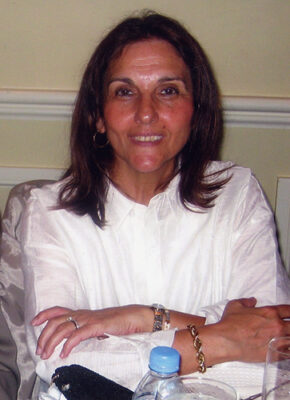
Author Arpi Sarafian

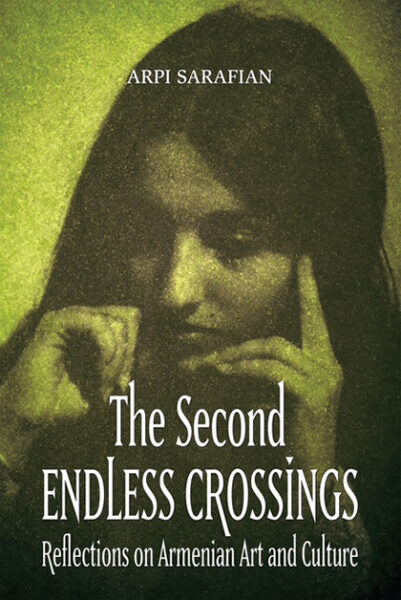
The Second Endless Crossings: Reflections on Armenian Art and Culture: Arpi Sarafian’s Critical Tour de Force

264
0

“It is simply in the nature of the Armenian to study, to learn, to question, to speculate, to discover, to invent, to revise, to restore, to preserve, to make, and to give.”

— William Saroyan

Arpi Sarafian begins her second volume of collected reviews with a quote from her literary idol Virginia Woolf: “The soul is not restrained by barriers. It overflows, it floods, it mingles with the soul of others.”

Throughout Sarafian’s delightful essays, one feels her soul overflow as well. Unlike some other literary critics, Sarafian prefers to edify rather than criticize, to uplift rather than tear down. Each one of the 56 entries in this 2024 compendium offers insight into a contemporary Armenian writer or artist. Some like David Kherdian and a revisited William Saroyan are well-known and acclaimed, while others such as the Armenian Creatives are relatively new on the scene. And given recent events in Artsakh (Karabakh) and Armenia, Sarafian’s writing takes on renewed vigor as she highlights writers with a penchant for reform, including novelist Micheline Aharonian Marcom and poet Alan Semerdjian.

Novelist Aris Janigian provides a fine and enlightening interview to open the compendium, which follows up on Sarafian’s previous volume, Endless Crossings: Reflections on Armenian Art and Culture in Los Angeles, published in 2019. The subtitles to both volumes suggest the many ways in which her reviews cross and recross the many rich layers of contemporary Armenian writing. And as Sarafian herself notes in her foreword, the title to this most recent volume also alludes to Woolf’s The Second Common Reader. The present volume is peppered with references to the brilliant feminist who famously asserted that a “room of one’s own” was needed for any successful writing career. We are glad that Sarafian has found a room of her own to write from, for her writing is equally important and enlightening within its own context. Almost all of the pieces in the compendium first appeared over the last five years in the pages of the Armenian Mirror-Spectator, where Sarafian is a regular contributor, a publication which continues to give important space to Armenian literature and writing in general.

Sarafian’s book is divided into seven parts, such as “Fiction,” “Translations,” “Armenia Forever,” and “The Promise of a Woman’s Difference.” One of my favorite pieces is her fine review of Maryam Petrosyan’s 2017 The Gray House, a best seller in Russia that has otherwise gone relatively unnoticed in the Armenian diaspora. Sarafian perfectly captures both the odd beauty and humanity of this boarding house for misfits and handicaps. Petrosyan’s tale takes the reader into a world of children who have limbs missing, who stutter and suffer from other deformities. There is even a room of death called “Sepulcher” within the house itself. In the gray house however, the children are among their own and are not judged. The book is one great metaphor for what is wrong with society. Sarafian, with her usual incisiveness, writes: “What ultimately emerges is Petrosyan’s empathy for her fellow human beings, good and bad.” And later: “Petrosyan’s imagined world enlightens and opens into spirituality. The references to the ancient Chinese Taoist philosopher Lao Tzu and the need for “introspection,” “spiritual cleansing” and “deeper self-awareness,” indicate how far we have traveled from “the spirit” of the true Tao.” Sarafian gives the reader a rare and complete overview of the book, both stylistic and spiritual, while tantalizingly dropping hints of plot details that make one want to read it its (over 700-page!) entirety.

Get the Mirror in your inbox:

Sarafian is also explicitly concerned with the place of Armenians in the American literary canon, or their lack thereof. Anyone who takes even a cursory look at current college curricula, even those purporting to represent “minority literature,” will notice a preponderance of Anglo-Saxon writers and a corresponding lack of Armenians, from Leon Surmelian down to our many brilliant contemporary poets and fiction writers: “Exclusion is the name of the game here. The majority/minority mentality in the United States has led to minority groups being repressed by the so-called dominant culture. Even at a time — roughly in the early 1970s to the 1990s — when celebrating diversity and multiculturalism was the politically correct thing to do, the works of minority (i.e. ethnic) writers were pretty much excluded from the list of ‘accepted’ texts on English booklists.”

Sarafian includes a layered discussion of that best-known of all Armenian writers: “The case of William Saroyan is a little more complex. Why would we stop teaching a writer whose works enjoyed enormous popularity when they were first published? Saroyan’s obvious celebration of our diversity may be a factor in excluding him from a literary canon that privileges Anglo-Saxon writers.”

But here as elsewhere, Sarafian goes deeper in her analysis and beyond the more obvious reasons for Saroyan’s exclusion from the canon: “I also think that the autobiographical strand in much of Saroyan’s writing places him outsides the academic mainstream which for decades following the ’30s when Saroyan’s works were being published, was dominated by the New Criticism, a critical approach that privileges texts that separate the work form its content and that lend themselves more readily to close textual analysis.” Ditto — this had always been my contention as well, namely that Saroyan’s work has been met with this double critical whammy from which it is only now beginning to recover thanks to the efforts of people like Aris Janigian and Mark Arax to re-assert his importance. In a sense, Sarafian justly asserts, the fluidity and conversational tone of Saroyan’s stories was simply not experimental enough for mid to late-century academic tastes.

Sarafian’s criticism is also unique for its breadth and scope. She reviews children’s literature for example and puts it on equal footing with its “grown-up” counterparts. The same is true for translation, an often overlooked artform. Sarafian discusses both books translated into Armenian, such as Vahe-Vahian’s pristine translation of Khalil Gibran’s The Prophet (Markaren in Armenian) —  which she deems as perhaps superior even to the original — as well as classical works such as Nigoghos Sarafian’s The Bois de Vincennes, translated from Armenian and Denis Donikian’s Trashland, translated from French but which takes place in contemporary Armenia. She also provides a delightful analysis of Shushan Avagyan’s A Book, Untitled, which recounts an imaginary meeting between two important early 20th century Armenian feminists, Zabel Yesayan and Shushanik Kurghinian.

A former professor at Cal State and a graduate of AUB who holds a PhD in English Literature from USC, Sarafian also knows when to offer qualified criticism, as when she suggests for example that a text by the talented Kamée Abrahamian might be stronger if not published handwritten or when she takes the outspoken Kardash Onnig to task for perhaps too often changing his opinions. Yet she is always fair. Sarafian also has a eye for covering both established authors like Micheline Aharonian Marcom whose distinctly lyrical deconstructed style may have encountered resistance among more conservative Armenian readers — here she glowing accounts of both a brief history of A Brief History of Yes and The New American, to writers like the sublime poet Alan Semerdjian and the powerfully gritty Aida Zilelian. Sarafian also has her hand on the pulse of latest developments, as in the three pieces that she devotes to the singular group known as the Armenian Creatives under the separate entry “We Resist.” This group of young writers is almost single-handedly revamping Western Armenian with new vocabulary, slang and modes of writing previously ignored by a language which has of late been passed down mainly through outdated textbooks and such. At first Sarafian is somewhat puzzled by the collective’s work, but by her third review she has been won over — and is proud to say so!

Sarafian also sheds light on some of our most gifted writers whose work has perhaps been at times uneven, such as her sensitive accounting of Pete Najarian’s 2021 Mutual in Love Divine, a sixteen-part opus on the themes of love and death. She ends this piece, her penultimate review in the collection, by describing this excerpt: “Once upon a time before the atom bomb and the mass extinction of life, a woman walked home from the factory at day’s end…” as “exquisite writing. Mutual in Love Divine is Najarian at his best.” One wants to add that this is Sarafian at her best as well, were it not for the fact that all her writing seems equally exquisite, like a new flower which blooms under the writer’s fine pen each time she sits down to write.

Re-reading the essays in Sarafian’s book engendered the following reflection in me about the disconnect between cultural transmission and the survival of Armenian culture, especially in the diaspora. Writing a check for a designated charity or the construction of a new church are laudable acts, but they usually require relatively little time commitment or creative thinking on the part of donors. The same is true of volunteering for most community events. Meanwhile, the type of thought and writing that a few people like Sarafian quietly engage in exists on an altogether different and perhaps higher plane. Along with teachers who transmit the Armenian language and culture daily to their students, nothing is more difficult — and important — than to think, critique and suggest new directions for cultural workers such as writers, artists and performers. We owe Sarafian a debt of gratitude and hope that her pen continues to grace the pages of the Armenian Mirror-Spectator for some time more to come.

Get the Mirror-Spectator Weekly in your inbox: