

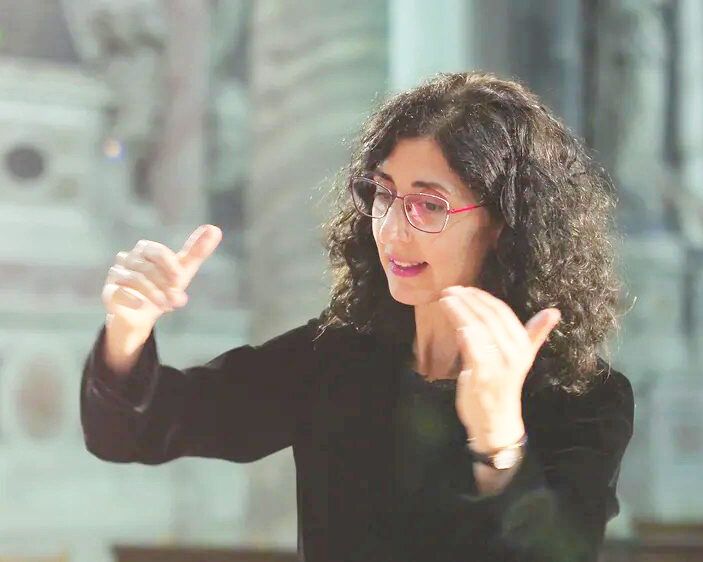
YEREVAN/VENICE — I met conductor and composer Justine Rapaccioli last August in Venice, after the Divine Liturgy held at the city’s Armenian Church of the Holy Cross. Justine was born and raised in Britain and studied at Royal Holloway (University of London), the University of Pisa, the Venice Conservatoire, the Accademia Musicale Pescarese, and the Accademia Europea in Vicenza, earning a degree in music and diplomas in violin, piano, choral conducting and orchestral conducting.
Active in the field of contemporary music, Rapaccioli has conducted performances for both the Venice Biennale Musica and Biennale Arte. She is also regularly invited to work as a choral clinician at international workshops and seminars. As a composer, Justine writes principally for choir, and her music has been performed in Italy, England, and France. In 2019, The Tallis Scholars performed her motet for double choir, Quae est ista, in Rome, Florence and Genoa. In 2023, her Da Pacem Domine, written for five sackbuts (an early form of the trombone used during the Renaissance and Baroque eras) and choral drone (a sustained, continuous vocal note or chord sung by a group of singers to create a fixed harmonic foundation), received its premiere performance at the Royal Chapel of the Palace of Versailles.
She is the founder and director of the vocal group Edesse Ensemble, a recipient of the Komitas Medal, and one of the few vocal ensembles in Italy which actively programs and performs Armenian music.
She is Deputy Conductor (Maestro Sostituto) of the Cappella Marciana, the choir of St Mark’s Basilica, Venice. Her work has also been featured in interviews on BBC Radio 3.
Dear Justine, you are active both as a conductor and a composer, with a particular focus on choral music. How do these two aspects of your musical life influence one another, and does your experience as a conductor change the way you write for voices?
These two aspects are certainly intertwined, although it’s the conducting which mostly informs the composing. Being a conductor naturally involves immersing oneself in the music one has to perform, which, in its initial stages means making a thorough study of the score. This provides insights into the composer’s distinctive compositional process and style. Then, the physical act of conducting itself reveals how the singers respond to what they read on the page, the places of ease or difficulty — in tuning, breathing, timbre, sustaining the line of the phrase and so on. This all becomes significant when I’m writing my own works. I’m inspired by the writing of other composers and also very mindful of what suits the voice best, what is possible at a practical level.