


That Western Armenian, the language spoken by most Armenians in the diaspora, is still alive must be evidence of its openness to grow and to evolve, readiness to change being an essential characteristic of language. Especially in a multi-lingual universe, such as the Ottoman Empire where Western Armenian took root, words, themselves not fixed entities and all too often dependent on their contexts for meaning, are borrowed from the surrounding languages as needed, to eventually become part of the recipient language.
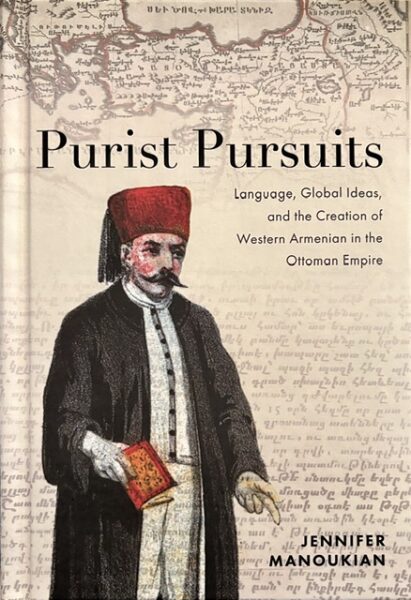
Jennifer Manoukian’s groundbreaking Purist Pursuits: Language, Global Ideas, and the Creation of Western Armenian in the Ottoman Empire (Stanford University Press, 2026) is built on the premise that the social realities surrounding the evolution of Western Armenian, starting in the 18th century to the 1915 Armenian Genocide and beyond, have not been adequately examined.
In the realm of the diverse cultures and populations of the Ottoman Empire, avers Manoukian, words from Turkish, Arabic and other languages were constantly borrowed by Western Armenian. Manoukian deplores the fact that in their eagerness to create a pure language that would be in line with the rising nationalistic ideologies that started with the 1840’s, the “intellectual purists” of Istanbul, who were at the helm of the creation of Western Armenian, cleansed the language of loanwords in favor of previously used or newly coined Armenian words, based on the belief that one nation should speak one language.
Using “pure” Armenian was never a historical norm, asserts Manoukian. There were indeed more than 70 dialects — regional non-standard varieties of spoken Armenian — in the Ottoman Empire in 1915, Western Armenian being only one “among many valid language varieties worthy of scholarly attention.” It was only in the 1890s that the purified vernacular of the Istanbul dialect, referred to as Western Armenian, replaced Classical Armenian — in use since the fifth century primarily as a written language — and spread as a spoken language. The merger of the written and the spoken languages was completed in the aftermath of the 1915 Genocide, in the diaspora.
“Language purity in and of itself [is] a myth,” notes Manoukian. Indeed, protecting language from foreign influences to keep it “pure” is an impossibility as no language exists in complete isolation. The constraints of purism on self-expression, adds Manoukian, create intense anxiety, as they ignore “the inherent geographic, social, and situational variability of spoken language.” It may in fact have been unrealistic, for a linguistically diverse population, to make the use of the 1890s Istanbul dialect — cleansed of its Turkish borrowings — the sole model for speech. Yet, to claim that the current status of Western Armenian as “definitely endangered” — as classified by UNESCO in 2010 — is largely due to contemporary speakers choosing to abandon it altogether because of their feelings of anxiety, “a direct result of the ideology of purism fashioned in the Ottoman period,” would be downplaying the complexities of maintaining a standard Armenian language in a globally dispersed diaspora.
The ideals of stability and unity are not inherently negative. It is the insistence on fixed, rigid forms of “correctness” that creates the paralyzing anxiety and the fear of failure that would incite speakers to refrain from using the language. A comment from one of my freshman students on his high school English Composition essays sums it all up: “I used to get my essays back bleeding.” One does not need policing to teach “correctness.” In fact, telling students not to worry about mechanical correctness/rules in the early stages of their composing helps create the non-threatening environment they need to acquire the necessary skills to get their meaning across.