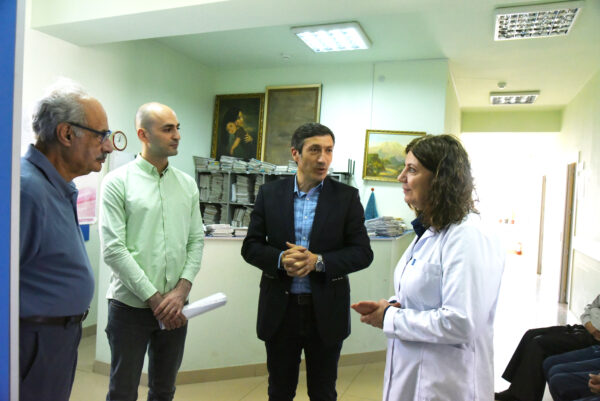


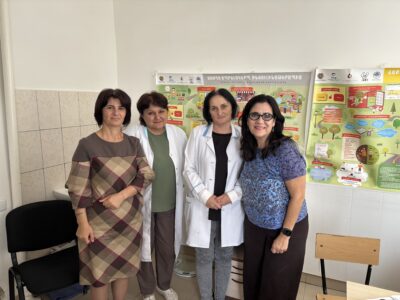
Dr. Armineh Mirzabegian, right, at the clinic in Khndzoresk

BOSTON — The Armenian American Medical Association of Boston (AAMA) and the Fund for Armenian Relief (FAR) have banded together to bring heart health to rural citizens of Armenia. The aim is to reduce high blood pressure among residents there, since that condition can lead to heart attacks or strokes.

The Hypertension Management Program in Rural Armenia (in memory of Dr. Aram V. Chobanian) is an initiative by AAMA, which FAR is implementing in collaboration with HENAR (Health Network for Armenia). The program is funded by the Afeyan Family Foundation.

This past September, AAMA board member Dr. Armineh Mirzabegian visited the two clinics where the project is taking place, in Aragatsotn and Syunik provinces.

“We knew cardiovascular mortality is the leading cause of death all over the world and hypertension is the leading reason for cardiovascular illness, and we knew if we worked on this, it would be very impactful,” said Mirzabegian in a recent interview.

She was joined in the interview by Dr. Hambardzum Simonyan, the deputy country director on development and healthcare programs at FAR.

Mirzabegian said, “Worldwide, only 1/5 patients with hypertension have their blood pressure adequately under control (WHO), and in Armenia, studies indicate the control rate to be less than 20 percent.”

Get the Mirror in your inbox:

Follow-up visits and communications are key. In fact, she noted that institutions in the US that have implemented large-scale hypertension programs can achieve control rates more than 80 percent, such as Kaiser Permanente (CDC).

The inception of the program dates back to 2019, when Dr. Aram Chobanian, the former president of Boston University and a cardiovascular specialist, was alive. Post-COVID, Dr. Noubar Afeyan announced that he would fund an AAMA program in Armenia.

The impetus for the project came from Mirzabegian’s experience with her patients here as a primary care physician. “Blood pressure often increases with age, raising the risk of stroke and heart disease. Controlling your blood pressure can greatly reduce this risk, said Mirzabegian.

She continued, “As our project advisor, Dr. Chobanian emphasized the importance of adopting a systems-based approach, alongside educating doctors and nurses. Drawing on insights gained from attending a  Conference on Cardiovascular Disease and Global Health and through close collaboration with fellow board members, including Dr. Vatche Minassian, a proposal was developed. However, a local partner in Armenia was still needed, and thus, FAR  was approached.”

“Why FAR? They have had continuing medical education programs for over 20 years, not just for doctors but also for nurses, across provinces in Armenia. They have the infrastructure in place and the network,” she added.

This is the first project between the AAMA and FAR, though previously, the two had collaborated on sending humanitarian aid during the Artsakh war and COVID-19.

Increasing Heart Disease

Simonyan and Mirzabegian said one in three adults in Armenia is affected by hypertension. There are fewer resources in rural areas, and thus, they decided to focus on it. FAR settled on Byurakan in Aragatsotn and Khndzoresk in Syunik as the pilot sites.

Khndzoresk is on the border with Azerbaijan and is serviced by a mobile component through HENAR and Santé Arménie. There is one doctor in a van visiting the surrounding villages. In Byurakan, the program is situated in a building.

In this collaborative effort, the doctors in the US share their knowledge and experience and the doctors on site in Armenia do the work seeing patients and following the guidelines of the WHO Hearts Package.

The WHO guidelines specifically address needs in developing countries, with emphasis on affordability and behavior modification, in addition to medications and follow-ups after the initial diagnosis.

Both stressed that hypertension is already being treated in Armenia, however, this specific protocol is creating a model for a start-to-finish model in rural regions, where patients’ adherence to a treatment regime is not consistent.

“When you have a protocol, it gives more value and emphasis. We’re constantly learning in terms of what combinations work better. I still have to go to classes, learn motivational interviewing, what can you suggest to the patient to adhere to the medications, because, for example, some people skip pills,” Mirzabegian said.

“It has several steps, which includes making sure the medications are available, making sure the doctors and nurses are trained and that educational materials are available for patients to get them engaged,” she said.

That includes electronic records, which Armenia is in the process of implementing, Mirzabegian said.

Explained Mirzabegian, “The goal is to use this specific hypertension treatment protocol, such as what medication to use first, second third, patients come in once a month to check, etc. They have that in place. It is a team-based approach.”

Simonyan concurred. “According to the WHO, the purpose of this model is to establish the interrelated and obligatory cycles that are necessary for better control, such as community engagement, medicine, treatment adherence, patient education and an electronic database. For this we need to conduct a baseline evaluation with physicians and healthcare workers in the pilot sites and get them trained and train the patients, provide the medicines, etc. All this requires certain organizational work.”

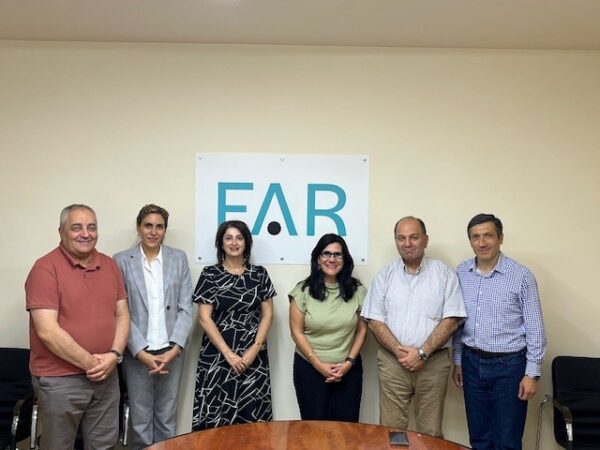
Meeting with the FAR physician experts , who provide guidance and training for the local physicians and staff at the two sites mentioned. From left, Samvel Hovhannisyan, family practice, Laura Sahakyan, Cardiology, Elena Aghajanova, Endocrinology, Armineh Mirzabegian, Primary Care (AAMA), Hamayak Sisakyan, Cardiology and Hambardzum Simonyan, FAR Deputy Country Director, Healthcare Programs Director

Simonyan’s colleagues in Armenia in this effort include Dr. Arno Hovhannisyan, and Armenian experts, Dr. H. Sisakyan, Dr. S. Hovhannisyan, Dr. E. Aghajanova and Dr. L. Sahakyan.

He added that he hoped the program would grow nationally. He said, “Our long-term goal is to show the government the success of this model and insist on replicating it nationally. In this case it’s very important to have also approval by local experts and specialists who played an instrumental role in the adoption of these protocols, training guidelines, and training for local staff.”

A vital point for doctors working in rural places is that medicine is not the most important part of the control, but behavior and lifestyles are, Simonyan said. “This is a very simple protocol. It is very affordable so this is why we are sure that if we have success, we can share it with the government.”

“The behavior change is much more important. This program, we use this opportunity one more time to provide our health care professionals working in primary care that they should spend a little more time for patient education, for follow-up and monitoring, which are necessary in Armenia,” Simonyan said.

Something that sets the WHO protocol apart from the protocol in first-world countries is emphasis on follow-up, finding out why patients don’t come for scheduled visits and more direct communication stressing the importance of the process. “If you have that system in place, it’s going to make a big difference,” Mirzabegian said.

While many often think that the typical diet of Armenians is healthy, Simonyan said that much has changed. Fast food and junk food are prevalent even in rural areas, including foods with high sugar and salt. In addition, traditional breads and cheese are very salty. Tobacco and alcohol consumption remains high, with smoking rates climbing.

In addition, obesity is increasing due to an unhealthy diet and little physical activity.

At the Byurakan clinic, with Dr. Richard Babayan, left, and Dr. Hambardzum Simonyan, right, and colleagues

Positive Results

The efforts seem to be paying off.

“After four months we found positive findings,” Simonyan said.

“We already have an idea how it’s working. We are in the right direction. It’s not a formal evaluation but preliminary results show that we have registered decreasing in both sites elevated blood pressure. It is the first stage before the diagnosis of hypertension,” Simonyan said. “We have improvements in important indicators. … They registered some community members who said they have started to smoke less and started to walk and increase physical activity.”

Some preliminary numbers indicate that the elevated blood pressure numbers in Byurakan have gone from 31 to 23 percent and 53 to 40 in Khndzoresk, he said.

Mirzabegian said that when she visited Khndzoresk, she heard from physicians that patients would come more frequently and talk about other concerns, such as cholesterol and diet. “They felt they were being heard and that people cared for them. It is a motivation.”

She said one particular doctor in  Byurakan area started to walk with her husband in the evenings. At first, many thought it was strange. Before long, most of the villagers joined them in the evening strolls.

And the benefits seem to trickle in a different direction. They got high school students to do data entry after asking the patients questions. Those students have gotten certificates which will help them especially as some have been motivated to get into healthcare.

Mirzabegian stressed that the program can be formally assessed after 18 months.

Simonyan paid tribute to Mirzabegian, saying similar programs are executed with a huge staff. “We’re doing this program with a small staff but great dedication,” he said.

—Alin K. Gregorian


Get the Mirror-Spectator Weekly in your inbox: