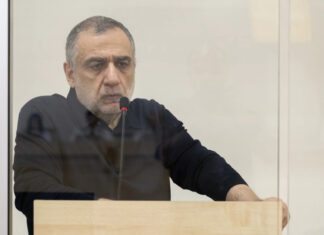


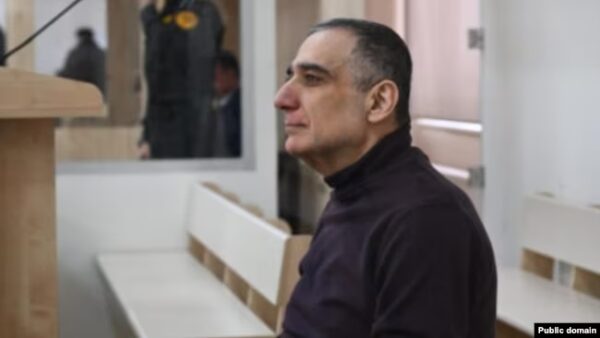
Ruben Vardanyan at a trial session in Baku

About Ruben… and Indifference (A Personal Testimony)

285
0

By Vahan Zanoyan

“It is not death that is frightening. What is truly frightening is indifference — a state that enters us quietly and gradually, like radiation, and destroys us from within.” Ruben Vardanyan from a cell in the dungeons of Baku, December 17, 2025

At first I hesitated to write this article, because this topic is personal, and I have long advocated de-personalizing articles that touch upon inter-Armenian political affairs, and focusing instead on political issues rather than individual actors. But in this case, I will make an exception. I will speak about Ruben Vardanyan the person, as I’ve come to know him in the past 20 years.

Indifference has always been Ruben’s nemesis. In the office building of one of Ruben’s foundations, on 6 Baghramyan Street in Yerevan where we used to hold many meetings, in one of the conference rooms, on the wall, there is the following quote from Elie Wiesel, who was a member of the Aurora Selection Committee:

“The opposite of love is not hate, it’s indifference.

The opposite of art is not ugliness, it’s indifference.

Get the Mirror in your inbox:

The opposite of faith is not heresy, it’s indifference.

And the opposite of life is not death, it’s indifference.”

One of the most unforgivable shames of our nation today is the fact that we casually accept the presence of Armenian political prisoners in the dungeons of Baku. I shudder to think how Ruben would cope with today’s Armenia and with the widespread malaise and indifference prevalent in the entire Armenian nation. If he were free, Ruben would not be silent about their fate, regardless of whether he liked, agreed with or respected them as individuals. He refused to leave Artsakh when he had a chance because he did not want to leave the others behind. I can personally attest to this through my conversations with him during the last days before his arrest. If he had the freedom, he would devote his resources — both material means and the influence of his global relationships — to secure their release. And his motive to help free his compatriots would go beyond the individuals involved: he genuinely believes, as I do, that it is not just the fifteen individuals who are on trial in Baku, but the entire Armenian nation. That would be the motivation behind his determination to act. And although there are individuals and NGOs concerned with the freedom of our prisoners in Baku, painfully there is no widespread public outrage, and no consequential effort from our own government to secure their freedom.

I first met Ruben Vardanyan twenty years ago, in Davos, Switzerland, at the World Economic Forum. I was a moderator in some Davos discussion sessions at the time, and I was actively looking for Armenian participants. In the commotion of several hundred global political and economic leaders, I found Ruben Vardanyan. Even though relatively young, he was full of ideas and perfectly at ease in that global leadership circle. After the 2020 war we became much closer, and our relationship flourished into frequent meetings and discussions about the post-war Armenian condition, both in groups and bilaterally. I was with him when he took the decision to move to Artsakh. It was his decision, and his reason for taking it was nothing more than to try to prevent the depopulation of Artsakh.

The opposite of everything worth fighting for is indifference. And we seem to have lost the will to fight for the many just causes that we have fought for, and, because of that struggle, we have survived and maintained a sense of national identity. There are some pundits today who question the importance of our national identity, history and values. “Whose identity?” they ask sarcastically. “Mine, or yours?” “We’ve been sacrificing ourselves for 200 years defending this identity, isn’t it enough?” they ask. And the gullible members of our public buy the argument, not realizing that they are being led to the nation’s ideological slaughterhouse. (Paradoxically, what has reinforced the public indifference to the looming dangers to our security and national values have been a series of successes in areas unrelated to security policy, driven largely by Diaspora initiatives, such as education, healthcare, science and technology).

Ruben is one of the most principled men that I know. He will not compromise his values. For him, red lines are red lines, not subject to negotiation. After over two years in the most gruesome conditions in Azeri jails, he dares to declare “Artsakh was, is and will be” from the very jail where he got incarcerated for his devotion to his historic homeland. That statement may sound naïve, reckless and irresponsible to some (in fact, to many) in Armenia today, but it is not. It is principled. It is faithful. It is more genuine than most of the hopelessly defeatist statements appearing in our public discourse today.

Ruben has issued several messages from prison, through phone calls to members of his family. On May 30th of 2025, in connection with Ruben’s birthday, there was a discussion entitled “Dialogue with Ruben” organized by Ruben’s friends and colleagues. I had the honor to be present at that session, and, in my talk, analyzed Ruben’s messages sent from prison. So, I will not dwell on them further here.

But it is impossible not to cite one of his prison messages: “I am ready to be at peace with myself until the end and be completely happy.”  This, from a man, who has every reason to be bitter with the world, even, and especially with, the Republic of Armenia and with his compatriots. Yet, since his incarceration, he has not issued a single bitter or negative word about Armenia or Armenians. He is the personification of the exemplary Armenian, a true patriot, holding on to his principles and national values, and not breaking under the severe physical and psychological stress that he is subjected to.

This, I believe, is at least one of the reasons why Aliyev decided to try him separately from the others. Another reason is the fact that Ruben is one of the most well-known and respected Armenians globally today. Through this trial, Aliyev wants to neutralize the phenomenon of Ruben Vardanyan, not merely his person.

The widespread indifference in Armenia today reminds me of the boiling frog metaphor, which is about how a frog thrown in boiling water would jump out, but one in cold water that is heated slowly will stay until it boils to death, indicating how people gradually adapt to evolving dangerous situations until it is too late. The truth is that in real-life experiments, even frogs in cold water, when gradually heated jumped out. But our nation seems to have adapted to the rising temperature of the water we’re in. The losses of the 2020 44-day war should have been the most significant increase in the proverbial water’s temperature and acted as a wake-up call. But they were somehow accepted as an inevitable outcome, and later constantly downplayed by the official rhetoric. Eventually, our losses were justified by the argument that we had been in the wrong fight all along, and that the defense of Artsakh had been an impediment to Armenian statehood. These arguments were used to scare the public with imminent new wars.

By the time the main shock, the actual loss of Artsakh came in 2023, the public had already been desensitized and demoralized, and lost interest in Artsakh, also through public rhetoric. The occupied strategic territories in Armenia proper, which, in any normal country would have been a major and constant issue of public discourse, lost their importance. During this time also came the removal of our key national symbols, the marginalization of the Genocide, the sidelining of history and its lessons, the downgrading of national identity, values and dignity, and, more recently, the destructive and shameful conflict between the government and the church, and the increasing number of internal political prisoners in Armenia, which kept raising the temperature of the water further, while our nation was being drawn into a demoralized state of oblivious illusion about peace with our enemies and the promise of continued economic prosperity.

We are now at the point where we may not even have the strength to jump out. It may be difficult for many visiting Yerevan to believe this, but we are at that existential junction as a nation and as a sovereign state. The visible well-being in Yerevan and the economic and scientific progress, which give the public optimism today, can be lost in an instant.

This is the indifference that Ruben most feared. This is what he fought against, and what he sought to counter by example, by moving to Artsakh, fully aware of the risks and consequences of his decision. Since this article is personal about Ruben, I would be amiss not to mention his family, especially his wife, Veronika Zonabend, and son David Vardanyan. They have handled and continue to handle the most distressing conditions and heartbreaking news about Ruben with infinite grace, dignity and strength. Veronika continues to support the projects that she started with Ruben with great vigor and enthusiasm, such as the DWC Dilijan school, the Dilijan Church, the development of tourism in Tatev, Koris, as well as Dilijan, and many other projects.

An Armenia stripped of its national character and values is already defeated, even if in peace with its neighbors, because it would be a sterilized Armenia, a skeleton, just a map without a soul—indifferent to its history, culture, rights, identity and, most of all, to its national dignity. I know there are many who will mock these thoughts, and they will base their mockery on “what did we achieve with 34 years of senseless struggle,” but our history is much longer than 34 years. Our struggle is longer than three thousand years. 34 years is nothing but a blink in the history of nations. Nations prevail because they keep the will to struggle.

Ruben Vardanyan endures the worst physical and psychological treatment by his jailers without losing his faith. The prosecutor of the sham trials in Baku has demanded a life imprisonment sentence for him. But even that has not changed Ruben. His faith in struggling for a just cause has not died. Nor has his faith in restoring our national dignity in our Motherland, which cannot be measured by internationally recognized square kilometers. The true illusion is the “internationally recognized square kilometers,” and not the concept of our Motherland. The Motherland is real, it is historical, it is carved in stone, and it is carved in the collective memory of our nation. Even after all the attempts of the Turks and the Azerbaijanis to erase our history from Western Armenia and Nakhijevan and now Artsakh, the evidence exists and it is undeniable. To paraphrase Ruben, we were, we are, and we will be there.

Let me stress that this is not a call for war. Nor is it a negation of the benefits and dividends of peace. It is, however, a negation of the idea that we must rid ourselves of our national aspirations, just causes, history, rights, symbols and identity in order to attain peace. We cannot be indifferent to all that and remain independent. We cannot be indifferent to historical facts and our rights just because they are unattainable today. That won’t be peace. That will be indifference of the worst kind — it will be defeatism, surrender and compliance with the enemy’s demands. It won’t bring security, and it certainly won’t be Independence.

I am hopeful that Ruben will be reunited with his family and friends in the near future. Meanwhile, if the “Ruben Vardanyan Phenomenon” that Aliyev fears so much and is trying to neutralize inspires even a segment of the Armenian public, Ruben wins; and, by his example, he does more for our national cause from jail than most of our political actors have been able to do from their positions of authority.

Get the Mirror-Spectator Weekly in your inbox: