

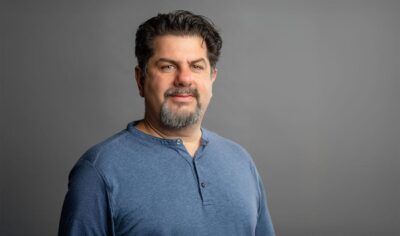
YEREVAN — The American University of Armenia (AUA) announced recently the appointment of Rev Lebaredian, vice president of Omniverse and Simulation Technology at NVIDIA, to the American University of Armenia Corporation (AUAC) Board.
Lebaredian brings more than three decades of experience in the computer graphics industry. His career has taken him through roles at Warner Bros. Digital and Disney’s Dream Quest Images before he launched his own venture, Steamboat Software.
Top visual effects studios worldwide have used his work in rendering and volumetric algorithms in numerous popular films, including “Stuart Little,” “Dr. Seuss’ How the Grinch Stole Christmas,” “X2: X-Men United” and many more.
After joining NVIDIA in 2002, Lebaredian began work on the first shading language for programmable GPUs. Since then, he has led teams tackling a wide range of challenges, from large-scale automated testing of 3D applications (GTL) and real-time physics simulation (PhysX) to in-game photography (Ansel), robotics simulation (Isaac Sim), and immersive product design and visualization (Project Holodeck).
For the past several years, Lebaredian and his teams have been integrating NVIDIA’s advancements in rendering, physics simulation, and artificial intelligence (AI) into a single platform for creating and simulating physically accurate virtual worlds — NVIDIA Omniverse. Currently, he leads the product, engineering, and research teams of NVIDIA Omniverse, an open platform that enables developers to build and operate physical AI and robotic system simulation applications.
When asked why he joined the AUA board, he replied, “An educated citizenry is essential to the survival and prosperity of the Republic of Armenia. Our only natural resource is our talented and hard-working people. Higher education is the way we will unlock Armenia’s potential energy, and through AUA I can do my small part to help accelerate this transformation. Armenian higher education needs to be world class for Armenia to prosper. With our limited population and resources, we can’t be world-class in every field, and discipline — but we can be strategic and choose a few key areas to be the world’s best.”