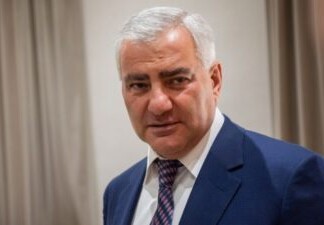



From left, Armenian scholar Andranik Arakelyan; Hayk Margarian, chair of the Trade and Investment Commission of Armenia’s International Chamber of Commerce; Itsik Moshe, founder of Israeli House; Tel Aviv-based journalist Larry Luxner; and Nairi Margari, deputy chair of the ICC’s Trade and Investment Commission, at a December 14 conference in Tbilisi (photo Larry Luxner)

Tbilisi-based Israeli House to Open Unofficial ‘Embassy’ in Armenia

743
0

By Larry Luxner

Special to the Mirror-Spectator

TBILISI, Georgia — Israel has no embassy in Armenia, but Yerevan will soon get the next best thing. In early 2026, Israeli House — a non-governmental network of cultural centers representing the Jewish state — plans to open its 28th branch worldwide in Armenia.

Local businessman Itsik Moshe, founder of both Israeli House and the Israel-Georgia Chamber of Business, made the announcement December 14 on the last day of a conference in Tbilisi marking the 35th anniversary of Jewish immigration, or aliyah, to Israel from the former Soviet Union.

Georgian students attend a December 14 conference in Tbilisi to promote Israel and counter antisemitism. The event was organized by Itsik Moshe, founder of Israeli House. (photo Larry Luxner)

“Israel Week” attracted some 300 people, about a third of them from Israel. The rest were mostly Georgians, with delegates coming also from Armenia, Turkey, Tajikistan and Iraqi Kurdistan. A few hours before participants gathered to light a menorah for the first night of Chanukah, news broke of the terrorist attack in Sydney, which killed 15 Australians doing the same thing.

“This is yet another painful reminder of the rising antisemitism that we all need to fight. We live in a very complicated world where facts are often blurred and the truth is hijacked,” said Yitzhak Shmuli, director-general of the Israel office of United Jewish Appeal-Federation of New York.


Get the Mirror in your inbox:

“Your presence here is refreshing, and it gives us hope,” Shmuli, whose organization is funding the expansion of Israeli House, told attendees. “I want to thank you for bravely standing with Israel and the Jewish people. We don’t take this for granted.”

In November 2022, Moshe was the target of a foiled terrorist attack when agents affiliated with al-Qaeda and sent by Iran’s Revolutionary Guards Quds Force attempted to assassinate Moshe on the street, in front of his own office. Fortunately, the plot was discovered by local security officials, who arrested several suspects including two Georgian-Iranian dual citizens.

Itsik Moshe is the founder of the Israel-Georgia Chamber of Business as well as Israeli House, which plans to open its next branch in Armenia (photo Larry Luxner)

Moshe, a Georgian Jew, was a key figure in the massive wave of Soviet Jewish emigration that began in 1989 and continued well into the 1990s. The first representative of the Jewish Agency in the USSR, he opened the first Israeli House in 2013, in Tbilisi. Since then, branches have been established throughout former Soviet republics including Azerbaijan, Turkmenistan and Moldova, as well as Albania, Romania, Bulgaria, Hungary and even India, Japan and Sri Lanka.

“With the rise of antisemitism, the growing concerns about the security of Jewish communities and the declining standing of Israel in many places, this model has really proven itself and could be part of the solution,” said Shmuli.

The most recent country to host an Israeli House is Colombia, whose leftist president, Gustavo Petro, is among Latin America’s fiercest critics of the Jewish state and Zionism in general.

“We have been working for 26 years in Colombia fighting antisemitism,” Viviana Valbuena, of Bogotá’s Comunidad Mesiánica Yovel, said in a videotaped message to the delegates in Tbilisi. “We defend the people of Israel, the land of Israel and the state of Israel, giving talks in schools and universities, holding marches to support Israel, and standing on the right side of history.”

Armenia and Israeli House

Andranik Arakelyan, one of three Armenians invited to the gathering, said that in the absence of an official embassy, the planned Israeli House in Yerevan will facilitate public diplomacy.

“Our two nations have a very similar history, and we share the same values,” Arakelyan said in an interview, discounting suggestions that Armenians are by nature antisemitic. “There is a small minority who think Israelis aren’t pro-Armenian because they haven’t yet recognized the Armenian Genocide. But that’s just a small minority. A much bigger majority wants to see our two states work together and cooperate.”

Georgia and Armenia are home to about 1,000 Jews each, though the Jewish presence in Georgia dates back to the fifth century B.C. That presence nearly disappeared after the Soviet collapse, with nearly all Georgian Jews emigrating to Israel. Today, Israel is home to roughly 120,000 “gruzinim,” as they’re known in Hebrew. They originally settled in Ashdod, Ashkelon, Haifa and Beersheba, though they’ve since spread throughout Israel — and a few have even returned.

Links between the two countries remain strong. In 2024, said Moshe, about 310,000 Israelis visited the Caucasus nation, and Georgia’s Black Sea resort of Batumi is now among the world’s top 10 tourist destinations for Israelis.

In fact, Israel now ranks fourth in foreign tourist arrivals to Georgia after Russia, Turkey and Armenia, with Israelis staying longer and spending more — an average $1,400 per visit — than any other nationality. It’s not uncommon to hear Hebrew in the streets, and one of Tbilisi’s top tourist attractions is the Museum of Georgian Jewish History, which chronicles 2,600 years of Jewish life in this country.

By contrast, Armenia never had a sizeable Jewish community, and very few Israelis visit, though direct flights exist between Tel Aviv and Yerevan. Before Russia attacked Ukraine in February 2022, maybe 200 Jews lived in the entire country — and they were served by a single synagogue. The war brought an influx of Russian Jews into Armenia, dramatically altering the community’s profile.

On October 7, Yerevan Jewish Home, an organization led by Nathaniel Trubkin, hosted a photo exhibit marking two years since the 2023 Hamas attack that sparked Israel’s invasion of Gaza. And last month, Armenia’s deputy foreign minister, Vahan Kostanyan, visited Jerusalem to meet Eden Bar-Tal, director-general of Israel’s Foreign Ministry. The talks focused on cooperation in agriculture, high-tech, medicine and tourism — fields where each country sees clear benefits.

Arakelyan, who has a PhD in Middle Eastern studies, currently advises the director of Yerevan’s National Polytechnical University. Among other things, he’s fluent in Arabic and studied in Syria for three months, but hasn’t yet traveled to Israel. He hopes that will soon change — especially now that Armenia and Azerbaijan have officially ended their decades-long state of war, paving the way for regional international investment.

“Israelis aren’t very visible in Armenia,” he said. “Armenians need to feel their presence, and I believe one of the first steps will be the opening of this Israeli House. People would like to get in touch with Jewish culture and learn Hebrew.”

A menorah is lit on the first night of Chanukah in Tbilisi, against a backdrop of Israeli and Georgian flags, at a December 14 event organized by Israeli House (photo Larry Luxner)

Arakelyan said other countries have similar institutions in Yerevan. Two examples are Spain, which has a three-story building where Armenian can take Spanish language courses and learn about Spanish culture, and Russia, which has maintained a Moscow House for nearly 20 years.

“I have a vision of seeing cooperation, and I want to break through the silence between our two countries,” he said. “Honestly, I think we Armenians have much to learn from the Jewish people — and hopefully Jews can learn things from us as well.”

Get the Mirror-Spectator Weekly in your inbox: