

At a time when faith in a viable future for Western Armenian, the language spoken by most diasporan Armenians, seems to be ebbing to a vanishing point, the Armenian Creatives, the collective of young Armenian artists who came together in Brooklyn, New York, in July 2018 to create a community of support, boldly declare Western Armenian to “still [be] thriving” and “already presently here and potentially always.”
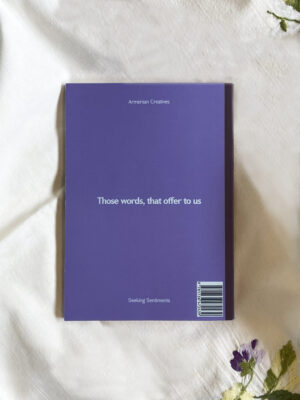
Motivated by their genuine concern over the gradual loss of Western Armenian, the Creatives initiated Those words, that offer to us, a three-volume bilingual — Western Armenian and English — series based on a new understanding of translation that stretches language beyond textual notations to include the social and the emotional nuances embedded into words, thereby ensuring a more complete interpretation of the original text that semantics alone could not communicate.
A translation is always a recreation of the original for it involves the negotiation of personal meanings held behind words that cannot be translated into words, notes co-editor Caroline Partamian in her Editor’s Note to the January 2023 inaugural issue of the series. The second issue, Those words, that offer to us: Handwritten Texts (May 2024) expands the process further to include the memories and the stories that surrounded original handwritten texts when they were being created. The third volume, Those words, that offer to us: Seeking Sentiments (self-published with support from the Calouste Gulbenkian Foundation, September 2025), stretches the capacity of expression even further by having the contributors engage with a phrase that sums up a sentiment “they long to communicate.” Inner feelings are arguably the most difficult to translate. They are perhaps even “untranslatable.”
Aram Ronaldo accomplishes his “translation” of the phrase “wave your magic wand” with the endless possibilities of magic. His “I have been raised on the power of magic” is rooted in his grandmother’s kitchen where the realities of Nene’s “small, slightly burnt wooden spoon” and the recipes that she preserved as she survived the Armenian Genocide mix with the fantastical tales she tells while making ma’amoul cookies on a Sunday afternoon. “Nene would wave her magic wand around the kitchen, making little miracles,” writes Aram. It is Aram’s ardent wish “that we all wave our magic wands . . . and invoke a few miracles daily.”
In much the same spirit of excitement, Levon Kafafian envisions a future for Western Armenian “flowing like water” a thousand years from now. Levon applies the phrase “like water,” which his middle school Armenian language teacher used when she asked the class to learn an assigned text by heart, to a Western Armenian that has survived, having evolved enough with which to write “a story taking place millennia from now.”
Slightly shifting focus, contributor Anahid Yahjian constructs the phrase “future nostalgia” to explore the “awful darkness” and the “horror” of the losses endured by her Western Armenian ancestors. The world the artist inhabits, however, is not a sick world. Even as she remains connected to a past of loss and of illness, Anahid can shift her gaze away from the “new, dreadful reality” that awaits each time. “My definition is ‘a nostalgia not for the past, but for the present and/or future,’” she notes with confidence.