

Beautifully written, acted, and directed, “Meet the Cartozians,” now playing at Pershing Square Signature Center, is arguably the finest play to date about the Armenian experience in America. More importantly, it transcends the specifics of Armenian-American history to offer universal insights — especially on questions of race and ethnicity. It has also garnered raves from mainstream outlets, including the New York Times.
Playwright Talene Monahon, whose work often explores identity, politics, and class, sets the play first in 1924 Portland and then, a century later, in 2024 Glendale. Six gifted actors portray characters across both eras.
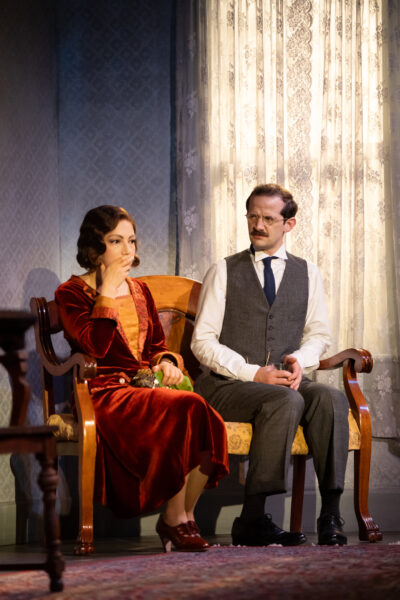
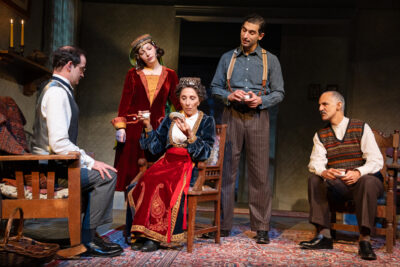
Act I revisits the historic — but now largely forgotten — 1925 United States v. Cartozian case. The U.S. government attempted to revoke Tateos Cartozian’s naturalized citizenship by claiming that, as an “Asiatic,” he did not qualify under existing naturalization laws. Cartozian hired sharp-witted Irish lawyer Wallace McCamant (Will Brill), who summoned a roster of expert witnesses — including renowned anthropologist Franz Boas—to demonstrate that Armenians were, in fact, considered white under the law.
Andrea Martin, pitch-perfect as matriarch Makrid Cartozian, fights to preserve Old World traditions, while Tamara Sevunts shines as her granddaughter Hazel, who steps in whenever needed to ensure things go “as they should” — even stopping her brother Vahan (Raffi Barsoumian) from testifying because he looks “too ethnic.” Through this landmark case, the audience gains a deeper sense of the Armenian tragedy of 1915 and the absurdity of American racial politics. As Sevunts, who grew up in Montreal, notes: “White is an Anglo-Saxon cultural construction. In Montreal — and Canada in general — one identifies with ethnicity, not race. Ethnically ambiguous, we Armenians pass as white.”
Act II jumps to 2024, on the set of a Christmas episode of a new Netflix series hosted by “the most famous woman in the world,” as historical drama gives way to sharp contemporary satire. Armenians in America have prospered, represented here by Nardek Vartoumian (Barsoumian), a university professor convinced he was denied tenure because he wasn’t Muslim; Rose Sarkisian (Martin), a wealthy Calabasas boomer doyenne; and Leslie Malconian (Susan Pourfar), a politically correct housewife campaigning to add “Armenian” as a category in the 2020 Census; and city councilman Robert Zakian (Nacer).
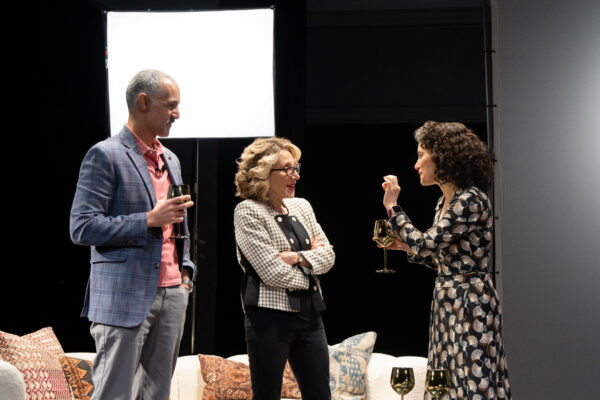
As they await the host — who is very late — the guests begin bickering about the Armenian Genocide, race, color, religion, and what it truly means to be Armenian. Vartoumian and Malconian argue that Armenians should be included under MENA or “people of color,” while Rose recoils at the thought of Armenians not being considered white. After a volley of witty lines (“Sounds like you’re calling me a Turk”), Rose reaches her limit: “What does that even mean? I’m going home to Calabasas.” Producer Alan O’Brien (Brill), also Irish, leans into the conflict for the sake of the show. Eventually the guests reconcile and leave, and Zakian is left alone onstage. Sevunts finally enters as the famous reality star and delivers a moving monologue about missing her father. The ending is sweet, if unsettling.