

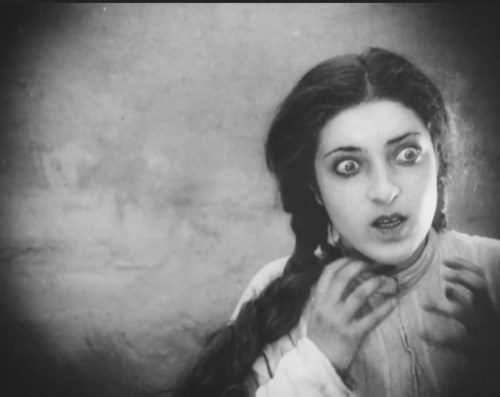
Barbara Madatova as Sonya in “Evil Spirit” (1927)

Bagratunyan Researches Armenian Women in Silent Films: Video Report

323
0

In recent years, Aurora Mardiganian’s name has become familiar to wider audiences thanks to the rediscovery of “Ravished Armenia,” the silent film in which she portrayed her own story, and also due to the Aurora Humanitarian Prize established by Ruben Vardanyan and Noubar Afeyan. In Armenia, however, a researcher has begun to view Aurora (Arshaluys) Mardiganian in a different context: as one of several Armenian women who appeared in silent cinema.

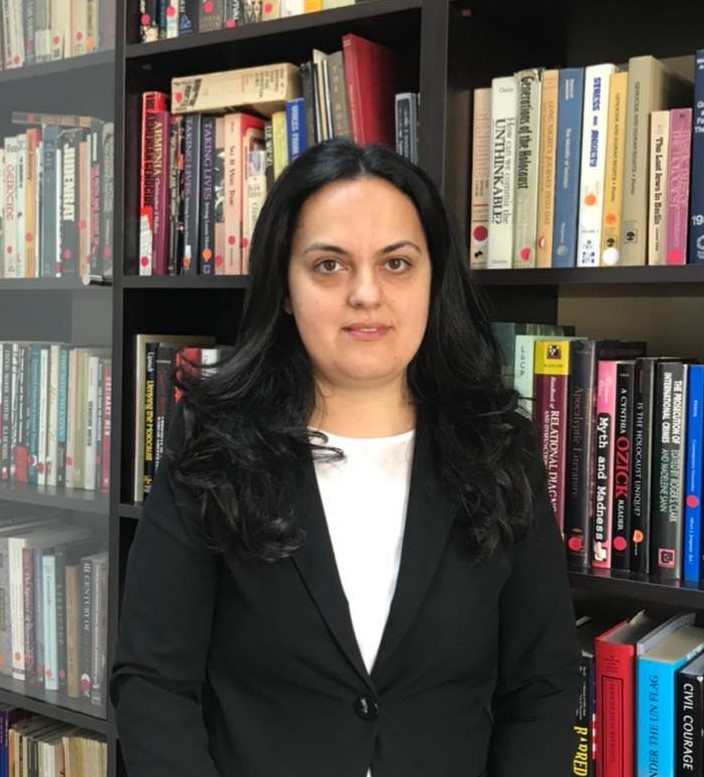
For nearly a year, Ruzan Bagratunyan has been studying Armenian actresses, as well as the technicians and administrators who contributed to early film, and published a book on them in 2024.

Ruzanna Bagratunyan’s book on Armenian women of silent cinema

In a Zoom conversation, Ruzan remarked about Mardiganian: “Her story was exceptional not only for Armenian history but for global history as well. Mardiganian is the only known female Genocide survivor to portray herself in a motion picture. While performing, she relived the horrors of the Genocide, and once even fainted on stage during a presentation.”

Aurora was not the only Armenian woman active in early American cinema. Flora Zabelle Hitchcock came to the United States after the Hamidian Massacres. She married the silent film actor Raymond Hitchcock, and together they performed in multiple Broadway productions in New York. Some sources suggest that she appeared in the 1911 version of “The Red Widow,” which would make her the first known Armenian actress of a silent film. Unfortunately, this 1911 film is lost.

Zhasmen (Mariam Grigoryan)

After her, the first instance of a film which has reached our times with an Armenian actress dates from 1913, when Armenian actress Mariam Grigoryan — known as Zhasmen — appeared in “The Keys to Happiness,” a two-part Russian silent film. Originally from Tiflis (present-day Tbilisi, Georgia), Zhasmen played numerous roles in Armenian, Georgian, and Azerbaijani cinema after returning to the Caucasus. Ruzan’s research illuminates the important role Armenians played in the formation of Azerbaijani cinematography: Hamo Beknazaryan directed some of Azerbaijan’s earliest films, and Armenian actors, including Zhasmen, were part of his teams.

The same is true of early Ottoman-Turkish cinema. When Muhsin Ertuğrul began directing the first Turkish films, numerous Armenians worked in the industry, including Siranush Aleksanian, Roza Felekian, Azniv Minakian, Vahram Papazian, Onnik Binemecian, and others.

Get the Mirror in your inbox:

“While filming ‘A Love Tragedy in Istanbul’ (1922), the Armenian actors spoke Armenian among themselves. Radical Turkish clerics overheard them, attacked them, and beat them severely. French soldiers stationed nearby — this was in 1922, when Istanbul was under Entente control — intervened and rescued them. Vahram Papazian later described the incident in his memoirs,” Ruzan recounts.

The Movie Database (TMDB)’s page on “A Love Tragedy in Istanbul” with the names of several Armenian actors (courtesy TMDB)

Another pioneering figure was Maria Goricheva-Kazanjieva, a Russian-Armenian actress who gained prominence across Russia and later the Soviet Union. She may have appeared in films as early as 1911, making her earlier than Zhasmen.

One of the founders of Soviet cinema, Sergei Eisenstein, held deep respect for Nina Agajanova, who wrote the scripts for his works. “Her home in Moscow served as a gathering place for leading Soviet filmmakers,” Ruzan adds. Armenian women were therefore not only actresses but also scriptwriters, educators, and administrators.

Ruzan’s research also brought to light Arsha Avanesova, an Armenian from Artsakh who may have been the first Soviet woman filmmaker to direct silent films. In addition to her production work, she taught film, and many iconic figures of Soviet cinema — including Eldar Ryazanov and Vasili Katanyan — were among her students.

In 1923, the Soviet Armenian government sent Hamo Beknazaryan and Daniel Dznuni to Tiflis with just 60 rubles to purchase equipment for newly founded PetKino, the State Film Organization of Armenia. “This was the founding capital of Armenian cinema,” Ruzan explains. Beknazaryan’s first film was Shirvanzade’s “Namus” (Honor).

The film was screened both in Russia and the United States, achieving tremendous success for its time. Its box office revenues reached 474,000 rubles — an extraordinary sum — which allowed PetKino to repay its loans and finance new productions.

Maria Chmshkian-Yermolinskaya in a still from the 1932 Armenian film “An Incident in the City of St. Louis”

Hasmik (Taguhi Hakobyan), Nina Manucharyan, Olga Maysuryan, Maria Shahubatyan Tatieva, Arusyak Voskanyan, Olga Gulazyan, and others were among the first actresses of Armenian silent cinema. Satenik Adamyan wrote one of the early scripts.

“Many of these women had no formal training, yet they performed remarkably well,” Ruzan emphasizes. “Their work and legacy significantly advanced Armenian cinema.”

The accompanying video below includes excerpts from an interview with Ruzan Bagratunyan as well as scenes from early Armenian silent films.

Get the Mirror-Spectator Weekly in your inbox: