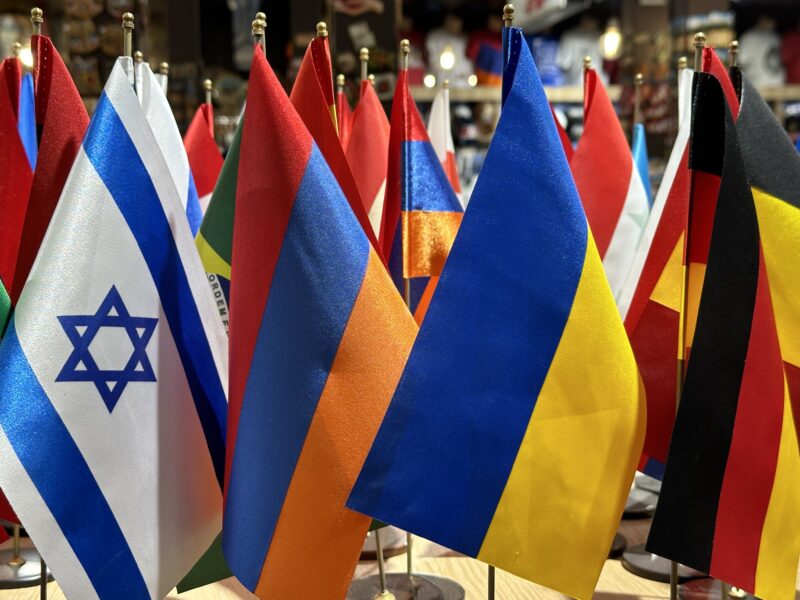


Flags of Israel, Armenia, Ukraine and Germany on sale at a Yerevan outdoor market (photo Larry Luxner)

Why Israel and Armenia Aren’t Closer — and Why That May Finally Change

36
0

By Larry Luxner

Special to the Mirror-Spectator

For decades, Armenia and Israel have had every reason to be close — yet were blocked by geopolitics. That may now be changing, thanks to an under-the-radar drama on the world stage.

It would be a long-overdue correction for the many Israelis and Armenians who see each other as natural partners: two small, non-Muslim democracies in a region dominated by authoritarian regimes; ancient peoples with deep diasporas and deep memories; communities that lived as successful minorities under Soviet rule.

Armenians have maintained a presence in Jerusalem since the 4th century, and Jews have lived in Armenia for centuries. And both nations endured genocide in the 20th century — the Ottoman slaughter of Armenians in 1915 and the Nazi extermination of European Jewry.
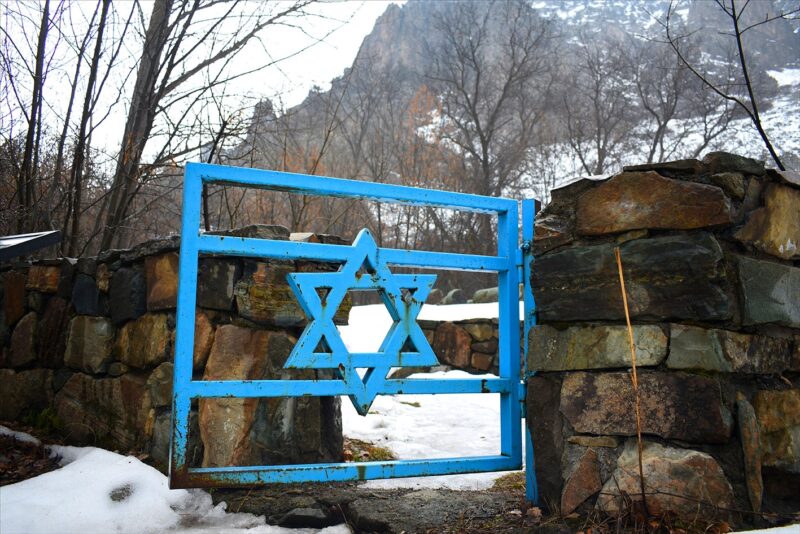
Entrance to the medieval Jewish cemetery of Yeghegis, which contains about 60 gravestones dating back to 1266. The site makes a popular day trip for Israeli tourists to Armenia. (photo Larry Luxner)

Yet those shared experiences never translated into trust. Israel’s strategic alignment with Azerbaijan — Armenia’s rival — long overshadowed everything else. Azerbaijan supplies Israel with oil and access to Iran’s northern flank, and in return has been a major buyer of Israeli drones and precision weapons. Those systems proved decisive in Baku’s victory in the 2020 war for Nagorno-Karabakh, and in the 2023 campaign that emptied the enclave of its 120,000 ethnic Armenian residents.
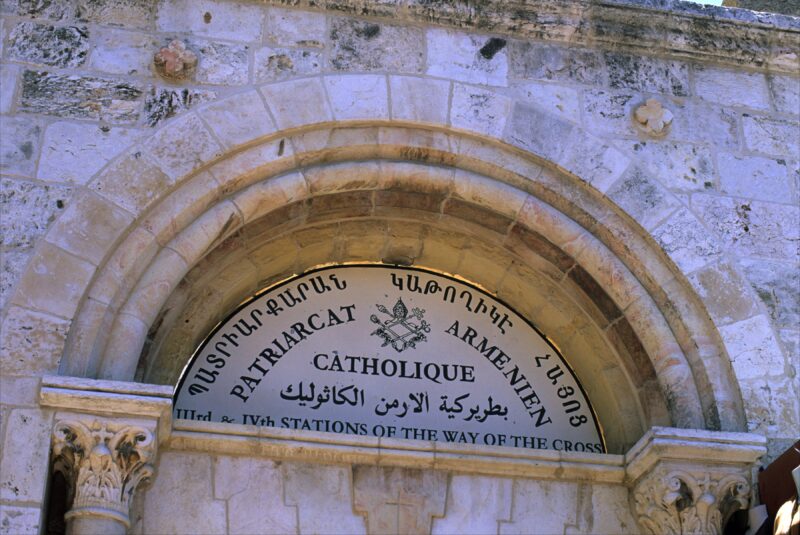
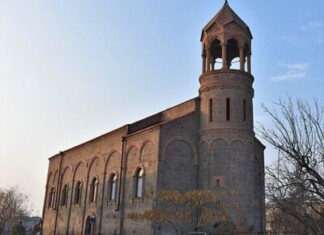
Armenian Catholic Patriarchate in Jerusalem’s Old City (photo Larry Luxner)

Get the Mirror in your inbox:

Now, however, something unprecedented has happened. In August, the United States — under President Donald Trump — persuaded Armenia and Azerbaijan to sign a peace agreement in Washington. The deal addresses remaining border and transit disputes, including in Armenia’s volatile southern Syunik province, and has dramatically reduced fears of renewed war in the South Caucasus.

For the first time in years, the possibility exists that Israel and Armenia might finally pursue the relationship that geography and history once seemed to promise.

Signs of warming have already begun to surface. Back in July, the Municipality of Jerusalem renamed a small square adjacent to Damascus Gate after Elia Kahvedjian, an Armenian photographer whose family perished in the genocide. It was not a state-level act — but it made Jerusalem the third Israeli city, after Haifa and Petah Tikva, to memorialize the 1.5 million Armenians murdered by the Ottoman Empire.

Later that month, Prime Minister Benjamin Netanyahu for the first time referred publicly to the 1915 atrocities as a genocide — a statement that drew a sharp rebuke from Ankara and marked a break with Israel’s long-standing policy of ambiguity.

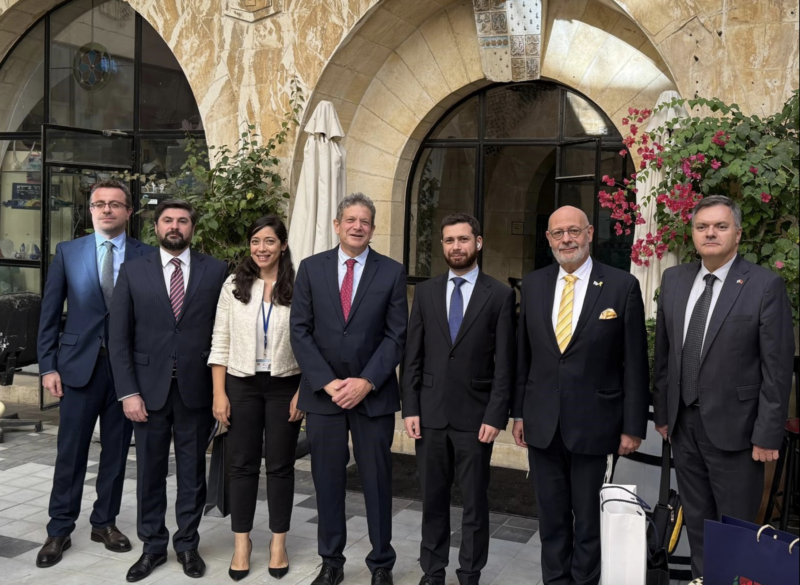
Top Armenian officials meet November 28 with Israeli officials in front of a restaurant in Jerusalem (photo courtesy Israel Ministry of Foreign Affairs)

And in November, Armenia’s deputy foreign minister, Vahan Kostanyan, visited Jerusalem to meet Eden Bar-Tal. The director-general of Israel’s Foreign Ministry. The talks focused on cooperation in high-tech, medicine and tourism — fields where each country sees clear benefits.

Armenian and Israeli officials gather in Jerusalem following bilateral talks November 28 (photo courtesy Israel Ministry of Foreign Affairs)

Yet despite this momentum, there is also frustration. Some Israelis argue Armenia is rife with antisemitism — a claim Armenian officials and Jewish residents say is greatly exaggerated, especially compared with the sharp rise in violent antisemitism across Europe since October 7. And Israel, despite five years of an Armenian mission operating in Tel Aviv, has still not opened an embassy in Yerevan.

“If you focus on antisemitism, you institutionalize it and make it a reality,” said Armen Akopian, Armenia’s envoy in Israel. “Focus instead on the absence of an Israeli embassy in Armenia, which I think sends a very wrong message. It means there is no interest in our country.”

Armen Akopian, Armenia’s ambassador to Israel (photo Larry Luxner)

Akopian notes that only three ex-Soviet republics remain without Israeli embassies: Armenia, Kyrgyzstan and Tajikistan. “As Armenia’s ambassador here, I’m not very comfortable being in this group,” he said. “I don’t believe Israel doesn’t have the money to support a small office in Yerevan. If they wanted to, they’d find it.”

He added: “Some people consider any criticism of Israeli politics as antisemitism. By that measure, everyone protesting the current Israeli government in Kaplan Street is antisemitic.”

Daily Jewish life in Armenia, meanwhile, appears largely untroubled.

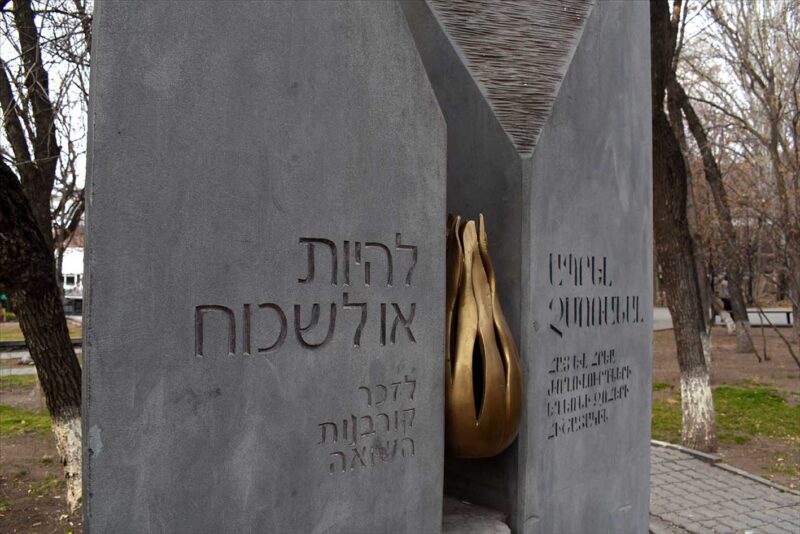
Holocaust memorial in a Yerevan park contains Hebrew and Armenian inscriptions (photo Larry Luxner)

“In four years here we haven’t faced antisemitism — no hostility or prejudice,” said Nathaniel Trubkin, founder of Yerevan Jewish Home, a charity that represents several hundred Russian and Ukrainian Jews who fled to Armenia in the wake of Russia’s February 2022 invasion. Originally from Moscow, Trubkin, 45, holds both Russian and Israeli citizenship.

“In almost four years in Armenia, we haven’t faced any antisemitism in daily life—no hostility or prejudice toward our ethnicity or religion,” he said, estimating that Jews comprise no more than 1,000 of Armenia’s three million or so inhabitants. “On the contrary, we’ve met many people in Armenian intellectual circles who truly want closer relations with Israel.”

From left, Tatiana Kliuchnikova, 30; Julia Kislev, 57; and Nataniel Trubkin, 45, at Yerevan’s Mama Jan Café. They are among an estimated 1,000 Russian Jews who have settled in Armenia since Russia invaded Ukraine in February 2022.

He acknowledged anger over Israeli weapon sales to Azerbaijan but said online hostility is “no worse than in any other country” since the Israel-Hamas war began.

The vandalism of Yerevan’s only synagogue, the Mordechay Navi Jewish Religious Center — three incidents between September and November 2023 — has also been portrayed by Armenian analysts as a false-flag attempt to damage the country’s reputation.

“The synagogue attack was immediately reported by Azerbaijan’s ambassador in Germany, who tweeted about it half an hour after the incident — that raises some questions,” Akopian said. “Meanwhile, look what is happening to synagogues and Jewish graveyards in Europe and the United States.”

Rabbi Gershon Meir Burshtein, spiritual leader at the Mordechay Navi Jewish Religious Center of Armenia in Yerevan (photo Larry Luxner)

Other sensitivities run in the opposite direction. Frequent incidents of Orthodox Jews spitting at Christian clergy in Jerusalem’s Armenian Quarter have inflamed perceptions among Armenians abroad. “Of course it creates bad feelings, because the police do nothing,” Akopian said. “They don’t even detain these people — and when they do, they release them after half an hour.”

These outbursts of religious hatred have received widespread coverage throughout the Armenian diaspora.

Giorgi Tumasyan, an Armenian community activist living in neighboring Georgia, views the Yerevan incident “as part of the hybrid warfare by Azerbaijan and Russia” against his country.

A blackboard in Russian and English announces the week’s upcoming Jewish-themed events at Mama Jan Café in Yerevan, Armenia (photo Larry Luxner)

“I believe there were some misunderstandings in our relations with Israel,” Tumasyan said by phone from Tbilisi. “From the Armenian side, until very recently we were very dependent on Russia, and Russian influence led to stereotypes about Israel and against Armenian-Israeli relations. It was Moscow’s agenda to keep our two communities far from each other.”

Tumasyan, chairman of the Armenian Community Platform of Georgia, said Israel’s historically poor relationship with Armenia is more a consequence of superpower rivalry than anything else, noting that “this is all about Russia wanting to limit our ties to Israel, and the United States too.”

But some in Armenia argue the bigger story is shifting geopolitics. “It’s in Russia’s interest to isolate Armenia — and they do it through Azerbaijan,” said Ruben Mehrabyan, vice-president of Armenia’s Rally for the Republic party.

“There are only a few democracies in the region — Armenia, Israel, Georgia and Cyprus — so our two countries should be best friends,” he added. “We have to look forward, not backward. Our relations are only about two countries, Armenia and Israel. It’s not about Azerbaijan or Iran. And the ball is now in Israel’s court.”

Get the Mirror-Spectator Weekly in your inbox: