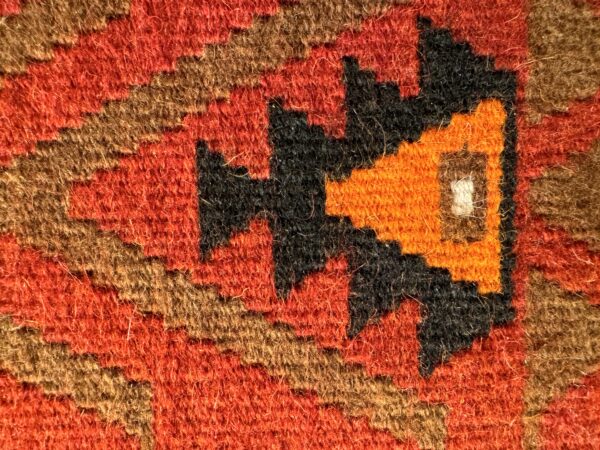



For artist Davit Mirzoyan, weaving this rug was not merely a hobby — it was an act of resurrection. For ten years, his mind and hands worked tirelessly, guided by an inner voice and the weight of a mission he felt chosen to carry out. On June 15, 2025 — his elder son’s birthday — he finished weaving a monumental Dragon (Vishap) rug. This moment marked not merely a project’s end, but a sacred delivery: a gift from ancestors, a bridge across centuries of loss, and the passing of a tradition on the brink of disappearance.
Mirzoyan’s rug is the latest incarnation of an ancestral flat-woven Dragon rug, a treasure rescued from the ashes of the Armenian Genocide and brought to present-day Armenia in the early 1920s.
From early childhood, Davit listened to his grandmother’s stories about the heinous atrocities she witnessed during her ordeal and the pandemonium of the genocide she was forced to endure. Yet, he could not have imagined then what important task fate had prepared for him.
It was as a student in the Art Department of the Armenian State Pedagogical University that Davit truly understood the rug’s significance. He realized it was not just a utilitarian object or a piece of antique tapestry, but the core of his identity, passed down through generations. He felt this with every fiber of his being, a conviction stemming from the deepest layers of his self. This realization grew gradually, eventually igniting a powerful, almost genetic urge to continue the cycle. That urge later solidified into a mission: to recreate this Dragon rug, which by then was dangerously close to disintegration.
This conviction, however, came later. From his first years of university, Mirzoyan felt strongly drawn to Armenian folk art and carpet weaving. His research revealed nothing similar to his ancestral rug, leading him to understand he had inherited something unique. By comparing available designs and applying logic to vast historical data, he concluded this was not mere folk art. It had ancient origins, stemming from knowledge possessed by ancient temple priests at least 3,500 years ago — a time when dragon worship was abruptly and violently terminated in Armenia. He theorized that these priests must have gone underground, keeping the Dragon rug weaving alive in secret, passing the designs and skills to their descendants through the generations.
Davit also discovered that since wool rugs are perishable and easily lost to time, each generation would weave an exact copy of their ancestral rug. With reverence, they would then retire the worn-out one, thus preserving the design for the future. This act of recreation was essential for safeguarding the rug’s iconography. Upon realizing how old, unique, and important this iconography was, Davit saw clearly the value of the millennia-old chain of recreations and the immense mission placed upon his shoulders. This rug now stands as a witness to the most recent performance, in 2025, of a millennia-old sacred ritual. It keeps the design alive and passes it on. It is a contemporary masterpiece that is simultaneously an ancient artifact—the most recent link in an unbroken chain that nearly snapped in 1915.