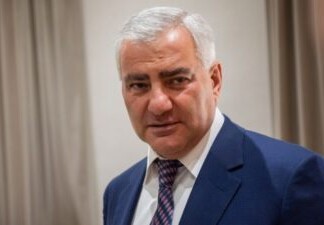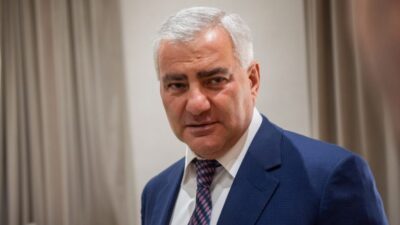


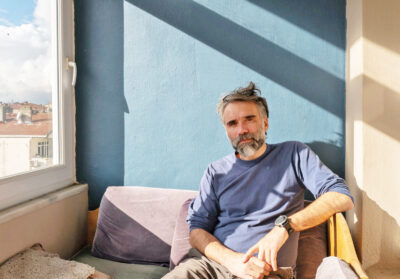
Andrea Savorani Neri © Monica Fritz, 2025.

Andrea Savorani Neri: A Visual Investigation on his Ancestors

285
0

YEREVAN/PARIS – Andrea Savorani Neri (born in 1976) is a Paris-based Italian photographer. He graduated in modern literature from the University of Bologna and studied photography at IUAV University of Venice. From the beginning of his career, he has explored the relationship between language and image. After research periods in Spain, France, and Russia, he settled in Paris and later taught at the University of Paris III, Sorbonne Nouvelle, and at Université Paris Cité.

He has collaborated with international TV networks, news agencies, and print media, including NUR Photo, IMAGO, Euronews, BBC, Sky TG24, RAI, and L’Espresso, among others. His work has appeared in major newspapers and magazines worldwide, such as Le Monde, Paris Match, Le Figaro, Libération, Le Point, The Guardian, The New York Times, Forbes, L’Espresso, La Repubblica, El País, Der Spiegel Al Jazeera, and many others.

For more about him see https://www.andrea-savorani-neri.com/
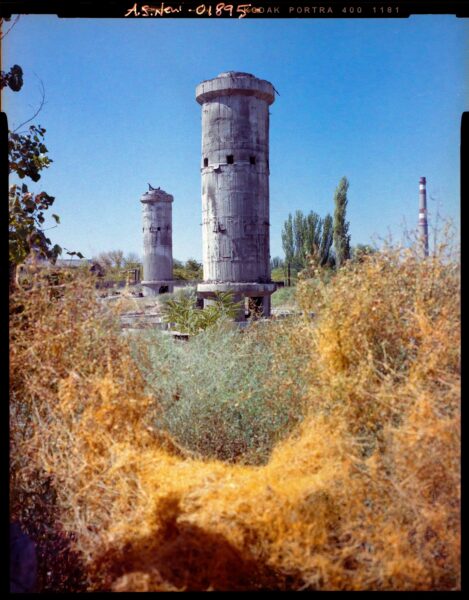
Architectural ruins in the semi-abandoned industrial area of Nairit, on the southern outskirts of Yerevan, Armenia, 23 September 2025.

Dear Andrea, while looking through your photographs, I was especially struck by your human portraits in what I would call a “dry” documentary style. Many of your subjects seem slightly disoriented in the world around them; they rarely smile — even when they are young people or children, even within the fashion context. Is this a conscious choice?

Both the absence of an overly obvious smile in my photographs and the vague feeling of disorientation with respect to the surrounding world are the result of deliberate choice. What exactly am I doing when I take a photograph of a person? What kind of relationship am I establishing with that person and, above all, what kind of representation do I want to give of that person to those who may observe their image? If we add the complexity and substantial unknowability of the individual to the fact that photography is always and in any case a fiction, not reality, the logical consequence is that it is necessary to avoid suggesting marked, overly defined, overly explicit emotions. This may seem paradoxical because photographs are by definition fixed images, but what I seek in my interaction with people is to achieve a sort of “zero degree” of the face portrayed. I prefer the absence of an expression that would explicitly suggest a state of mind, in order to preserve as much as possible the ambiguity and unknowability of the other. Creating images in itself necessarily implies a choice, but within this limit I would like to respect as much as possible the indeterminate nature of people, as well as that of places. And I believe that the two aspects you have highlighted are interdependent and linked: individuals live in a world whose nature they constantly seek to understand and whose codes they strive to decipher. My ambition is that at least part of this mystery — a mystery that is inherent in the primordial nature of photography as a medium — remains intact in my images.

Am I right in sensing that loneliness is a central theme in your work? Even your landscapes appear isolated, fragile, almost melancholic — despite their often-vivid colors. How do you relate to this interpretation?
Get the Mirror in your inbox:

It is an interpretation that sincerely honors me because it confirms that, at least to some extent, my images manage to evoke the themes and motivations from which they spring. The question of solitude runs through the entire history of art, but perhaps it is even more present in the history of literature. Photography has an indissoluble formal connection with poetry; both means of expression work on the basis of limits, of boundaries: the end of a line for poetry, the establishment of a relationship between presence and absence for photography. And speaking of poetry, your observation reminds me of Salvatore Quasimodo’s extreme synthesis: “Everyone stands alone on the heart of the earth / pierced by a ray of sunshine: / and suddenly it is evening.” I think that loneliness as an existential condition is an essential theme, especially for photography, which, perhaps more than other practices, takes place in silence and, indeed, in solitude. At least, this is the dimension that interests me. And I fully agree when you relate the question of loneliness to the question of the fragility of the landscape. With its unique ability to captivate the observer, photography emphasizes and sublimates the fact that at a specific moment in time, places (or people) had a certain appearance, certain characteristics. But a few events or the passage of time are enough to disrupt places and balances. Perhaps I am once again insisting on a paradox: photography has the gift of capturing the moment, but despite this (or perhaps because of it), it is a perpetual reminder of the fragility of places and people.

Your great-great-grandfather was the painter Salvatore Valeri (1856–1946), who was married to Maria Lekegian, sister of the Constantinople-born photographer Gabriel Lekegian (1848/1853–1921), later active in Egypt. Please share some information about your Armenian ancestors.

I am currently working on “Cross-Looking. A Visual Investigation on the Legacy of My Ancestors Valeri and Lekegian” project which has been awarded a Creative Europe grant. The work stems from personal research into the discovery of my origins, the need to reconstruct and reactivate memory, giving new life to connections and links that have been lost, both at a family level with the passing of generations and at a collective level because they have been buried by historical events. I have always known that my great-great-grandfather was a painter who, at a very young age, emigrated to Constantinople where he spent more than 40 years painting and teaching painting. His name was Salvatore Valeri and his wife, my great-great-grandmother, was Maria Lekegian, an Armenian from Constantinople. Their lives, like those of millions of others, changed dramatically with the end of the Ottoman Empire, the advent of the Young Turks and the founding of the Republic. In 1923–1925, they left Istanbul and settled in Faenza, in the house where four subsequent generations lived, including myself. It was the hometown of Giuseppe Neri, who married my great-grandmother Italia, one of the three children of Salvatore Valeri and Maria Lekegian. I have always known this story because, when they left Constantinople to settle in Faenza, the Valeri-Lekegian family took their belongings with them, including almost all of Salvatore’s paintings. My grandfather Alessandro was the last member of the family to be born in Constantinople, in 1921. I grew up looking at those pictures, oil paintings, watercolors and ink drawings. But the passing of generations, the cycles of history, and the shifts in space had erased a fundamental element from the family memory: that Maria Lekegian’s older brother was Gabriel, who, after training as a painter in Constantinople (and perhaps in Rome), emigrated to Cairo, where he began a dazzling career as a photographer. I discovered this connection about eight years ago, when I unearthed the portrait that his sister Maria had kept among her belongings from a box in the basement. It was then that I decided to take photographs following the traces of these two intertwined and linked destinies: one ancestor was a painter and the other a photographer, both of whom emigrated at a time when the two artistic practices had a very special relationship within the visual arts.

A century later, it is still difficult for us to realize how complex the balance and relationships between different cultures were within the geographical areas that we simplify by calling the West and the East. My ambition is that the work I am doing with Cross-Looking will allow me to reconstruct the mosaic of those crucial years, of which my family has preserved only a partial and faded memory.

Photographing the rediscovery of the lives and works of my ancestors is an exciting endeavor and, as a photographer, discovering in retrospect that I had an ancestor who was a photographer more than a century ago raises profound questions about the choices we make and the invisible traces that the past leaves on the present.

There is also a historical aspect, both in a broad sense and in the specific sense of the visual arts: Salvatore Valeri has remained semi-hidden in the history of Western art, largely because almost everything he produced never left the family house after 1923; Gabriel Lekegian, on the other hand, is mentioned in every text dealing with photography in the Middle East between the late 19th and early 20th centuries. However, apart from the thousands of images produced by his studio, very little is known about him. For me, looking at these two figures means looking at the lives of two emigrant artists who lived between the end of one era and the (dramatic) beginning of another, a pivotal period in the history of the visual arts. This memory, now faded, could help to reconnect a heritage that is deeply common and shared between Europe, Egypt and the former Ottoman Empire. It would be very presumptuous of me to suggest new perspectives on the practice of contemporary photography. I would simply say that photography must aim to reclaim one of its oldest roles, which I believe to be highly significant: to be a tool for observation, research and reflection, created almost miraculously to remind us that the eyes are only the exposed and visible part of the human brain. My connection with this history has therefore been mainly through images rather than stories. The Valeri-Lekegian-Neri family house preserves a portrait that Salvatore painted of his wife Maria, a canvas depicting the inner courtyard of the Beyazit II Mosque in Istanbul, paintings which, together with Lekegian’s images of Islamic art and Egyptian archaeology, have always been a kind of silent memento for me. The photographic work I am doing helps me to reflect on how memory crosses generations, discovering elements that even my father Stefano was unaware of, such as the exact date of Alessandro Valeri’s death. Alessandro, the twin brother of my great-grandmother Italia, was an architect. Through Cross-Looking and with the help of Paolo Girardelli, Professor of Art and Architecture History at Boğaziçi University in Istanbul, we discovered that Valeri was the designer of the Bulgur Palas in Istanbul, and not Giulio Mongeri as previously believed. He died in 1920 at the age of just 33, and it was in memory of Alessandro that his sister Italia Valeri and her husband Giuseppe Neri decided to name their first son — my grandfather Alessandro Neri — born just a year later, after him.

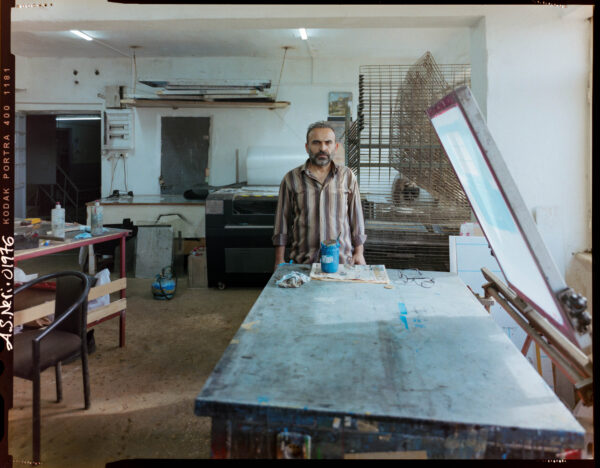
Alek, a metal engraver, in his workshop in Galata, near the Yolkuzade Mosque. Istanbul, 18 December, 2025.

Could you share your impressions from your recent visit to Cairo, where you retraced Gabriel Lekegian’s footsteps and searched for traces of his studios and work?

Each artistic residency in my project (Yerevan, Istanbul, Cairo and Italy) embodies different aspects of the unique narrative I am trying to construct through photography. In Cairo, the visual density and stimuli linked to my storytelling are so dense that it is not easy to summarize. The city stimulates a deep sense of urgency, a visceral need to observe and document through photography before the places are erased, and with them their memory. In Cairo, Lekegian covered a wide range of subjects, landscapes and portraits with his images. I structured my work around three main axis: first of all, finding and observing the places linked to Gabriel’s life story: the location of his photography studio; the key spaces of the Armenian community to which he belonged; the Armenian Catholic and Orthodox institutions, etc. Something of that world still remains, even if only in the interstices, while other things have disappeared, such as the Hotel Continental-Savoy, where the Lekegian family organized the reception for their daughter Elise’s wedding. The second axes of my research consists of visiting the places that Gabriel photographed (but also painted by Valeri, who created many of his canvases in Cairo), making an almost mystical pilgrimage, I dare say, to physically set foot in the same places and look at them from a similar but not identical point of view. I did this, for example, with the inner courtyard of the Sultan Hassan Mosque, photographing the large ablution fountain repeatedly, almost obsessively, of which Lekegian made one of the glass negative plates that I love most. The fact that I work with essentially the same tool that my ancestor used also gives strength to the gesture of taking the picture: on a tripod, with a large-format camera. For Lekegian, it was glass plates; for me, it is 4×5-inch color film, but the approach is exactly the same. Finally, there is the encounter with people. Lekegian, like Valeri, with whom he shared his artistic training and family ties, was particularly devoted to portraiture, not so much in the studio (although this was a commercial necessity) as on the street. For me, in addition to meeting the inhabitants of Cairo, there was the encounter with people who, by sharing their specific knowledge of those years with me, provided a window onto the description of that world. I would like to mention here just a few of the many people in Cairo who were kind enough to spend time with me, helping me with my research, posing for photographs, and giving me tips and advice: Omniya Abdel Barr, architect and historian of Islamic architecture; Haig Avakian, an Armenian intellectual from Cairo, who accomplished the extraordinary task of compiling a large collection of Lekegian’s images in two volumes, published in 2020 by Tchahagir, introduced by the most comprehensive and well-documented text ever written on the life of the Armenian photographer; Francis Amin, Egyptian researcher and historian, leading expert on the history of photography in Egypt; Chris Mikaelian, whose family has run Reader’s Corner in Downtown Cairo for three generations, a historic place where various communities, not only the Armenian one, met and mingled. They were my guiding lights before and during my work in Cairo, and our dialogue on this research is only just beginning.

And could you please share your impressions and photographic experience from your trip to Armenia? Did you feel any sense of kinship while you were there?

My stay in Armenia last September represents the most metaphorical chapter of my narrative. Gabriel Lekegian and Salvatore Valeri were not born in what is now Armenia, they did not live there, at least as far as we know, and they did not paint or photograph the territory within the current borders of the Republic of Armenia. And yet their names and their ties to the Armenian community and culture are unshakeable. To take my pictures, I therefore sought a symbolic link with the territory, and two interpretations emerged as I progressed with my work: the observation of people on the one hand, and the observation of archaeology on the other. These are two of the main themes of Lekegian’s work. But what archaeology could I look at, knowing that Lekegian had photographed the remains of ancient Egypt extensively, while I was in a former Soviet republic? Reflections made together with Vigen Galstyan (one of Cross-Looking’s partners as director of the photography department of the National Gallery of Armenia) led me to focus precisely on the Soviet past and in particular on the archaeology of the industrial era. An often-uncomfortable legacy, not particularly appreciated, certainly (perhaps we could say hopefully) destined to disappear. But it is an important legacy because only through it can we avoid reducing the narrative about Armenia to two themes that, like heavy boulders, occupy the collective imagination about the country: genocide on the one hand, and Christianity and its architectural and cultural heritage on the other. The uncomfortable, almost malodorous Soviet industrial past has the merit, so to speak, of reconnecting the country to a historical context and territorial relations, rather than isolating it, making it unique, an exception, on the basis of the catastrophe of the genocide and the grandeur of its Christian origins. This is how I spent almost a month studying and photographing places such as Nairit factory on the southern outskirts of Yerevan, or Alaverdi, Vanadzor, Gyumri and Metsamor. I photographed these places as if I were observing the monumental, disturbing, mysterious dimension of the remains of ancient Egypt: cooling towers instead of pyramids; enormous chimneys as if they were ancient minarets. However, I never neglected the relationship with the people I met along the way. And if there is one thing about Armenia that did not surprise me, it is the great hospitality, warmth and generosity that I already knew through my network of Armenian friends and colleagues living abroad.

Get the Mirror-Spectator Weekly in your inbox: