

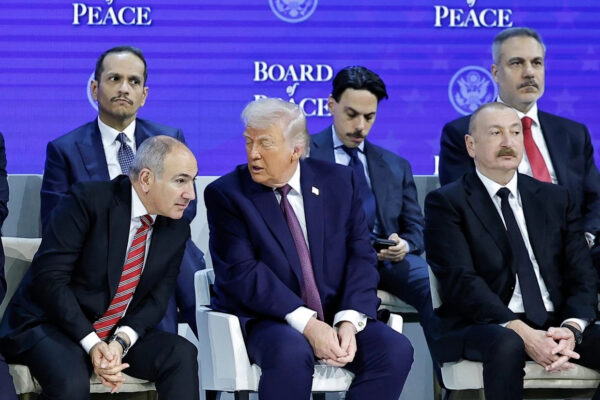
The ostentatious rapprochement between Prime Minister Nikol Pashinyan and the clique of autocrats led by President Trump, coinciding with the Davos forum and the establishment of the “Peace Council,” is reshaping the landscape of Armenian diplomacy. The Armenian prime minister’s decision to attend and sign Armenia’s free membership is a fundamental diplomatic blunder, a slap in the face of the UN, an institution that the United States and Israel certainly want to see disappear, but which it is premature to bury (if the Trump era does not end quickly, global chaos becomes a plausible development). This Armenian move is a setback to the long-standing friendly relations established with France, and also a stab in the back to the European Union, which opposes this new, brutal Trump entity; no surprise to anyone is the exception of Hungary’s Viktor Orban.
The Armenian prime minister, Nikol Pashinyan, who should have resigned the day after the surrender on November 9, 2020, needs concrete achievements to confirm and ratify the proclaimed peace and thus secure his re-election. There has been an acceleration of US diplomatic shuttles in the region — where the risk of an American attack on Iran is looming. More importantly, additional details have been provided on the implementation of the Trump Route for Peace and Prosperity (TRIPP). They constitute the immediate topical subject that we are analyzing here.
Is the Armenian government not rushing too quickly to try to conclude concomitant agreements with Azerbaijan and Turkey under pressure from the United States, agreements that the vast majority of the population view with skepticism or do not approve of? So many of the imposed concessions are unilateral and heavy, possibly trapping Armenia a little more into a corner from which it may not be able to extricate itself. Does it assess lucidly this new interest of the United States to be present in the South Caucasus?
Is Armenia’s pivoting to the United States well thought out or imposed? In order to assess the situation it is necessary to examine the new American policy in the world (I), its transposition to the South Caucasus through the TRIPP project (II), and the perception of this “instrument of peace” in light of statements made by Azerbaijan (III).
I – What is the new American policy?
Donald Trump’s National Security Strategy breaks with multilateralism and Kissinger’s famous Realpolitik. Huntington’s Clash of Civilizations theory often serves as a smokescreen and a tool for destabilizing resistant democracies. Only 29 countries would remain, according to a Foreign Affairs article. President Trump is promoting autocracies and far-right movements worldwide. On July 17, 2025, Secretary of State Marco Rubio ordered American diplomats to refrain from commenting on the fairness or integrity of foreign elections and on the democratic values of foreign countries unless there is a “clear and compelling” foreign policy interest for United States. Previously, in the same vein, the Trump administration had dismantled the United States Agency for International Development (USAID) and the funding it provided around the world to promote democracy and defend freedoms.