

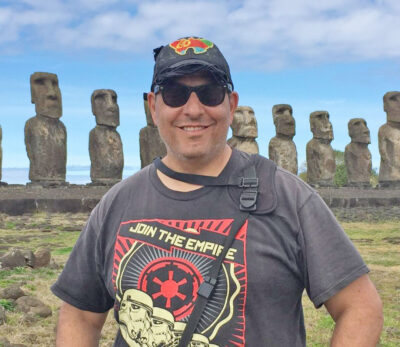
Ric Gazarian

Ric Gazarian: Discovering the World Through Travel

10
0

YEREVAN/ BANGKOK – Ric Gazarian (born in 1969 in Boston) is an American professional photographer, travel writer, author, podcaster, documentary producer, blogger, drone pilot and travel-industry speaker. A graduate of Boston College, he has traveled to more than 190 countries across all seven continents and is on a quest to visit every country in the world. Through his blog “GlobalGaz,” he shares experiences from off-the-beaten-path destinations, unusual journeys and places often overlooked by conventional tourism.

Gazarian is the host of “Counting Countries,” a popular long-form podcast in which he interviews some of the world’s most traveled people. The podcast ranks among the top 2.5-percent of podcasts globally, and he has hosted more than 150 guests.

He is also a documentary producer and has produced and appeared in “Hit The Road: India” and “Hit The Road: Cambodia,” adventure-travel films. The first one became a top-selling film on iTunes, while the second received the Mekong Minnies Award. He is also the author of three books, including Hit The Road: India; 7000 KM To Go; and Photos From Chernobyl.

Gazarian is deeply involved in the international travel community. He is the Bangkok Chapter Leader and Asia Coordinator of Travel Massive. He is also the co-founder and organizer of the Extraordinary Travel Festival, whose first edition took place in Yerevan, Armenia, in 2022; the third edition is scheduled to take place in Bangkok in October 2026. Gazarian also speaks at travel industry events.

Dear Ric, you have transformed your passion for travel into photography, books, films, podcasts, and a global travel community. Looking back at your journey — from simply visiting countries to documenting your experiences and connecting travelers around the world — which experience has changed the way you see the world most fundamentally?

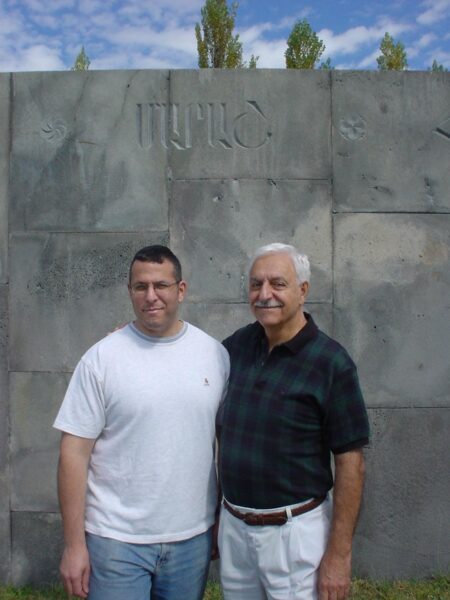
It goes back to a single trip in 2003, when I first visited Armenia with my father. That trip planted something I didn’t fully grasp at the time — the idea of moving to Armenia and somehow giving back to the country. Shortly after my return, I connected with Jason Demerjian, the founder of the Armenian Volunteer Corps. Soon after I then moved to Yerevan, renting a studio on Sayat-Nova Street, and volunteering with the Armenian Volunteer Corps. AVC placed me at Zatik Orphanage, where I ended up teaching English to 120 kids, as well as teaching English at Manana, an after-school program.
Get the Mirror in your inbox:

What I did not expect was how completely the direction of that arrangement would reverse itself. I went in thinking I was the one giving something — my time, my English lessons, whatever structure I could bring to a couple of after-school hours. But the kids at Zatik and Manana were the ones who actually did the giving. They handed me a sense of purpose I hadn’t had sitting behind a desk in financial services. They taught me patience, and they showed me what resilience looks like in people who’d had far less handed to them than I had. You go into volunteer work assuming you’re the helper. What nobody tells you is that the people you’re “supposed” to be helping end up helping you more — they’re the ones who change you.

That’s the experience everything else is built on. The country counting, the podcast, the festival — none of it exists without that first year in Yerevan teaching me that the exchange runs both ways.

Ric Gazarian and his father, Charlie, in Armenia in 2003

You have traveled to 190 countries, and your Counting Countries podcast features people who have visited all 193 countries. After hearing so many extraordinary travel stories, has your own definition of what constitutes “a country” changed?

I think the 193 UN member states is a legitimate and useful benchmark — it gives everyone a shared, objective finish line, and it’s the number I use myself when I talk about my own progress. But the deeper I get into this world, the more obvious it becomes that the UN list is only one version of “country,” and the planet is full of others that are just as real to the people living them.

I’ve spent time in a lot of these in-between places. Somaliland functions as a fully self-governing state with its own currency, passport, and elections, yet only one country recognizes it. Transnistria has its own army, its own money, and a Soviet-era identity frozen in place, despite sitting entirely inside Moldova on paper.

Then there are the micronations, which are their own fascinating category entirely — sovereignty as an idea, an art project, or a joke taken just seriously enough. The most famous is the Principality of Sealand: a former WWII anti-aircraft platform in the North Sea, off the coast of Suffolk, England, seized in 1967 by Paddy Roy Bates, originally to broadcast pirate radio outside UK jurisdiction. Sealand has since issued its own passports, currency and stamps, survived armed coups and functions today as a real, if tiny, self-declared state. I’ve visited, and there’s something genuinely unique and surreal about standing on a rusted platform in the middle of the ocean that has more institutional trappings of nationhood — flag, anthem, currency. I also shared tea with 4th generation royals — Prince James and Liam. Talk about memorable experiences.

Another example of what is a country or not is the Principality of Islandia, a micronation founded in 2018 by Gareth Johnson and Marshall Mayer that claims Coffee Caye, a small mangrove-covered island off the coast of Belize. I am one of the founding citizens. This is the world first crowd funded country as nearly 100 people financially teamed together to will this country into existence. These places make you realize that the definition of a country is a bit more gray than you might initially think. I’ve actually leaned into that question as I will be speaking at MicroCon 2027, the biennial gathering of micronationalists from around the world — a room full of people who take this exact ambiguity seriously, half as politics and half as art. My own answer, after all these years: the UN’s 193 is the right number to count toward, but the real map of the world has a lot more borders drawn on it than that. 

When I asked Argentine-Armenian photographer and avid traveler Araz Hajian which three parts of the world she would choose to separate from the rest, she named Antarctica, Armenia, and Iran. If you had to choose your own three, which would they be — and why?

Bhutan, Tuvalu, and Madagascar — three places I don’t think have any real equivalent anywhere else. Bhutan is simply unique. There’s no other country in the world quite like it — a nation that has deliberately built its entire identity around Gross National Happiness rather than GDP, that limits tourism by design rather than by accident, and that still feels like it’s operating on its own terms rather than the world’s. Expect to see locals dress in their traditional costume, a lack of development, and a country without a single traffic light.

Tuvalu is unique in a completely different way — a UN member country just north of 10,000 people, sitting in the middle of the Pacific, connected to the rest of the world by just three flights a week from Fiji. It’s one of the starkest reminders I’ve encountered that a “country” can be almost impossibly small and remote and still be entirely its own place.

And Madagascar, for the sheer strangeness of its biology and the richness of its people. It split off from the rest of the world so long ago evolutionarily that something like 90% of its wildlife exists nowhere else on Earth, and on top of that, it’s a genuine blend of African and Southeast Asian cultures and peoples that you don’t quite find anywhere else either.

 Every country has something interesting to offer. But let’s be a little politically incorrect for a moment: which country you have visited did you find the least interesting, and why?

I want to caveat this before I answer, because I think “least interesting” is partly a factor of circumstance rather than a fair verdict on a place itself. Sometimes you don’t have enough time or money to see a country properly. Bad weather, a security situation, or a mediocre guide can color an entire visit and leave you with an impression that isn’t really the country’s fault — it’s the trip’s fault. With that caveat, I’ll pick on Cabo Verde, the small island chain off the coast of Senegal in the Atlantic. I spent time in the capital and visited two other islands, and came away finding it bland and uninteresting. Nothing I encountered there really stood out — no monuments on the order of Angkor Wat or Petra, no landscapes that stopped me in my tracks the way the Danakil Depression or the fjords of Norway have. It’s entirely possible a different route, a different season, or more time would have shown me a different Cabo Verde. But going purely off my own visit, it’s the country that left a faint impression on me.

It would be fascinating to learn more about the odyssey of your Armenian ancestors. What do you know about your family’s roots, and how, if at all, have they influenced your passion for travel? 

Three of my grandparents survived the Armenian Genocide and eventually made their way to Boston, where I grew up. My fourth grandparent, also Armenian, was born in the US. My forefathers hailed from Maden, Marash, and Kharpert.

Growing up, I was very aware of my Armenian identity, but it didn’t shape me in any deep way — it was more a fact about myself than a lived experience. That changed with my first visit with my father in 2003, and even more so during my four-month stint as a volunteer in 2004. Growing up, I knew maybe 25 words of Armenian. During that stay, I picked up a basic working level of the language, interacted daily with Armenians from every corner of the diaspora, and traveled through multiple regions of the country as well as Artsakh. That trip was my real Armenian education — the one no amount of holiday dinners or family stories back in Boston could have given me.

That volunteer trip ended up shaping every trip I’ve taken since, in a way that had nothing to do with Armenian identity specifically. Before it, I only thought of traveling in one-week increments — the standard American vacation. Living in Yerevan for four months was the first time I understood that travel could be slower, deeper, and open-ended. It’s the template I’ve used for the rest of my life.

You have described both Yerevan and Bangkok as places you particularly enjoy. What did Armenia reveal to you as a traveler that you had not expected to find there?

I’ve had nearly a 25-year window visiting Yerevan since 2003, and the changes I’ve witnessed are dramatic. Walking the streets back then, the city had a gloomy, Soviet feel to it and was economically depressed. It felt like there were no foreigners there at all, except for other Armenians visiting from the diaspora.

Today I find it to be the polar opposite. Money is pouring into Yerevan, and the development seems endless. There are infinite options now — restaurants, cafés, bars, live music, and so much more. The city is eminently walkable. And Yerevan today feels like a genuinely international, cosmopolitan city — not a place defined by its past, but one that’s confidently building its own present.

Do you have any plans to return to Armenia, either with the Extraordinary Travel Festival or as part of a new travel or creative project?

I was incredibly enthused about bringing the Extraordinary Travel Festival — the largest gathering of the world’s top traveled people — to Yerevan. It was my small gesture: bringing 130 mega-travelers and content creators to Armenia and making a small contribution toward promoting the country to an audience that could genuinely spread the word. It would be my personal opportunity to develop deeper roots in the country.

While the event itself was a huge success, the experience behind the scenes unfortunately was not. I booked a restaurant on Abovian Street for 130 participants, agreement in hand, and still caught them twice trying to financially cheat the event. When I shared that experience online to warn other organizers, the restaurant turned around and sued me — a case the courts ultimately dismissed. On top of that, another large and prominent restaurant group reneged on our agreement shortly before the event, leaving me scrambling to secure two replacement venues for my guests on quick notice. And while many governments make a concerted effort to support events like this, precisely because of the exposure and tourism they generate, the Armenian government chose not to lend any direct support to the festival.

So, as you might imagine, I don’t have plans to promote or work with Armenia in any serious capacity going forward. It’s a strange thing to say about a country I feel so personally connected to, but running an event there taught me that love for a place and confidence and ease in doing business are two very different things.

Get the Mirror-Spectator Weekly in your inbox: