

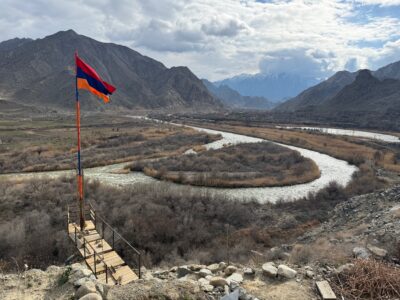
The Araks River is at the border of Armenia and Iran (photo Marut Vanyan)

Aviation, Infrastructure, and the Election Campaign: How Does the Iran War Affect Armenia?

429
0

YEREVAN — “Dear all, who knows whether the Iranian checkpoint is already open?” asks a Syunik resident in a Facebook group. “No,” “no,” “no,” “not yet,” users respond in the comments.

Unlike superpowers interested in oil, ordinary citizens of Armenia are interested in when the war in Iran will end so that they can go buy cheap cooking oil and washing powder there.
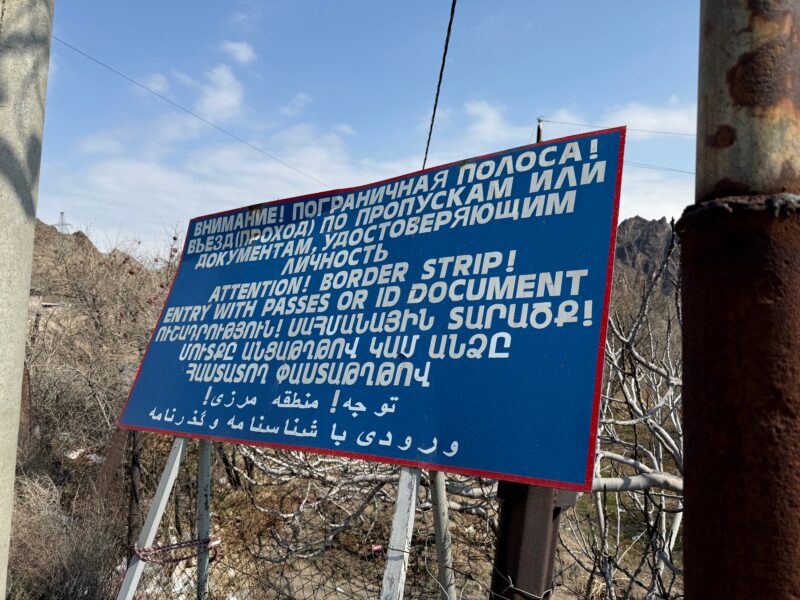
A trilingual sign at the Armenia-Iran border on the Armenian side (photo Marut Vanyan)

Just a few months ago, at least in Armenia, there was an impression that high-speed trains would soon be running via “Trump’s Route.” This project seemed more realistic especially after the visit of US Vice President JD Vance, but the war that broke out in Iran overshadowed everything and, as they say, there are bigger fish to fry.
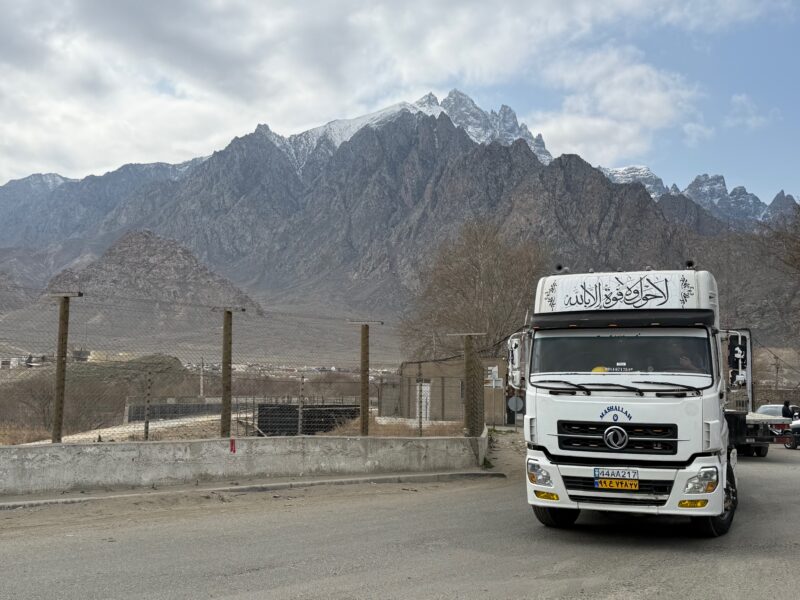
An Iranian truck makes its way near the Armenia-Iran border (photo Marut Vanyan)

Against the backdrop of the upcoming elections in Armenia, those with pro-Russian and pro-Western orientations are actively arguing and discussing this topic. So, where is your America, where did the TRIPP project disappear? some experts in Armenia ask. One side says that it is disastrous for Armenia. The other side claims that it will provide security guarantees for the country and offers the prospect of great economic opportunities, while the US Department announced that we haven’t forgotten – just wait a “little bit.”

The Trump administration remains committed to implementing the Trump’s Route to International Peace and Prosperity (TRIPP) project, a spokesperson for the US State Department said in response to an inquiry by Armenpress.

At an April 11 meeting in Gabala, Azerbaijan, between Armenian and Azerbaijani civil society representatives, Azerbaijani President Ilham Aliyev’s assistant Hikmet Hajiyev declared: “The implementation of the TRIPP project promises new opportunities for Armenia as a transit country. At a time when global developments — often described as resembling a Third World War — and the ongoing situation in the Middle East underscore the importance of established peace between Azerbaijan and Armenia.”
Get the Mirror in your inbox:

Meanwhile, Iranian Ambassador to Armenia Khalil Shirgholami said, “We have expressed our opinion on this in the past and said that we are not against developing Armenia’s potential as a transit route. We have also discussed lifting the blockade, the North-South route, and connecting the Black Sea and the Persian Gulf with the Armenian authorities. We have also expressed concern about whether this will create security problems.”

Nearly nine months have passed since Trump signed a declaration in Washington about the road, which aims to connect Azerbaijan with its Nakhichevan exclave, but it is still unclear what the route of the road will be or who will ultimately build it. Everything depends on the outcome of the Iran war.

However, predictions continue to be made in Armenia about the Armenia’s European future, its relations with Russia and about war and peace.

During the recent Putin-Pashinyan meeting in the Kremlin, the Russian leader made it clear that Armenia cannot sit on two chairs simultaneously.

“Simultaneous membership in the Customs Union with the European Union and the EAEU is impossible; it is simply untenable by definition. The issue is not even a political one; it is purely economic. Some matters require extensive collaborative efforts that must be undertaken over years. These include differences in the evaluation of specific product groups, their market entry, and phytosanitary supervision for agricultural products. Russia and the European Union have entirely different, markedly divergent requirements concerning phytosanitary matters,” said Russia’s President Vladimir Putin.

Ahead of the elections in the summer, Armenian Prime Minister Nikol Pashinyan’s “happy bus” is traveling through the cities of Armenia, and he is shaking people’s hands and getting to know their problems. Billboards with portraits of his electoral rival Samvel Karapetyan are installed in large cities of Armenia, and the latter’s nephew Narek Karapetyan is holding a rally in Yerevan’s Freedom Square. Everyone is talking about peace, the development of the country, and everyone is convinced that the program they are proposing is the best. At the same time, there is noticeable indifference among ordinary people, who are really exhausted by all this. “Whoever it is, it doesn’t matter. I have to solve my own problems,” they would say.

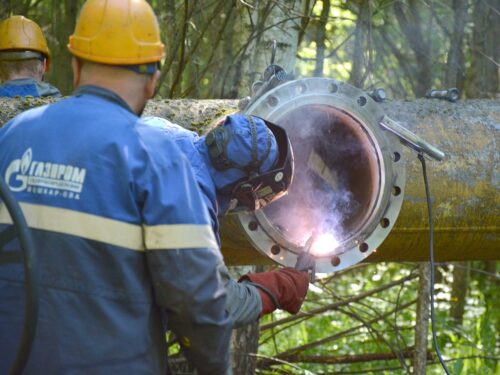
When people talk about TRIPP, it is immediately associated with Armenia’s Syunik, through which “Trump’s Route” is supposed to pass. But the fact is that on the ground it is Iranian construction companies that are building infrastructure there, digging tunnels and laying bridges and roads. As a result of the war that broke out in Iran, a slowdown in construction is observed today, although the Armenian government assures that it will be completed. In any case, it is natural that for Iran today the priority is to restore the infrastructure damaged by the US and Israeli strikes in its own country. The war in Iran cannot but have a negative impact on Armenia, especially since it seems that it has not yet been resolved.

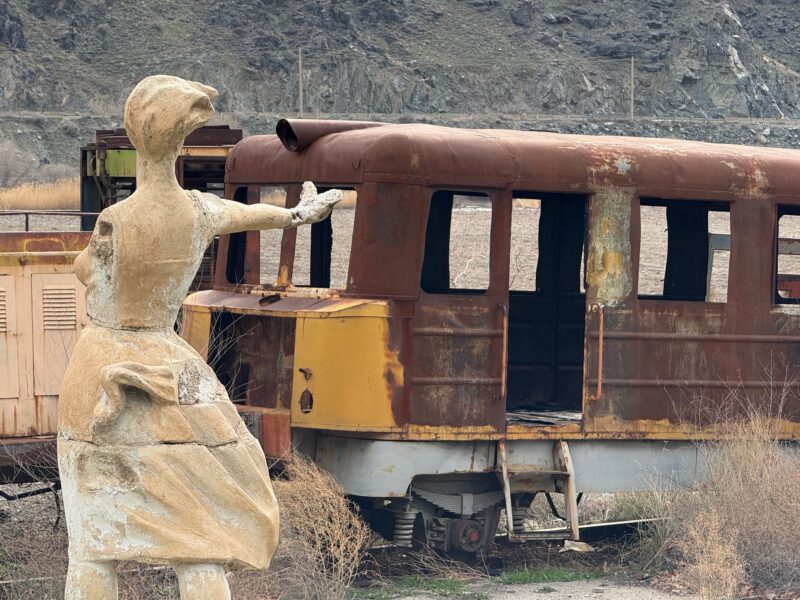
While the rusty wagons from the early 1990s continue to stand at the Meghri railway station, Armenia has announced the restoration of the planes at the Syunik airport. A small Czech plane for 18 passengers will again operate flights on the Yerevan-Kapan-Yerevan route. The ticket price is 20,000 Armenian drams.

Rusty wagons and a statue outside the Meghri railway station (photo Marut Vanyan)

“Dear citizens, starting today, Kapan-Yerevan-Kapan flights resume, with a frequency of 5 days a week,” the Ministry of Territorial Administration and Infrastructure of Armenia informs.

Recently, news has also emerged about planes with longer wings. Turkish Airlines started operating flights on the route Istanbul–Yerevan–Istanbul.

“Flights on the route Istanbul–Yerevan–Istanbul will be operated daily. Starting from May 14, the frequency will increase to 10 flights per week, and from June 15 — to 14 flights per week,” http://Zvartnots.aero informs.

“Turks and Armenians should be friends. Türkiye must be gate to the world for Armenians,” “Good news. Hopefully more business and cultural exchange will follow. Next should be visa free travel,” “I wish Armenians would visit Türkiye and see there is no hostility against Armenians in Türkiye like hostility against Turkish in Armenia,” “Turkey will be flooded with these peasants now. This will serve no interest of Turkey. Just close the borders and cancel flights. Let them pay more and take a longer route,” people post under my tweet.

After what is happening in Ukraine and the Middle East, especially in Iran, which is at Armenia’s front steps, what is left for little Armenia to do but remain silent and motionless and wait, like the gondola cars in the Meghri railway station?

Get the Mirror-Spectator Weekly in your inbox: