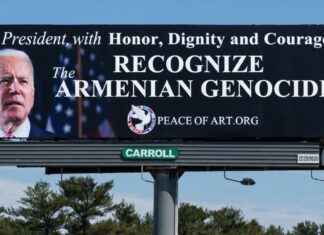


BERLIN — April 24, the day to commemorate the victims of the 1915 Armenian Genocide, is approaching. Sadly, they were not the only victims; among those who escaped physical extinction are countless individuals who were robbed of their identities, their names, their ethnicity, and their religious belief.
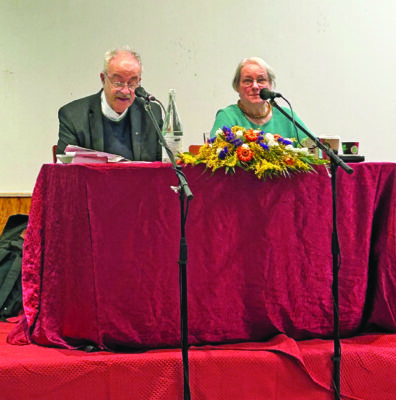
That was the “Genocide after the Genocide,” a theme discussed at a daylong conference at the Dersim Cultural Society in Berlin on March 14, and which brought together scholars and representatives of Armenian, Aramaean, and Pontic (Pontian) Greek communities who shared the fate of the two genocides.
Sociologist and genocide scholar Dr. Tessa Hofmann, whose human rights organization AGA (Working Group for Recognition: Against Genocide, for Understanding among Peoples) had launched the initiative, introduced the concept and gave a brief account of the events. The starting point was the genocide of an estimated three million indigenous Christians in the Ottoman Empire between 1912 and 1922, perpetrated by two consecutive regimes: the nationalist Committee of Unity and Progress, known as the Young Turks, and then the Kemalists. The victims were the Christian minorities who included Armenians, the Asyrian/East Syrian Old Church of the Orient, Greek and Syrian Orthodox as well as the Greek and Aramaean Uniate churches.
Citing Raphael Lemkin in his groundbreaking 1944 work, Axis Rule in Occupied Europe, Hofmann identified the survivors as the victims of the “genocide after the genocide,” those whose lives were saved but at the price of total assimilation and self-denial. Genocide “targeted the national group in its entirety and the related actions were aimed at individuals, not as individuals, but as members of a national group.” As she summarized the point, “One might survive, but could no longer be an Armenian, Greek, or Syro-Aramaean Christian.”
What prompted the convening of the daylong Berlin conference was the recent appearance of a Turkish book (2022) in German translation entitled, Alevitische und alevitisierte Armenier: “Wir sind Jesus untertan, wir sind Ali verpflichtet (Alevite and Alevitized Armenians: “We Are the Subjects of Jesus, We Are Committed to Ali”). Author Kazım Gündoğan, of Alevite heritage, is also a filmmaker. Together with his wife, film director Nezahat Gündoǧan, he has researched and produced documentaries on the history of the genocide in the Dersim region.
Among his previous books are The Lost Girls from Dersim, The Monk’s Grandchildren and The Armenians of Dersim, which portray the snuffing out and forced assimilation of the Armenian, Alevite, Kurdish and Zaza peoples in Dersim.